
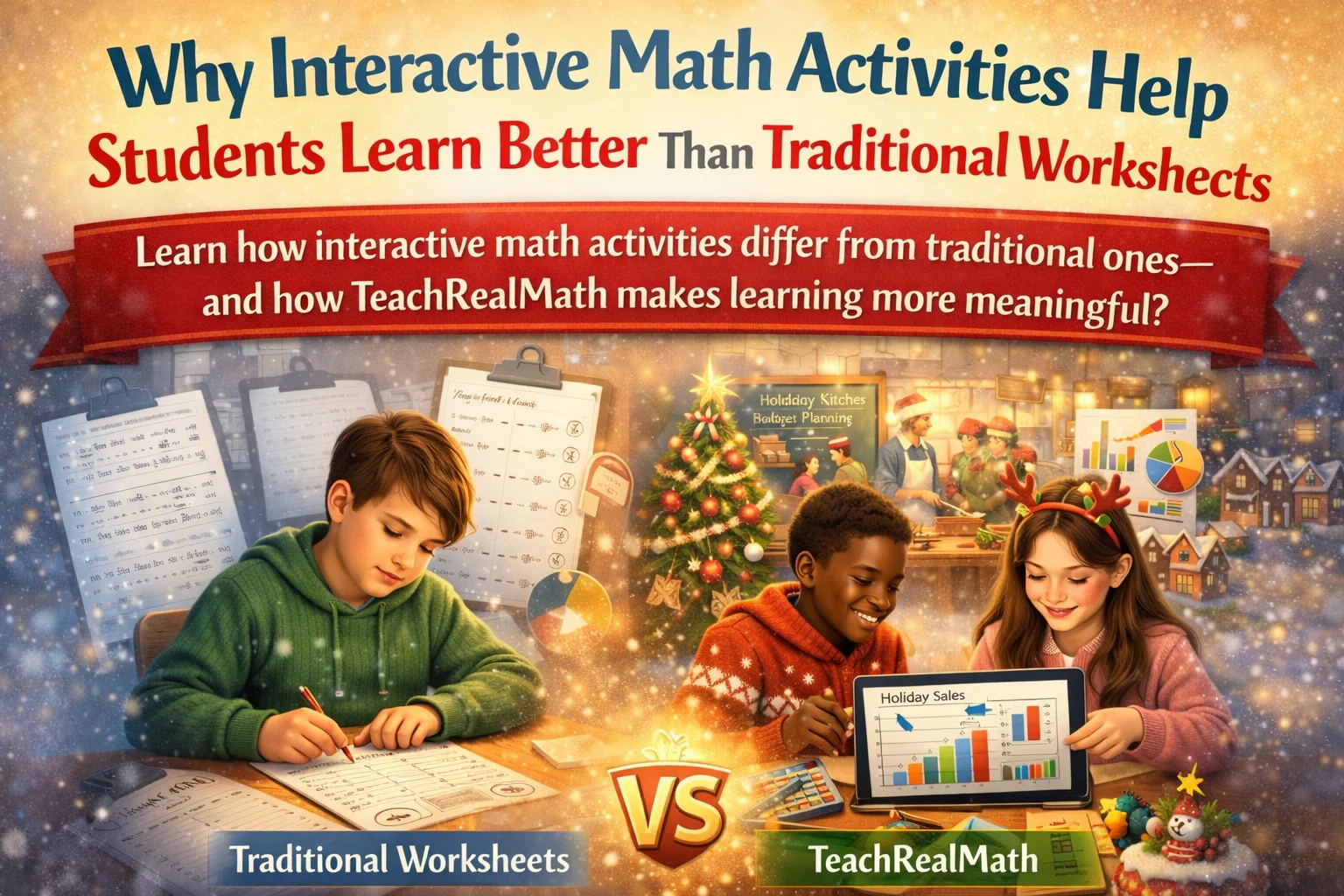
Why Interactive Math Activities Help Students Learn Better Than Traditional Worksheets
For decades, math classrooms have depended heavily on traditional worksheets to teach and practice concepts. Worksheets have long been seen as a reliable way to reinforce skills, but many teachers now observe a growing challenge.
Students often complete worksheets by following steps mechanically, without truly understanding the math behind them. Once the worksheet is done, the learning frequently fades, and students struggle to apply the same concepts in real-life situations.
The Limitations of Traditional Math Worksheets
Traditional worksheets typically focus on repetition. Students may solve multiple similar problems, such as finding percentages, calculating area, or simplifying expressions.
While repetition can build short-term familiarity, it often does not help students understand why the math works or how it connects to everyday life. As a result, many students view math as abstract, boring, or disconnected from the real world.
The Shift Toward Interactive Math Learning
For years, math instruction has focused heavily on repetition and procedural practice. While this approach can build basic skills, it often leaves students struggling to understand why the math works or how it applies beyond the classroom.
This gap between practice and true understanding has led many educators to seek more effective, student-centered approaches.
Interactive, real-world math learning is emerging as a powerful solution. Instead of passively completing worksheets, students are placed inside meaningful scenarios where math is required to make decisions, solve problems, and evaluate outcomes.
Whether students are budgeting for an event, analyzing data trends, or optimizing a solution, they actively use math as a thinking tool—not just a set of steps to memorize.
Interactive elements such as sliders, graphs, simulations, and instant feedback allow students to see cause-and-effect relationships in real time, strengthening conceptual understanding.
Most importantly, interactive learning builds relevance. When students recognize how math connects to real life, engagement increases, confidence grows, and learning becomes more durable.
How Real-World Context Makes Math Meaningful
Real-world context transforms math from abstract numbers into practical tools students can actually use.
When interactive math activities are built around familiar situations—such as budgeting for gifts, planning events, comparing prices, analyzing sales trends, or interpreting real data—students immediately understand why the math matters.
Instead of asking, “When will I ever use this?”, students begin to recognize math as a problem-solving skill they need in everyday life.
These authentic scenarios help learners connect new concepts to prior knowledge, making ideas easier to understand and remember.
Real-world activities also encourage deeper thinking. Students must analyze information, make decisions, and justify their reasoning rather than simply follow steps. This builds critical thinking, supports long-term retention, and boosts confidence—especially for middle school students who often struggle with abstract formulas.
Active Learning vs Passive Practice
Worksheets often encourage passive learning, where students follow fixed steps to reach an answer.
Interactive math activities require active participation. Students explore relationships, adjust values, test ideas, and observe outcomes. This active involvement strengthens critical thinking skills and helps students develop a deeper understanding of mathematical concepts.
For a visual example of active math learning, see: Interactive Math Learning Example
Moving Beyond Worksheets with TeachRealMath
Traditional math worksheets provide structured practice and can be useful for reinforcing basic skills. However, they often limit learning to repeated calculations and fixed answers, offering little opportunity for students to explore concepts or connect math to real-life situations.
TeachRealMath takes a different approach.
Instead of static worksheets, TeachRealMath offers interactive, real-world math activities that serve as meaningful alternatives to traditional practice. Students engage with dynamic values, visual models, and authentic scenarios where math plays a real role.
They are not just completing problems—they are analyzing situations, adjusting variables, and understanding the impact of their choices.
Example TeachRealMath Activities
- City Park Design Using Equivalent Ratios
- Shopping Spree – Discounts, Deals & Decisions
- City Park Design Using Equivalent Ratios
These activities are standards-aligned, auto-graded, and randomized—ensuring each student receives a unique learning experience while saving teachers valuable time.
Explore Ready-to-Use Activities
Teachers looking for meaningful alternatives to worksheets can explore activities across grade levels at:
👉 https://www.teachrealmath.com/activities/?grade=7
Final Thoughts
By integrating interactive math activities instead of relying solely on worksheets, educators can help students see math as relevant, practical, and worth understanding.
TeachRealMath supports this shift by transforming routine practice into meaningful learning—helping students build skills that last far beyond the worksheet.