City Park Design Using Equivalent Ratios

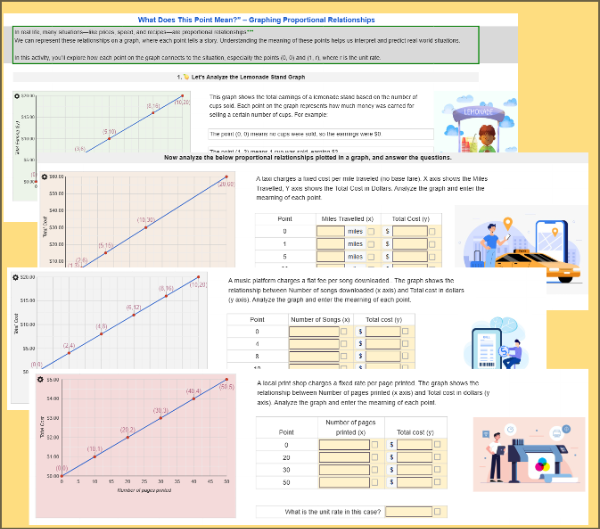
In this hands-on activity, students use equivalent ratios to scale down real-world park dimensions and see their design come to life in an automatically generated graph. As they convert measurements, complete ratio tables, and analyze the final layout, they build fluency in proportional reasoning and visual interpretation.

City Planner – Designing a Scaled Park is an interactive, real-world math activity where students take on the role of junior city planners. Their task is to convert real park feature measurements into scaled dimensions using a fixed ratio (1 cm = 5 m), applying their understanding of equivalent ratios and proportional reasoning.


As students complete ratio tables and enter scaled lengths and widths, an interactive graph automatically updates in real time, visually displaying the layout of the park. This immediate feedback bridges the gap between numeric computation and visual understanding, reinforcing the connection between math and spatial reasoning.


🧠 Skills and Concepts Reinforced:

  • Applying equivalent ratios to solve scale problems
  • Understanding proportional relationships and the constant of proportionality
  • Using ratio tables to support structured reasoning
  • Interpreting line graphs that represent scaled dimensions
  • Analyzing the visual layout of the park based on student inputs
  • Responding to multiple choice questions that require interpreting features on the graph

🧩 Key Features:

  • Ratio tables scaffold student thinking for each feature
  • A graph dynamically reflects each correct input, building the scaled park piece by piece
  • Includes multiple structures (playground, pond, garden, etc.) with varying real-world sizes
  • Ends with graph-based questions that deepen interpretation and reinforce scale understanding

This worksheet brings math to life through meaningful visuals and real-time feedback, helping students master scaling in an engaging and applied way.

Learning Objective

Students will apply their understanding of equivalent ratios and proportional relationships to convert real-world measurements into scaled dimensions using a fixed scale (1 cm = 5 m). They will use ratio tables to reason through conversions, reinforce the concept of constant of proportionality, and interpret the relationship between scaled drawings and actual dimensions by observing a dynamically generated graph of their park layout. This activity supports both computational fluency and visual-spatial reasoning within a real-world design context.

City Park Design Using Equivalent Ratios preview
Preview
Grade level
7
Type
Mini Lab (real-world worksheet)
Duration
15 minutes
Auto-graded
Yes
Topics
Ratios & ProportionsRatioMulti-Step Ratio Problems
Tags
Real WorldGamifiedStory-BasedProblem SolvingGraph-Based

Related grade 7 activities

More interactive, auto-graded activities on the same standards and topics.

Mini LabGrade 7· 15 min

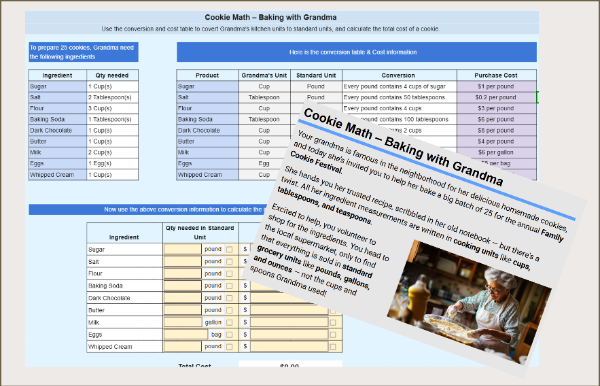
Cookie Ratios – Baking with Grandma’s Recipe

In this real-world math activity, students apply their understanding of ratios and fractions to convert Grandma’s recipe from kitchen units to standard grocery store units. Using a conversion chart and price list, they calculate the quantity and cost of each ingredient, determine the total expense for 25 cookies, and find the cost of one cookie.

LabGrade 7· 120 min

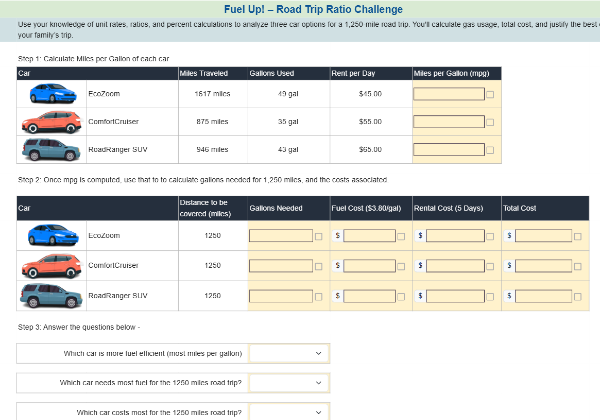
Theme Park Tycoon - A Ratios & Proportions Lab

Theme Park Tycoon is an 8-part Grade 7 ratios and proportions project where students design Aurora Park for an investor. Every worksheet's numbers carry forward, so their choices on rides, pricing, and budget flow into a final ROI they defend. Auto-graded, interactive, and 7.RP-aligned. Real proportional reasoning with real stakes.

LabGrades 7, 8· 180 min

Precision Construction: A Geometry Project

Step into the role of a construction engineer! In this hands-on geometry lab, students estimate costs for concrete, flooring, painting, HVAC, roofing, landscaping, and more using real-world floor plans. Covers area, volume, surface area, and unit conversions. Auto-graded and perfect for 7th grade classrooms.

Mini LabGrade 7· 15 min

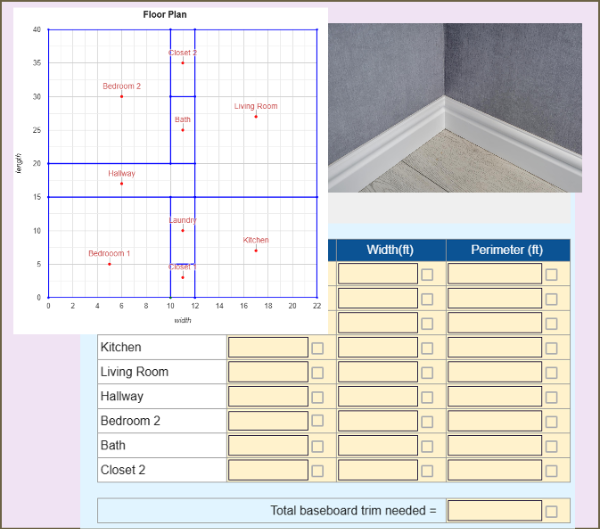
Baseboard Trim Estimation: Perimeter

Students use a floor plan on a coordinate grid to measure room dimensions, calculate perimeter, and estimate the total length and cost of baseboard trim needed for an apartment renovation. A hands-on geometry application!