Theme Park Tycoon: A Connected 7th Grade Ratios and Proportions Project
Looking for a 7th grade ratios and proportional relationships project that actually makes proportional reasoning feel necessary? Theme Park Tycoon puts students in the role of lead designer for Aurora Park, a brand-new theme park funded by an investor named Marisol Chen. Across eight connected meetings, students take an empty 12-acre plot and build it into a complete investor pitch, using ratios, unit rates, percentages, scale drawings, and break-even analysis to make every decision.
What makes this ratios project different is continuity. Each worksheet's committed numbers carry forward into the next, so a student's own choices about rides, ticket prices, marketing, and concessions flow all the way through to their unique final return on investment. A wrong answer is not just a wrong calculation. It is a wrong business decision the student has to live with downstream.
What students do across the eight meetings:
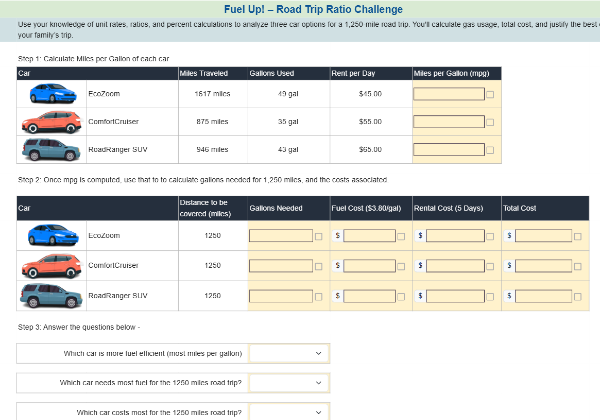
- Compute and compare unit rates across five competing parks, then decide which rates are proportional (7.RP.A.1, A.2)
- Write and graph equations of the form y = kx to size the park to its crowd (7.RP.A.2b, A.2c, A.3)
- Choose and budget rides under real capacity, cost, and anchor constraints (7.RP.A.1, A.3)
- Set ticket prices against a rival park using discounts and a demographic mix (7.RP.A.3)
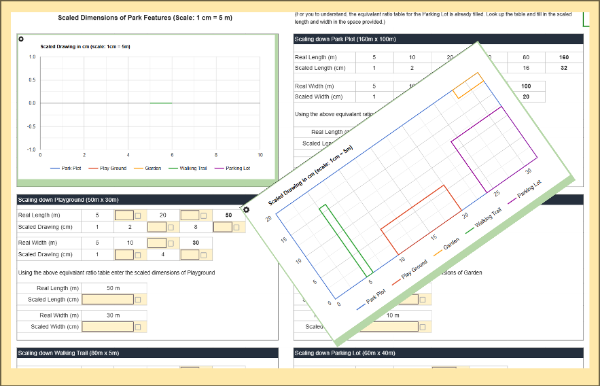
- Split a marketing budget by ratio and scale the park emblem onto a billboard with scale drawings (7.RP.A.2, A.3)
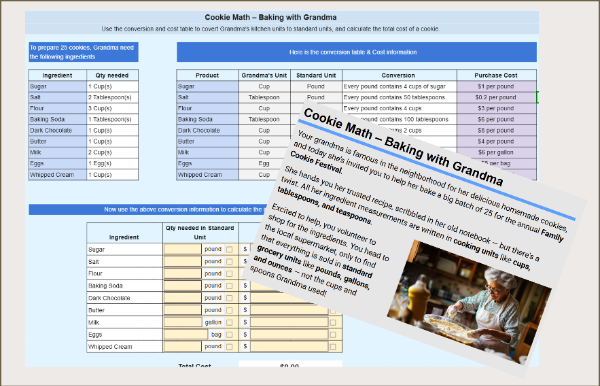
- Apply percent markup to set a concession menu, then scale a sales mix to revenue per visitor (7.RP.A.3)
- Model fixed cost against proportional revenue to find a daily break-even point (7.RP.A.2c, A.3)
- Synthesize every figure into a season-long return on investment percentage (7.RP.A.3 synthesis)
Why teachers love this project:
- Fully aligned to Common Core 7.RP, with every worksheet anchored to a specific standard
- Interactive and auto-graded, with a live dashboard showing who has started, finished, or gotten stuck
- No-dominant-strategy design means students build different parks and defend different answers, so it resists copying and rewards real reasoning
- Built-in Make the Call prompts push students to justify decisions, turning computation into argument
- Plain seventh-grade language introduces revenue, cost, profit, and ROI with no prior business knowledge required
- Flexible pacing, roughly one class period per meeting, across two to three weeks
- Includes intro slide decks, a complete teacher activity guide, and a closing investor pitch
Theme Park Tycoon works as a culminating ratios unit project, a real-world application sequence, or an engaging way to review proportional reasoning before assessment. If your students keep asking when they will ever use this, this is the project that answers them.
Standards covered: 7.RP.A.1, 7.RP.A.2 (a, b, c, d), 7.RP.A.3
Grade level: 7 | Topic: Ratios and Proportional Relationships | Format: Interactive, auto-graded, eight connected worksheets