What Does This Point Mean? - Graphing Proportional Relationships

Students explore graphs of real-world proportional relationships—like taxi fares, printing costs, and song downloads—to interpret points and identify unit rates. With minimal reading and strong visuals, this activity builds deep understanding of coordinate graph meaning.

📈 Understanding Graphs of Proportional Relationships – Interactive 7th Grade Math Worksheet


In this engaging 7th grade math activity, students analyze graphs of proportional relationships in real-world scenarios such as lemonade stands, taxi fares, music downloads, and printing costs. Using clearly labeled interactive graphs, students determine what each point means and identify the unit rate—with special attention to the points (0, 0) and (1, r), where r is the unit rate.


Students:

  • Interpret the meaning of coordinate points on proportional graphs
  • Identify and explain the significance of (0, 0) and (1, r)
  • Calculate the unit rate in various contexts
  • Strengthen graph-reading and real-world reasoning skills


📘 Math Concepts Covered:

  • Proportional relationships
  • Unit rate
  • Graph interpretation
  • Coordinate points and their meaning


📏 Aligned Standards:

  • CCSS.MATH.CONTENT.7.RP.A.2.D – Explain what a point (x, y) on the graph of a proportional relationship means in terms of the situation, with special attention to the points (0, 0) and (1, r).


🔧 Key Features:

  • Multiple real-world graph contexts
  • Auto-graded, interactive question table
  • Minimal reading, high visual clarity
  • Perfect for reinforcing proportional reasoning and unit rate interpretation


Learning Objective

Students will analyze and interpret proportional relationships represented on graphs. They will identify the meaning of key points—including (0, 0) and (1, r)—in real-world contexts, and determine the unit rate by examining patterns in the data. Through multiple scenarios, students will develop a deeper understanding of how proportional relationships are visualized and explained using coordinate graphs.

Randomization Available

If randomization is enabled, each student will receive different unit rates in each graph. This means that the slopes of the lines and total values at each point will differ.

💡 Tip: When assigning this activity to your classroom, you can optionally enable randomization to give each student a unique version of the problems. When you re-assign the same worksheet, each student will get a new set of questions, helping them master the content through repeated practice.

What Does This Point Mean? - Graphing Proportional Relationships preview
Preview
Grade level
7
Type
Skill Practice
Duration
15 minutes
Auto-graded
Yes
Randomized per student
Yes
Common Core standards
7.RP.A.2b7.RP.A.2d
Topics
Ratios & ProportionsUnit RateProportional Relationships
Tags
Real WorldFinancial CalculationsDrill & PracticeGraph-BasedBell Ringer

Related grade 7 activities

More interactive, auto-graded activities on the same standards and topics.

Mini LabGrade 7· 15 min

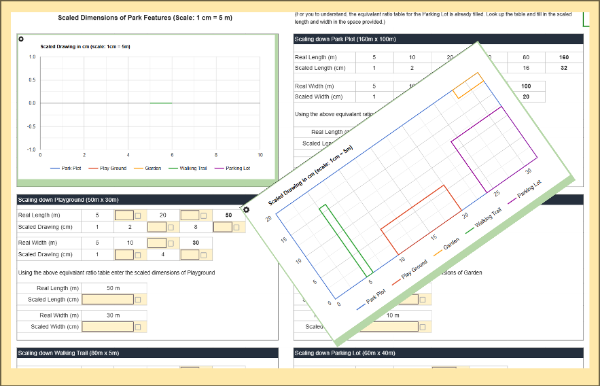
City Park Design Using Equivalent Ratios

In this hands-on activity, students use equivalent ratios to scale down real-world park dimensions and see their design come to life in an automatically generated graph. As they convert measurements, complete ratio tables, and analyze the final layout, they build fluency in proportional reasoning and visual interpretation.

Mini LabGrade 7· 15 min

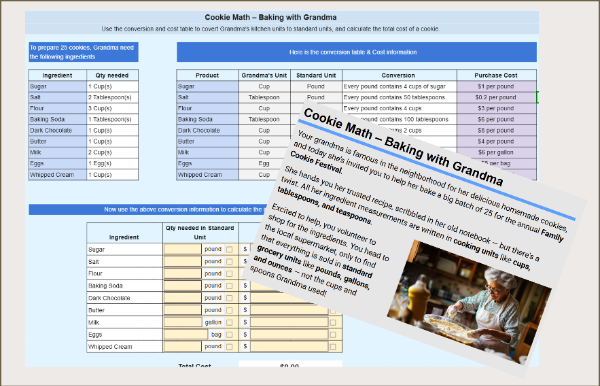
Cookie Ratios – Baking with Grandma’s Recipe

In this real-world math activity, students apply their understanding of ratios and fractions to convert Grandma’s recipe from kitchen units to standard grocery store units. Using a conversion chart and price list, they calculate the quantity and cost of each ingredient, determine the total expense for 25 cookies, and find the cost of one cookie.

LabGrade 7· 120 min

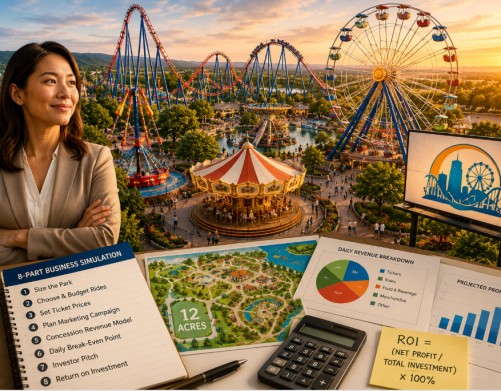
Theme Park Tycoon - A Ratios & Proportions Lab

Theme Park Tycoon is an 8-part Grade 7 ratios and proportions project where students design Aurora Park for an investor. Every worksheet's numbers carry forward, so their choices on rides, pricing, and budget flow into a final ROI they defend. Auto-graded, interactive, and 7.RP-aligned. Real proportional reasoning with real stakes.

Skill PracticeGrades 6, 7· 20 min

Halloween Races : Speed, Distance & Time

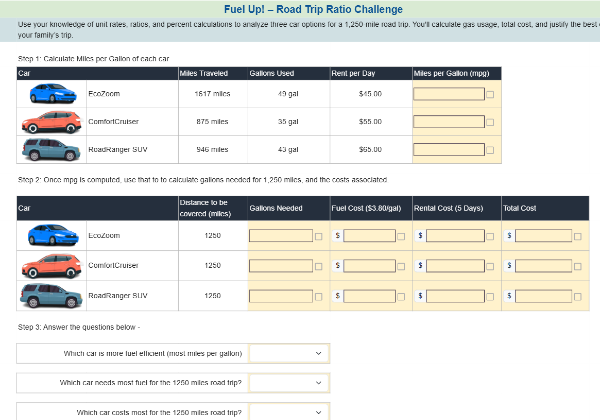
In this spooky Halloween-themed activity, students calculate the speed of different Halloween characters using the speed = distance ÷ time formula and determine who’s fastest in the crew. A fun and educational way to reinforce rate and proportional reasoning!