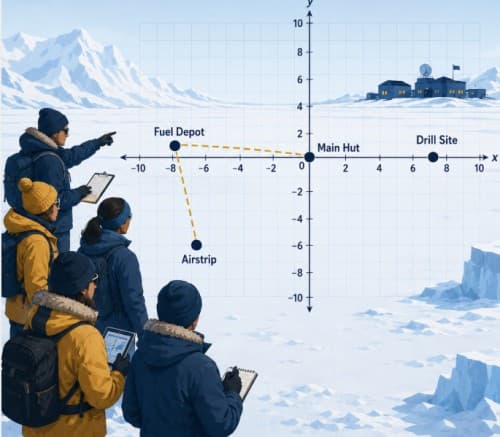
Research Station Zero - Number System Project
Turn the entire 6.NS strand into one unforgettable mission, and give Grade 7 students a real-world rational-number challenge at the same time. Research Station Zero is a connected, multi-worksheet project where students become the logistics officer of an Antarctic research station after a storm tears through the camp, destroying supplies and corrupting the station's records. A rescue plane is waiting at a distant airstrip, but the team wants to stay long enough to finish their research, and nobody knows how much food or fuel is actually left. Commander Chen puts the student in charge of recounting everything from scratch and answering one question: how long can the team keep working before they have to walk out. Each worksheet hands its answer to the next, building toward a single survival verdict. This is math with stakes, where a wrong answer is a wrong decision, not just a wrong number.
What students do across the project, and why:
- Map the station on a coordinate grid (6.NS.C.6, 6.NS.C.8). The storm scattered the team's maps, so the first job is rebuilding the layout. Students plot the Main Hut, Fuel Depot, Drill Site, and Airstrip using positive and negative coordinates, then measure the walking distances between them along safe north-south and east-west routes. This map becomes the foundation for the evacuation route later.
- Analyze a week of sub-zero temperatures (6.NS.C.5, 6.NS.C.7, 6.NS.B.3, 7.NS.A.1). The outdoor thermometer was destroyed in the storm, so the team has no way to read the current temperature. The only record left is a logbook of last week's daily readings. Students order those negative temperatures from coldest to warmest and compute the weekly average, producing a single working temperature that stands in for the broken instrument and drives every fuel and pace calculation that follows.
- Ration the food supply (6.NS.A.1, 7.NS.A.2). With supplies damaged and the inventory uncertain, the team needs to know how long they can eat before the food forces them out. Students divide fractions to find how many days each supply lasts at its daily consumption rate, then identify the supply that runs out first. That shortest supply sets the food limit on how long the team can stay.
- Calculate fuel and find the bottleneck (6.NS.B.3, 6.RP.A.3, 7.NS.A.2). The station runs on five separate fuel systems, each with its own reserve and burn rate, and the cold makes everything burn faster. Students apply the cold factor from the temperature worksheet to find each system's real consumption, divide to see how many days each lasts, and find the system that fails first. That bottleneck is the fuel limit on how long the team can stay and keep working.
- Plan the walk to the airstrip (6.NS.B.3, 6.RP.A.3). Once food or fuel runs out, the team must evacuate to the waiting plane. Using the map from the first worksheet, students confirm the fifteen-kilometer route, then divide the team's baseline pace by the cold factor to find their real walking speed in the cold and calculate how many days the walk takes. This tells the team how late they can afford to keep working before they have to leave.
- Pack the bags and sync the rescue signal (6.NS.B.4). Before leaving, the team prepares for the walk and for contact with rescue. Students use greatest common factor to pack identical supply bags so every crew member carries a complete kit, then use least common multiple to find when four rescue signals all transmit at once, the moment a strong combined message can punch through the atmospheric noise.
- Reach the final verdict (6.NS.C.7, 7.NS.A.3). With every number rebuilt, students compare them using less than and greater than to find the binding constraint, set the leave day, and prove whether the team can finish the mission and reach the plane in time. This is the payoff that ties the entire project together.
Why teachers choose Research Station Zero:
- Covers the full Grade 6 number system strand in one coherent, standards-aligned project
- Extends naturally into Grade 7 as a real-world rational-number problem-solving and review unit (7.NS.A.1, 7.NS.A.2, 7.NS.A.3), so it fits a 6th grade core unit or a 7th grade application and review block
- Auto-graded worksheets with immediate feedback, so students see results in real time and you save hours of marking
- A connected storyline where each worksheet carries its result forward, reinforcing that math builds on itself
- Real-world scenario design that answers the question students always ask: when will I ever use this
- Interactive elements including coordinate plotting, dynamic tables, and live recalculation, not static fill-in-the-blank pages
- Introduction slides set up each worksheet with narrative context, so students understand the why before the how
- Works as a multi-day unit, a review project, or an engaging way to anchor the number system strand from start to finish
Bring real stakes to the number system. Whether your students are meeting these skills for the first time in Grade 6 or putting them to work in Grade 7, they will not just practice fractions, decimals, negatives, coordinates, factors, and multiples. They will use them to get a team home.
Learning Objective