
Unfold It: Nets and Surface Area
Interactive Nets and Surface Area: Unfold It (Grade 6, 6.G.A.4)
Stop asking students to imagine how a box unfolds. Let them watch it happen.
This interactive digital worksheet brings Common Core standard 6.G.A.4 to life with a slider that unfolds each solid into its net, one face at a time. Students see exactly where every face comes from, then calculate its area and add up the total. Every answer is checked instantly, so students get feedback while they work and you get your evenings back.
What's included
- 4 auto-graded problems covering the full range of 6.G.A.4
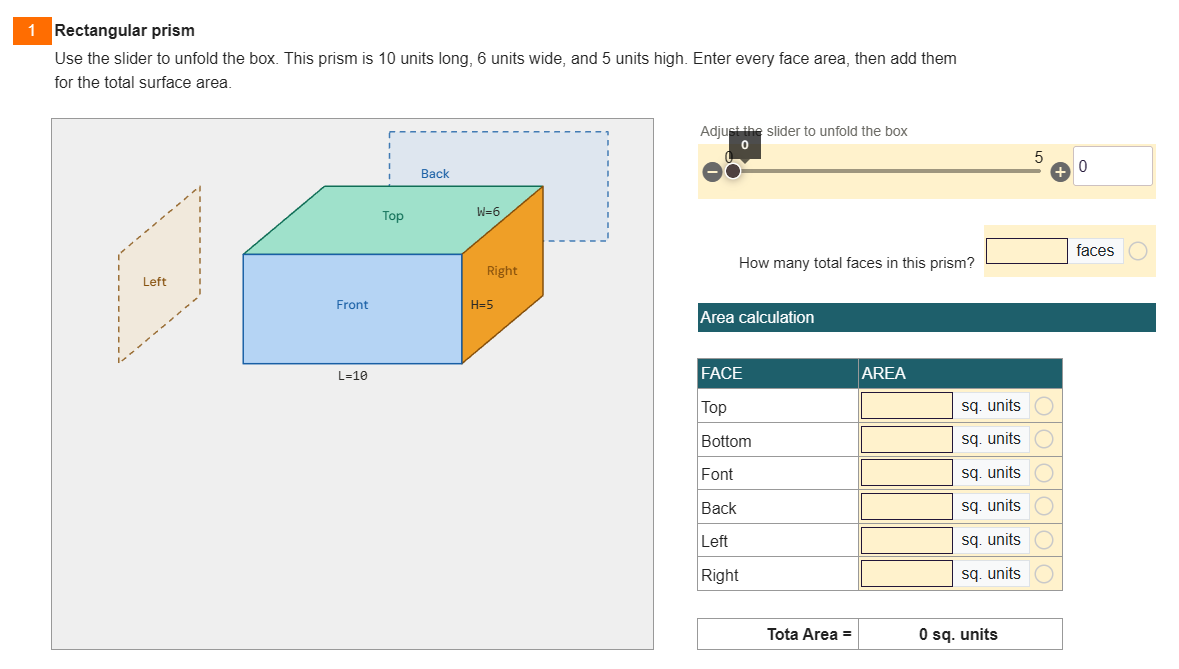
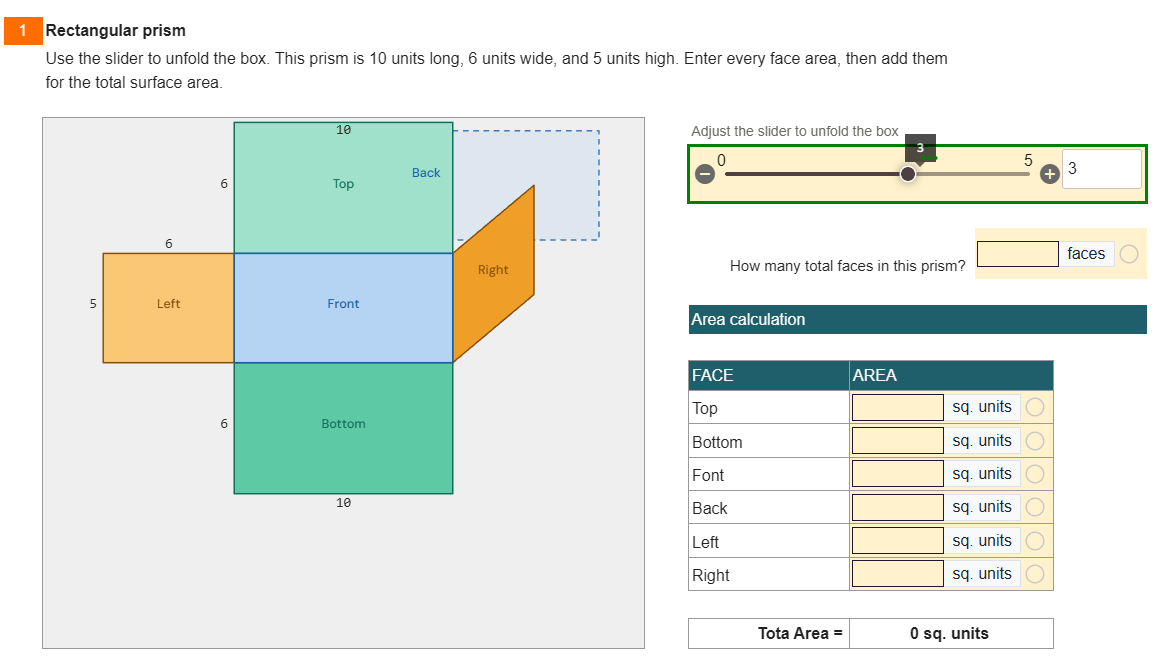
- Problem 1: Rectangular prism (10 × 6 × 5)
- Problem 2: Rectangular prism (6 × 4 × 3)
- Problem 3: Triangular prism, with faces that peel off the solid and rebuild as a net
- Problem 4: Square pyramid, one square base and four triangles
- Live face-area table for every solid
- Face-count check question before each calculation
- Teacher guide with learning objective and classroom tips
Students will use a slider to unfold the faces of prisms and pyramids, below image shows the initial state and how the prism opens up -
Why teachers like it
- Zero prep. Assign it and go. No printing, no answer key, no grading.
- Instant feedback. Students see green checks as they go, so misconceptions get caught in the moment instead of a week later.
- The animation teaches. The unfolding isn't decoration; watching a face leave the solid and land in the net is the spatial reasoning the standard is actually asking for.
- Built for real classrooms. Works for whole-class instruction on a projector, independent practice, sub plans, review, or homework.
- Honest math. Every dimension is chosen so face areas come out as clean whole numbers. Slant heights are given rather than derived, because deriving them requires the Pythagorean theorem, which is Grade 8. No accidental off-grade content.
Standards alignment
Common Core 6.G.A.4: Represent three-dimensional figures using nets made up of rectangles and triangles, and use the nets to find the surface area of these figures. Also supports 6.G.A.4 review in Grade 7 and 8, and pre-teaching for students moving into 7.G.B.6.
Perfect for
Grade 6 math, Grade 7 review, surface area units, geometry centers, sub plans, distance learning, RTI and small group work, test prep, early finishers.
Topics: surface area, nets, rectangular prism, triangular prism, square pyramid, 3D shapes, geometry, area of rectangles, area of triangles, spatial reasoning
Learning Objective
This worksheet develops the core idea behind Common Core standard 6.G.A.4: that every three-dimensional solid is built from flat faces, and that unfolding a solid into its net makes those faces visible and measurable all at once. Students work with four solids of increasing difficulty, two rectangular prisms, a triangular prism, and a square pyramid, and for each one they use a slider to watch the solid open into its net, identify every face, calculate each face's area using rectangle and triangle area formulas they already know, and sum those areas to find total surface area. The goal is not memorizing a surface area formula. It is building the spatial reasoning to see that a solid and its net are the same surface in two arrangements, so that a student who can picture how any solid unfolds can find its surface area without a formula to recall.
