Master Budgeting with Rational Numbers: Real-World Math for Middle Schoolers
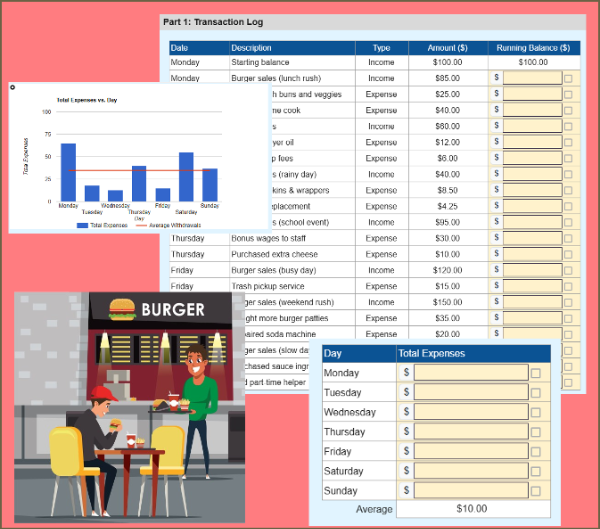
In this engaging math activity, students step into the shoes of a teen managing their own debit card. Over the course of a week, they record 20 realistic transactions—including deposits, withdrawals, refunds, and purchases—and use rational number operations to calculate their running balance.
This hands-on worksheet reinforces key Common Core standards by having students apply addition and subtraction of positive and negative rational numbers to solve real-world financial problems. After tracking their balance, students group and sum withdrawals per day, visualize their spending with an auto-generated graph, and reflect on their spending habits to build financial awareness and mathematical reasoning.
🔑 Key Features:
- 20 realistic debit card transactions spread across 7 days
- Students calculate running balance using rational number operations
- Daily withdrawals tracked and visualized with a spending graph
- Supports discussions around budgeting, overdraft fees, and financial habits
- Aligned to 7.NS.A.1 and 7.NS.A.3 of the Common Core
- Great for independent or classroom-based financial literacy lessons
Students will apply addition and subtraction of rational numbers to real-world financial contexts by maintaining a running account balance, categorizing daily withdrawals, and analyzing spending patterns—developing both computational fluency and financial literacy.
If randomization is enabled, each student will receive a unique set of transaction amounts in their debit card log.
As a result, the running balance, daily spending totals, and final answers will be different for each student, making the activity ideal for individualized learning and reducing the risk of copying.
💡 Tip: When assigning this activity to your classroom, you can optionally enable randomization to give each student a unique version of the problems. When you re-assign the same worksheet, each student will get a new set of questions, helping them master the content through repeated practice.