Crate Build: Area, Volume, and Surface Area

Pack & Ship Co. is a hands-on Grade 6 geometry capstone. Students become builders filling a real client's crate order across five connected worksheets, applying coordinate geometry, composite area, volume, and surface area. Every measurement carries forward to a final bill, so careless work has real consequences. Covers all four 6.G standards in one engaging, auto-graded job.

Pack & Ship Co. — A Grade 6 Geometry Culminating Lab


Turn the end of your geometry unit into a job your students actually want to finish. In Pack & Ship Co., students step into the role of a builder at a custom-crate workshop, filling a real order from a client named Dana Ruiz. Over five connected, story-driven worksheets, they build a wooden shipping crate from the first cut to the final bill, applying every geometry skill from the Grade 6 unit along the way.


This is not a worksheet packet. It is one continuous job with a carry-forward spine: the crate size students find in the first activity decides the cuts, the cuts decide whether the cargo fits, and the fit and the wrapping decide the final cost. One careless measurement early shows up later as overspending the client's budget, which comes straight out of the builder's pay. The math is never busywork. It always decides something students care about.


Standards covered (full Grade 6 geometry strand):

  • 6.G.A.3 — Plotting polygons on the coordinate plane and finding side lengths from coordinates (cutting the crate panels)
  • 6.G.A.1 — Area of composite figures by decomposing into rectangles and triangles (cutting the steel reinforcements)
  • 6.G.A.2 — Volume with fractional edge lengths, shown by packing with unit cubes (proving the cargo fits)
  • 6.G.A.4 — Surface area using nets of rectangles and triangles (wrapping the crate)
  • 6.RP and 6.NS — Unit rates and decimal operations (totaling the bill against the client's budget)


Why teachers choose this lab:

  • A true capstone. Built to review and connect an entire unit of geometry, not to teach skills in isolation. Students finish having used coordinate geometry, composite area, volume, surface area, and rates in service of one real goal.
  • Engagement built in. The storyline, the client, the budget, and the carry-forward consequence keep students invested in getting the math right.
  • Auto-graded with live tracking. Answers validate instantly. From your console you can see who has started, who has finished, and who is stuck, in real time.
  • Ready to run in about one class period. Each worksheet opens with a short intro that frames the next step, so the storyline carries students forward with no extra prep. Easily split across two shorter sessions.
  • Low-stakes and exploratory. Wrong answers pause progress but never erase student work, so students can retry, experiment, and self-correct.


Best for: Grade 6 math classrooms looking for an end-of-unit geometry review, a real-world application project, or a problem-based learning activity that connects area, volume, surface area, and the coordinate plane into a single meaningful task.


Assign Pack & Ship Co. and give your students the experience of using geometry the way real builders do: to measure, decide, and ship a finished job.

Crate Build: Area, Volume, and Surface Area preview
Preview
Grade level
6
Type
Lab
Duration
60 minutes
Auto-graded
Yes
Common Core standards
6.G.A.16.G.A.26.G.A.36.G.A.4
Topics
GeometryArea and CircumferenceVolume and Surface Area
Tags
Real World

Related grade 6 activities

More interactive, auto-graded activities on the same standards and topics.

Mini LabGrade 6· 20 min

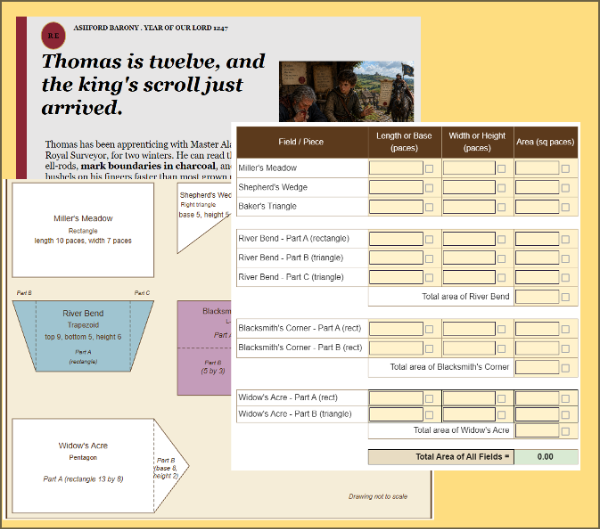
Area of Composite Shapes in Medieval Ashford

Step into Medieval Ashford as an apprentice surveyor measuring seven fields for the king's tax. Students decompose rectangles, triangles, trapezoids, L-shapes, and pentagons into simple pieces, calculate areas, and convert to bushels. Interactive scroll fills with color as answers are correct. Auto-graded. Common Core 6.G.A.1.

Skill PracticeGrade 6· 15 min

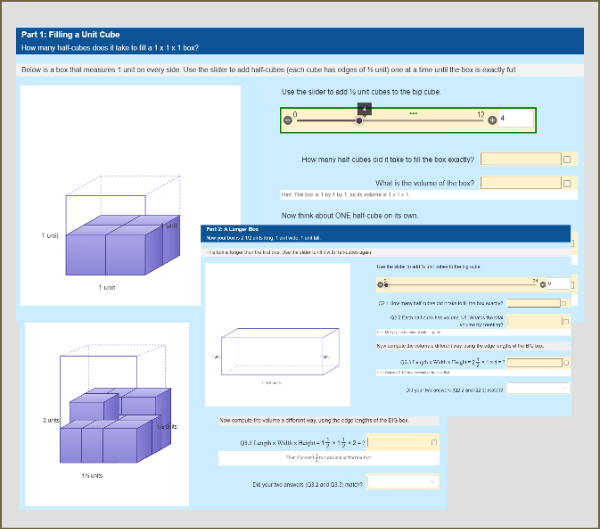
Discovering Volume with Half-Cubes

Interactive 6.G.A.2 worksheet where students fill three rectangular prisms with half-unit cubes using a slider, then verify volume two ways: counting (cubes × 1/8) and formula (L × W × H). Students discover why V = L × W × H works for fractional edge lengths through hands-on packing of 1×1×1, 2½×1×1, and 1½×1½×2 boxes. Auto-graded. Grade 6.

Mini LabGrade 6· 20 min

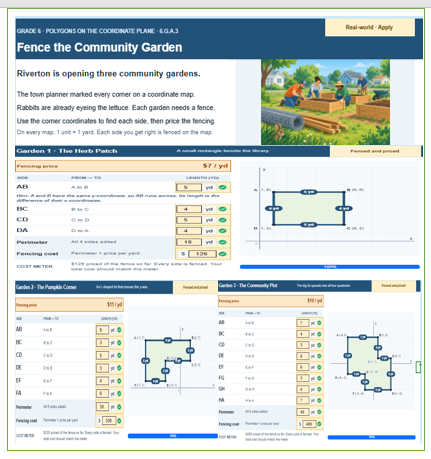
Fence the Community Garden

Grade 6 students fence three community gardens on the coordinate plane. Using the labeled corner coordinates, they find each side length, add up the perimeter and price the fencing. The gardens move from the first quadrant into all four, and every correct side fences the map live. Randomized numbers, instant feedback and a cost meter make 6.G.A.3 practice real and self-checking.

Skill PracticeGrade 6· 20 min

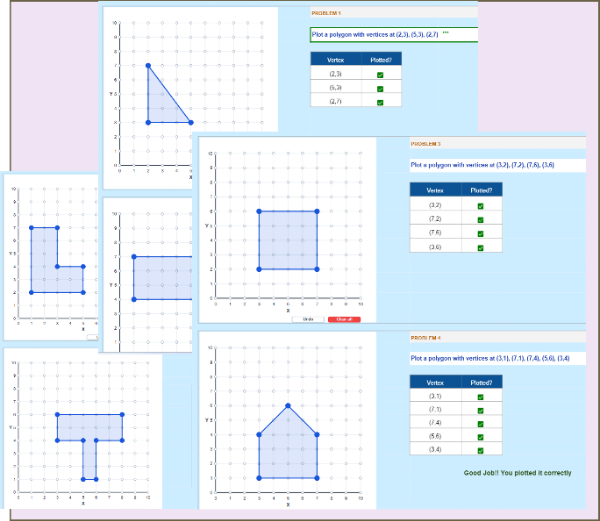
Plot Polygons on the Coordinate Plane

Interactive 6.G.A.3 practice for plotting polygons on the coordinate plane. Six problems progress from triangles and rectangles to pentagons and concave shapes. Students click grid points to plot vertices and get instant per-vertex feedback. Auto-graded with checkmark validation. Perfect for in-class practice, homework, or formative assessment in Grade 6 math.

Mini LabGrade 6· 20 min

Stained Glass: Area of Composite Figures

Students become the apprentice cutter at Glasswing Studio, finding the area of ten stained glass segments to fill a real commission. They decompose rectangles, triangles, L-shapes, trapezoids, and more, then convert square inches to square feet to price the glass. Interactive, auto-graded, with instant visual feedback. Aligned to 6.G.A.1. Supports per-student randomization.

Mini LabGrade 6· 30 min

Tent Fabric Review: Surface Area from Nets

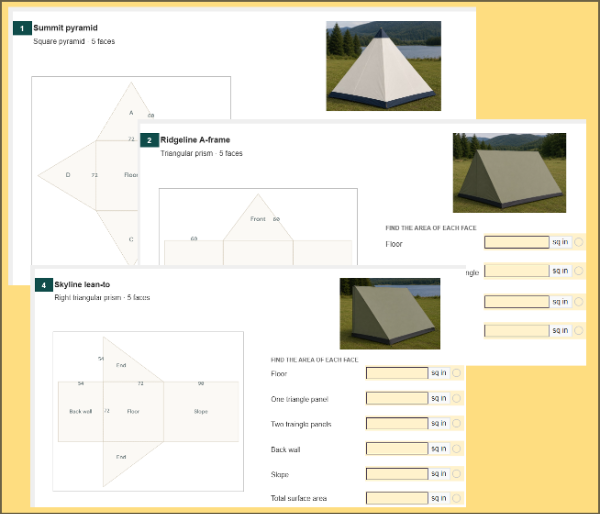
Which tent uses the least fabric? Students become product designers comparing four tent shapes that share the same floor but differ in surface area. Working from real nets of rectangles and triangles, they calculate each face, total the surface area, and turn it into fabric cost. A hands-on 6.G.A.4 activity with auto-grading, live feedback, and randomized versions for every student.