Fence the Community Garden: Polygons on the Coordinate Plane (6.G.A.3)
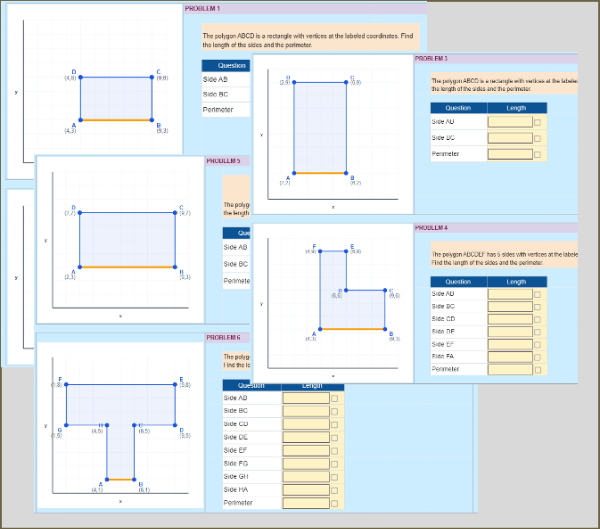
Turn coordinate geometry into a real job. In this interactive Grade 6 math activity, Riverton is opening three community gardens, and the rabbits are already eyeing the lettuce. Students use the coordinates of each garden’s corners to find side lengths, work out the perimeter, and calculate how much the fencing will cost.
What students do
- Read the coordinates printed at each corner of a garden drawn on a coordinate grid.
- Find the length of each side by spotting corners that share an x or a y-coordinate and finding the difference between the other coordinates.
- Add the side lengths to find the perimeter.
- Multiply the perimeter by the price per yard to find the total fencing cost.
Built-in progression
- Garden 1: a rectangle with every corner in the first quadrant.
- Garden 2: an L-shaped lot that crosses the y-axis, so students work with negative coordinates.
- Garden 3: an eight-sided plot spread across all four quadrants, with several sides crossing an axis.
Why teachers like it
- Coordinates, not counting: the grid lines are faded and the axes are unnumbered apart from 0, so students use coordinates the way the standard intends rather than counting squares.
- Instant visual feedback: each correct side length appears as fence on the map, labeled with its length.
- Cost meter: it fills only for sides that are entered correctly, so students can check their total cost before they type it.
- Randomized every time: the corner coordinates and fencing prices change for each student, so answers can’t be copied and the activity can be replayed for extra practice.
- Self-checking: all 24 answers are checked automatically, and a checklist tracks progress across the three gardens.
- Scaffolded: a hint on the first side models the method, then students work on their own.
Standards alignment
- CCSS 6.G.A.3: draw polygons in the coordinate plane given the coordinates of their vertices, use coordinates to find the length of a side joining points with the same first or second coordinate, and apply this to real-world problems.
- Supports 6.NS.C.8: solve problems by graphing points in all four quadrants, and use coordinates and absolute value to find distances between points.
Great for
- Grade 6 geometry units on the coordinate plane.
- Perimeter and real-world measurement practice.
- Intervention or review for Grade 7 students.
- Math centers, independent practice and homework.
Students finish knowing how to find distances on the coordinate plane, and they see why the skill matters: it’s how real planners measure, budget and build.
Keywords: coordinate plane worksheet, polygons on the coordinate plane, 6.G.A.3 activity, perimeter on a coordinate grid, distance between points with the same x or y-coordinate, four-quadrant coordinate plane, Grade 6 geometry, real-world math, interactive math worksheet, self-checking math activity, TeachRealMath
Students find the side lengths of rectilinear polygons on the coordinate plane from the coordinates of their corners, then use those lengths to work out the perimeter and the fencing cost at a given price per yard. The gardens move from the first quadrant to all four, so students practice finding distances between points that share an x or a y-coordinate, including across an axis. This builds 6.G.A.3, with support from 6.NS.C.8.
The worksheet supports randomization. If you enable it every students will receive different angles to work. This prevent copying of answers.
💡 Tip: When assigning this activity to your classroom, you can optionally enable randomization to give each student a unique version of the problems. When you re-assign the same worksheet, each student will get a new set of questions, helping them master the content through repeated practice.