Phone Plan Showdown – Mastering Expressions & Equations

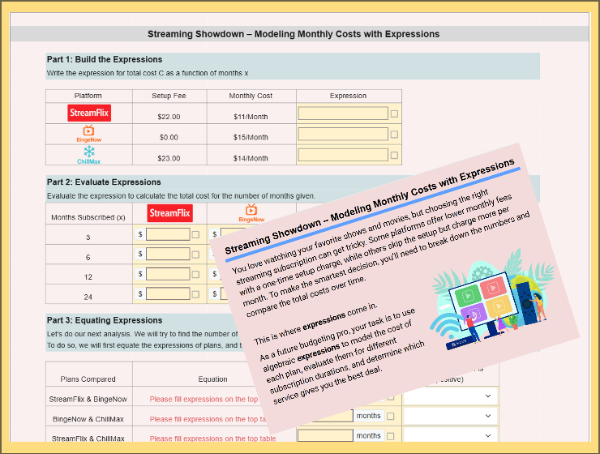
Students compare three different phone plans by writing algebraic expressions to model their monthly cost. They evaluate these expressions for different data usage amounts and determine at what point one plan becomes more economical than the others.

In this real-world algebra challenge, students take on the role of a savvy shopper analyzing three mobile data plans. Each plan includes a base cost and a variable per-GB charge. Rather than being given the expressions, students must:

  • Write algebraic expressions to represent each plan
  • Evaluate their expressions for different GB values (e.g., 2 GB, 5 GB, 10 GB)
  • Compare costs to determine which plan is cheapest at each level of usage
  • Set expressions equal to each other to find the exact data usage where plans cost the same

🔍 What students learn:

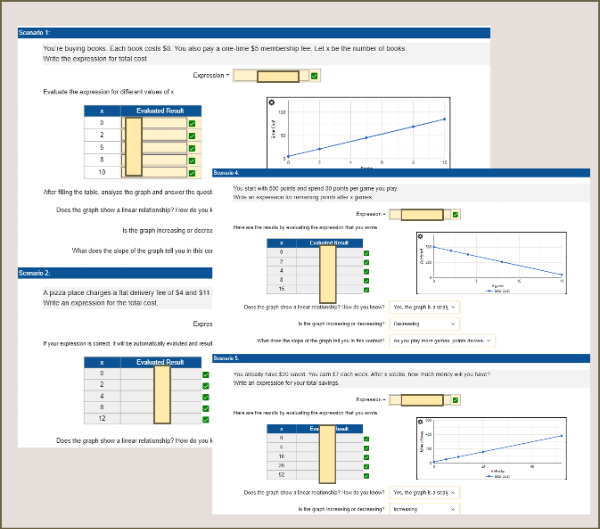
  • Modeling real-world scenarios using algebraic expressions
  • Substituting values into expressions to evaluate outcomes
  • Comparing and interpreting results in a meaningful context
  • Using equations to find break-even points in pricing

📈 This worksheet makes expressions and equations meaningful by helping students use math to make smart financial choices—just like they would in everyday life.

Learning Objective

Students will be able to construct and evaluate algebraic expressions to represent real-world pricing scenarios, and solve equations to determine break-even points. They will apply these skills to compare multiple phone plans based on varying data usage and make informed decisions by interpreting and analyzing their mathematical results.

Randomization Available

  • To ensure individualized learning and discourage copying, each student receives a unique version of the worksheet. The monthly base fees, per-GB charges, and usage amounts for the phone plans are randomized. This means every student will write and evaluate different expressions and reach unique conclusions based on their personalized data.

💡 Tip: When assigning this activity to your classroom, you can optionally enable randomization to give each student a unique version of the problems. When you re-assign the same worksheet, each student will get a new set of questions, helping them master the content through repeated practice.

Phone Plan Showdown – Mastering Expressions & Equations preview
Preview
Grade level
6, 7
Type
Mini Lab (real-world worksheet)
Duration
15 minutes
Auto-graded
Yes
Randomized per student
Yes
Topics
Expressions & EquationsEquivalent ExpressionsSolving EquationsUsing Variables in ContextLinear Equations
Tags
Real WorldFinancial CalculationsStory-BasedApplicationProblem SolvingHomeworkAssessment

Related grades 6, 7 activities

More interactive, auto-graded activities on the same standards and topics.

Mini LabGrades 6, 7· 20 min

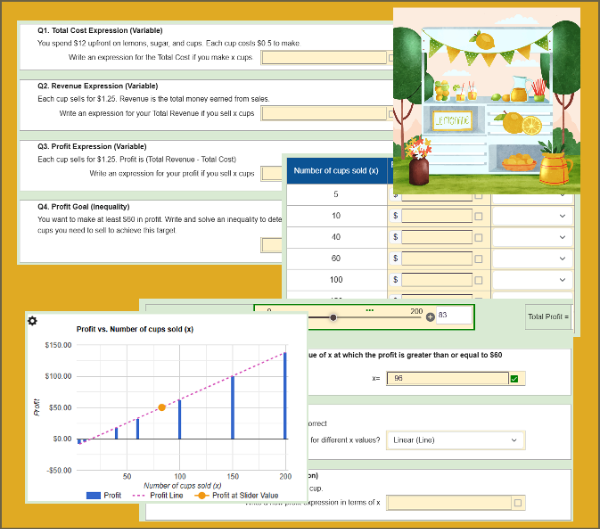
Lemonade Stand: Profit Using Expressions

Help plan a lemonade stand by writing expressions for cost and profit, solving inequalities to reach a profit goal, and analyzing how the number of cups sold affects earnings. Students build a table, plot a linear graph, and use a slider to visualize how profit changes—making math both real and interactive!

Skill PracticeGrades 6, 7· 15 min

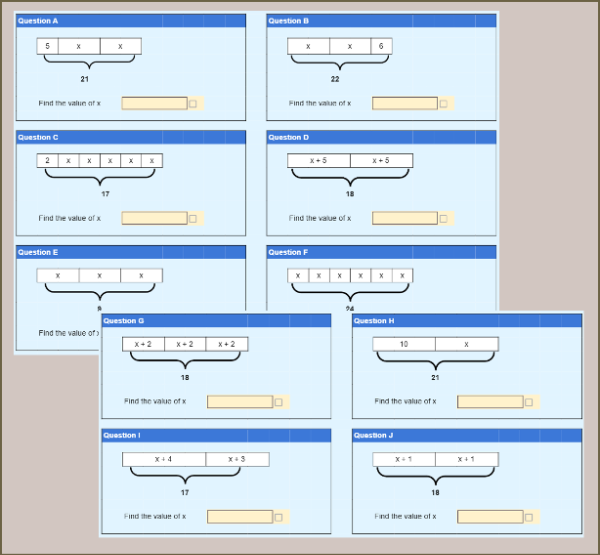
One-Step Equations with Tape Diagrams

Help students build algebra skills using visual tape diagrams. In this worksheet, learners solve one-step equations by identifying equal parts, understanding variable relationships, and finding the value of x. A great introduction to algebraic thinking for 6th grade and early 7th grade.

Skill PracticeGrade 7· 20 min

Solving Equations: Real-World Word Problems

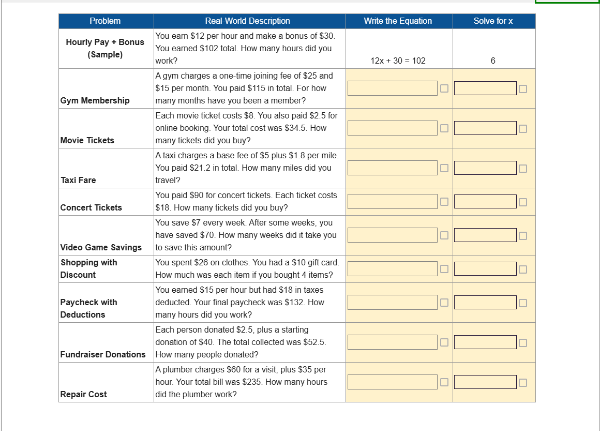
Practice solving real-world problems using one-step and two-step equations with rational numbers. Students write and solve equations based on scenarios like taxi fares, savings, and ticket purchases—perfect for building equation fluency.