
Three class periods. One build. Every decision carries.
A TeachRealMath project is 2 to 4 connected class periods where students build something real. What makes it different from a packet of worksheets: each day's decisions become locked inputs for the next day's math. Here's exactly how one runs.
Auto-graded throughout · intro deck included · your prep: none
Theme Park Tycoon, day by day
The Grade 7 flagship. Students design Aurora Park for an investor. Watch what carries forward, because that's the whole idea. Every project at every grade follows this same shape; only the scenario, the standards, and the number of days change.
Outputs from each worksheet/activity become inputs for the nextChoose rides, set the land plan
Students pick rides from a catalog, place them on a land budget, and watch cost and capacity recalculate with every choice. There is no single right park; there is the park they can defend.
Price tickets against live demand
Students set ticket prices for the rides they chose, and a demand curve responds instantly. A higher price means fewer visitors; the revenue math is theirs to balance, using their own park from yesterday.
Balance the budget, pitch the park
Everything reconciles. Construction costs from day 1, revenue from day 2, and operating costs meet in one budget that has to work. Students finish with short reasoning prompts defending their park to the investor.
Because math you're accountable to is math you remember
Carry-forward isn't a gimmick. It changes what the math is for.
Stakes make retention
On day 3, a student isn’t solving problem 14. They’re rescuing the budget of a park they designed. Application with consequences is what makes the ratio math stick past Friday.
No two parks are alike
Randomized numbers plus each student’s own decisions mean every budget is different. Copying a neighbor’s answer is impossible, because the neighbor is solving a different park.
The math is honestly earned
Each day anchors a specific Common Core standard, and the scenario needs it. Unit rates on day 1, proportional relationships on day 2, multi-step reasoning on day 3. Nothing decorative.
What running a project actually asks of you
Less than a normal lesson does. The project runs itself; you coach.
Assign day 1
The intro deck is included; project it, or let students read the brief. No prep, no printing, no setup.
Watch the console
While students build, the live console shows who’s moving, who’s stuck, and where. Sit with the group that needs you.
Pause between periods
Every project pauses cleanly at the end of a period and picks up exactly where each student stopped, tomorrow or next week.
Absent students catch up
A student who missed day 1 starts there on their own while the class continues. Their park waits for them.
This is what you watch while class runs: who's moving, who's been stuck and where, who's catching up, all updating in real time as students work. Walk to the desk that needs you instead of discovering it while grading.
There's no fixed pacing. Run it the way your calendar works.
A project pauses cleanly at any point and picks up exactly where each student stopped. So the three days don't have to be consecutive, and they don't have to wait for the end of the unit.
Three periods to end the unit
Teach the topic path first, then spend the skills on the project in consecutive periods. The classic run, and the most popular: the unit closes with something built.
One project day per week, as you teach
Run day 1 after the unit-rates lesson, day 2 the week proportional relationships land, day 3 as the unit closes. The project pauses between days and applies each skill the week you teach it.
Interrupted? Nothing breaks
Assemblies, sub days, snow days, testing weeks: pause whenever, resume whenever. There's no expiration, and every student comes back to their own park exactly where they left it.
What students walk away with
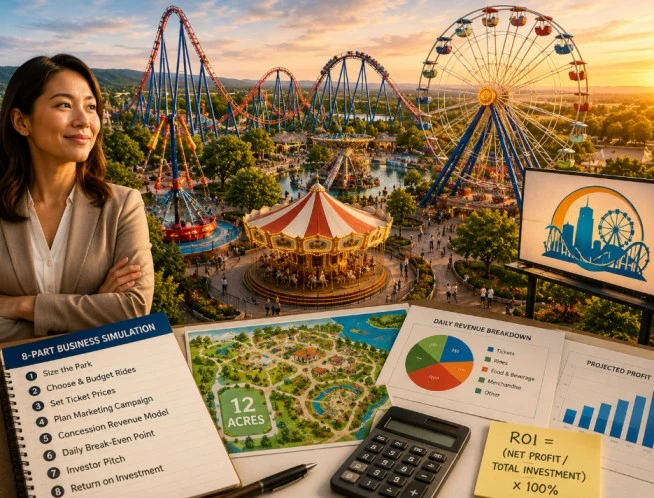 Student work
- A designed, priced theme park that exists because of their decisions, not a worksheet with answers on it
- A balanced budget they had to make work, with the ratio and proportion math that made it work
- A short investor pitch defending their choices, which is the reasoning made visible
- A score already in your gradebook, because the math graded itself along the way
The questions teachers actually ask
What if we run out of time?
What about students who were absent?
Can I run this with one device cart, or shared devices?
How is it graded?
How much do I need to prepare?
Download the Theme Park Tycoon teacher guide and preview the first day exactly as your students would see it.
If it's your first project, start here
Theme Park Tycoon for Grade 7, Precision Construction and Pack & Ship for the others. Preview a sample project right now, no account needed.