Bracing Estimation: Pythagorean Challenge

Estimate metal strap bracing for a house by analyzing a floor plan and using the Pythagorean Theorem. Students measure exterior wall lengths, calculate diagonal brace lengths, and compute total material needed. A hands-on, real-world construction task that strengthens geometry and problem-solving skills.

Bring geometry to life with this hands-on Construction Bracing Estimation Worksheet, where students take on the role of a real framing estimator. Using a detailed floor plan, learners identify exterior wall sections, measure wall lengths, and apply the Pythagorean Theorem to calculate the diagonal brace lengths needed to keep the structure stable against lateral forces. This activity blends 8th-grade geometry with authentic CTE (construction & carpentry) skills, giving students a powerful real-world context for right triangles.


Students learn how diagonal metal strap bracing strengthens walls, why exterior walls need reinforcement, and how mathematical precision affects safety and building durability. The worksheet walks them through wall measurement, brace calculation, and cost estimation—mirroring the tasks performed by professional estimators, engineers, and framers on actual job sites.


Key Features

  • Realistic construction scenario using a full house floor plan
  • Authentic application of the Pythagorean Theorem for diagonal bracing
  • Students calculate wall lengths, brace lengths, and total material cost
  • Clear diagrams and labels for every wall section
  • Reinforces measurement, right triangles, and practical estimation skills
  • Perfect for integrating CTE and math, project-based learning, and real-world geometry


Standards Alignment

Aligned with CCSS 8.G.B.7, students determine unknown side lengths, apply the Pythagorean Theorem in real contexts, and connect geometry to practical construction problems.


Classroom Impact

This worksheet helps students understand why the Pythagorean Theorem matters outside the classroom. From home building to engineering, architecture, robotics, manufacturing, and design, diagonal measurements appear everywhere. Students finish the activity with strengthened conceptual understanding—and a sense of how math powers real industries.

Learning Objective

Students will apply the Pythagorean Theorem to calculate diagonal brace lengths for exterior wall sections using real construction floor-plan measurements. By interpreting a scaled architectural diagram, computing wall lengths and diagonal supports, and determining total material requirements, students will develop practical skills in geometry, measurement, and construction estimation.

Bracing Estimation: Pythagorean Challenge preview
Preview
Grade level
8
Type
Mini Lab (real-world worksheet)
Duration
30 minutes
Auto-graded
Yes
Common Core standards
8.G.B.7
Topics
GeometryPythagorean Theorem
Tags
Real WorldFinancial CalculationsCareer MathStory-BasedApplication

Related grade 8 activities

More interactive, auto-graded activities on the same standards and topics.

LabGrade 8· 120 min

The Navigator's Cipher: Pythagorean Problem

-Turn the Pythagorean theorem into a treasure hunt. In this story-driven Grade 8 lab, students decode a navigator's secret map, measure a hidden island, repair a ship, and triangulate buried treasure. Five auto-graded activities, ~4-5 class periods, covering 8.G.A.3, 8.G.B.6, 8.G.B.7, and 8.G.B.8. Run it right after introducing the theorem.

Mini LabGrade 8· 20 min

Community Center Construction - Pythagorean Mission

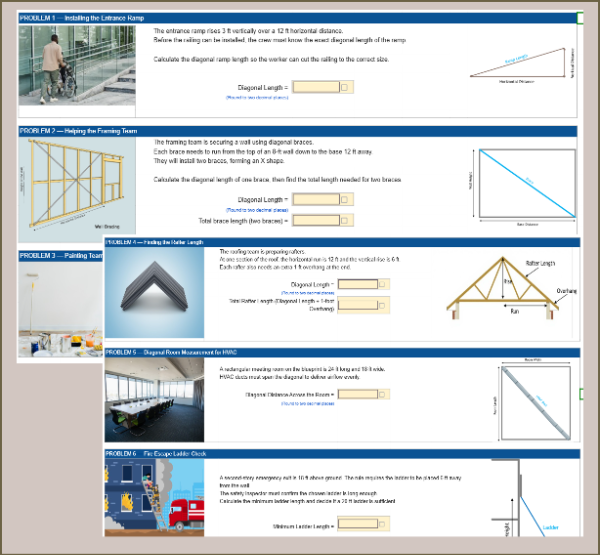
Help students apply the Pythagorean Theorem through real construction problems! From ramps and rafters to ladders and HVAC ducts, learners calculate diagonal distances and solve practical measurement tasks. Real-world visuals and auto-graded inputs make this an engaging 8th-grade geometry activity.

Skill PracticeGrades 6, 7, 8· 10 min

Back to School: My Coordinate Story

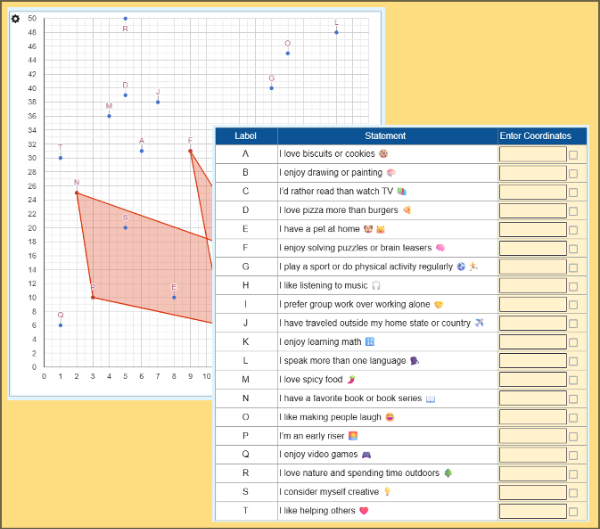
Students read 20 fun statements and choose the ones that describe them. For each, they find the matching point on a graph and enter its coordinates. As they do, a unique shape forms on the coordinate plane. This back-to-school activity falls under Geometry and helps students practice plotting points while expressing themselves.

Skill PracticeGrade 8· 20 min

Distance Between Points Using Pythagorean Theorem

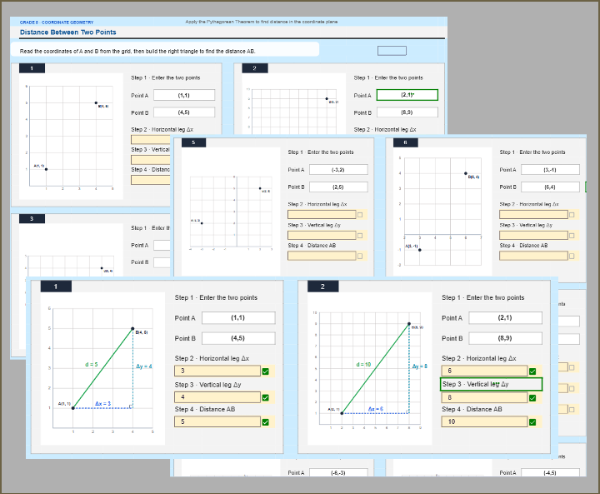
Turn the distance formula into something students can see. On an interactive coordinate grid, students read two points, build the horizontal and vertical legs, and watch a right triangle form before applying the Pythagorean Theorem to find the distance. Ten auto-graded problems progress from clean whole-number triangles to mixed-quadrant challenges. Aligned to 8.G.B.8.

LabGrades 7, 8· 180 min

Precision Construction: A Geometry Project

Step into the role of a construction engineer! In this hands-on geometry lab, students estimate costs for concrete, flooring, painting, HVAC, roofing, landscaping, and more using real-world floor plans. Covers area, volume, surface area, and unit conversions. Auto-graded and perfect for 7th grade classrooms.

Skill PracticeGrade 8· 30 min

Turning Shapes: Exploring Rotations on the Coordinate Plane

Rotate shapes on the coordinate plane to discover how orientation changes while size and shape stay the same. In this interactive worksheet, students apply rotation rules for 90°, 180°, and 270° turns about the origin, record new coordinates, and visualize that rotations create congruent figures.