Turning Shapes: Exploring Rotations on the Coordinate Plane

Rotate shapes on the coordinate plane to discover how orientation changes while size and shape stay the same. In this interactive worksheet, students apply rotation rules for 90°, 180°, and 270° turns about the origin, record new coordinates, and visualize that rotations create congruent figures.

Help students see geometry in motion! In this interactive worksheet, learners explore how rotating a figure about the origin changes its orientation but not its size or shape. Step by step, they apply the rules for 90°, 180°, and 270° rotations, record new coordinates, and visualize that all rotations preserve congruence.

💡 Students will learn to:

  • Apply rotation rules on the coordinate plane:
  • 90° → (x, y) → (y, –x)
  • 180° → (x, y) → (–x, –y)
  • 270° → (x, y) → (–y, x)
  • Plot new coordinates after each rotation.
  • Observe how figures turn around the origin without changing shape or size.
  • Compare all three rotations to understand orientation and congruence.


🧭 Worksheet features:

  • Three rotation challenges (90°, 180°, 270°) with coordinate tables.
  • Clean, grid-based visuals for easy plotting.
  • Step-by-step guided rules for each rotation.
  • Reflection questions to reinforce geometric reasoning.
  • Supports randomization, so each student receives a unique figure and coordinates.


Perfect for 8th-grade geometry and aligned with CCSS 8.G.A.1 – Understanding Congruence through Transformations.

Learning Objective

Students will explore how rotating a figure 90°, 180°, and 270° clockwise about the origin affects its position on the coordinate plane.

They will apply the rotation rules to find new coordinates and verify that rotations preserve shape, size, and angle measures, proving the rotated figures are congruent to the original.
Turning Shapes: Exploring Rotations on the Coordinate Plane preview
Preview
Grade level
8
Type
Skill Practice
Duration
30 minutes
Auto-graded
Yes
Randomized per student
Yes
Common Core standards
8.G.A.18.G.A.1a8.G.A.1b
Topics
GeometryTransformationsCongruence and Similarity

Related grade 8 activities

More interactive, auto-graded activities on the same standards and topics.

Mini LabGrade 8· 20 min

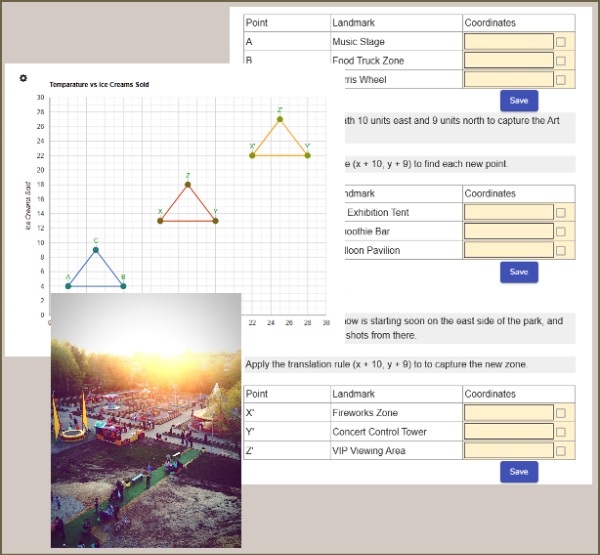
Drone Flight Path Challenge: Discovering Translations

Students take control of a drone mapping a city festival to learn how translations work! They plot the drone’s flight path, move it to new coordinates, and verify that the triangles remain congruent after each translation. Through two real-world missions, students discover that translations slide shapes without changing their size, angles, or orientation—making them perfect examples of rigid motion.

Mini LabGrade 8· 30 min

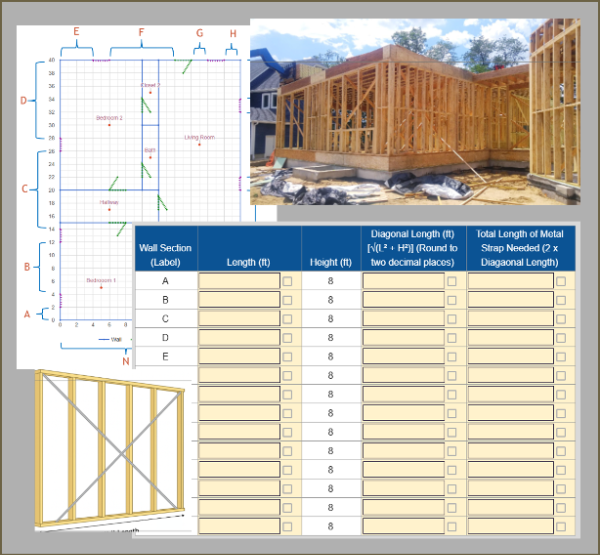
Bracing Estimation: Pythagorean Challenge

Estimate metal strap bracing for a house by analyzing a floor plan and using the Pythagorean Theorem. Students measure exterior wall lengths, calculate diagonal brace lengths, and compute total material needed. A hands-on, real-world construction task that strengthens geometry and problem-solving skills.

Mini LabGrade 8· 20 min

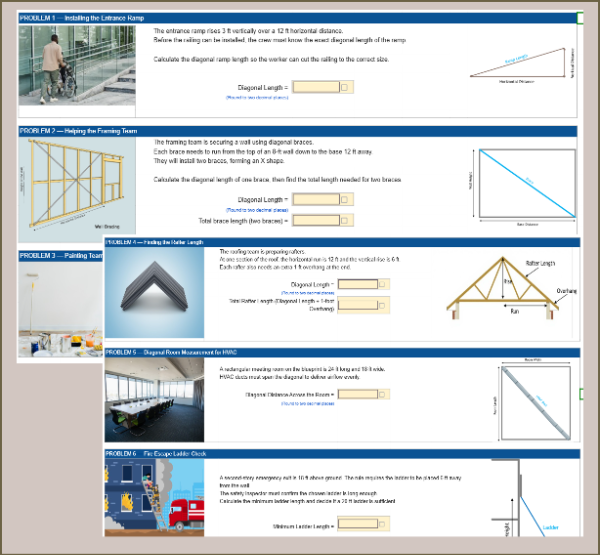
Community Center Construction - Pythagorean Mission

Help students apply the Pythagorean Theorem through real construction problems! From ramps and rafters to ladders and HVAC ducts, learners calculate diagonal distances and solve practical measurement tasks. Real-world visuals and auto-graded inputs make this an engaging 8th-grade geometry activity.

Mini LabGrade 8· 20 min

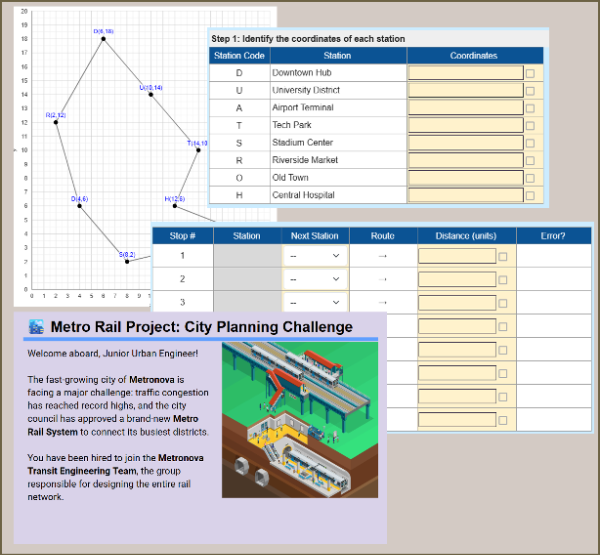
Designing Metronova Metro: Distances on the Coordinate Grid

Design a metro rail system by calculating distances between stations using the Pythagorean Theorem. Identify coordinates, build a travel route, estimate total rail length and construction cost, and justify your proposal. With optional randomization, each student receives unique station coordinates.

Mini LabGrade 8· 20 min

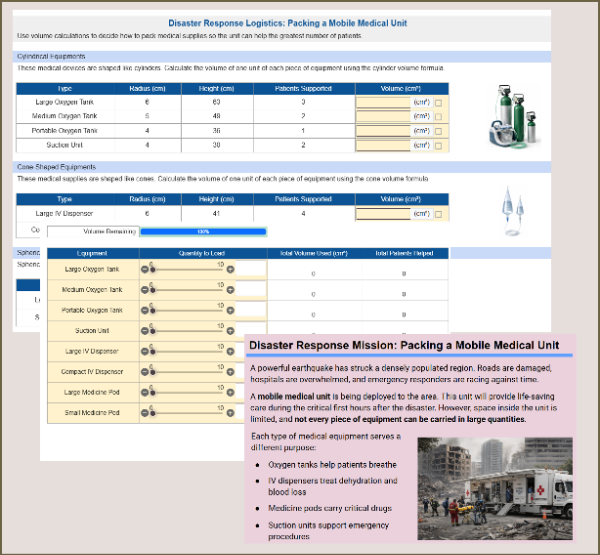
Disaster Response: Packing a Mobile Medical Unit Using Volume Calculation

Pack a mobile medical unit in this interactive real-world math challenge. Students calculate volumes of cylinders, cones, and spheres, then use sliders to choose equipment quantities that help at least 100 patients while staying within storage limits. A powerful application of CCSS 8.G.C.9 focused on decision making and optimization.

Mini LabGrade 8· 20 min

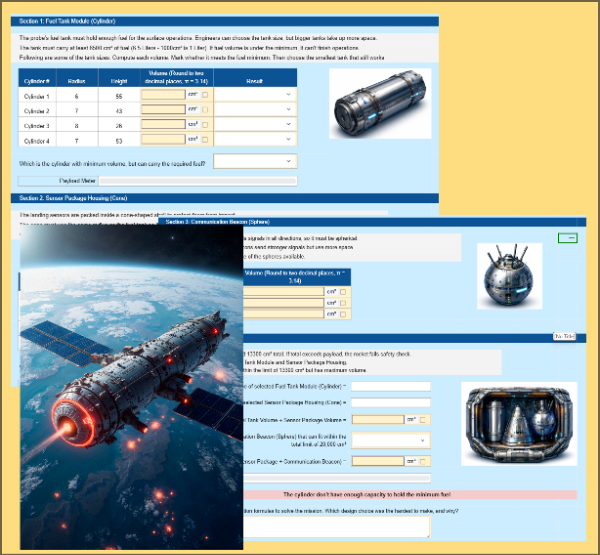
Mission Payload: Volume of Shapes

Design and launch a deep space probe in this interactive real-world math challenge. Students calculate and compare volumes of cylinders, cones, and spheres to meet fuel, sensor, and payload constraints. Using realistic engineering decisions and auto-graded inputs, learners apply 8.G.C.9 concepts while optimizing space and making mission-critical choices.