Mission Payload: Volume of Shapes

Design and launch a deep space probe in this interactive real-world math challenge. Students calculate and compare volumes of cylinders, cones, and spheres to meet fuel, sensor, and payload constraints. Using realistic engineering decisions and auto-graded inputs, learners apply 8.G.C.9 concepts while optimizing space and making mission-critical choices.

Mission Payload: Packing a Deep Space Probe

Interactive Volume Worksheet | CCSS 8.G.C.9


In this engaging real-world math activity, students step into the role of spacecraft engineers tasked with preparing a deep space probe for launch. To succeed, they must calculate and compare the volumes of cylinders, cones, and spheres while working within realistic engineering constraints.


This worksheet moves beyond routine calculations and challenges students to apply volume formulas to meaningful decisions about capacity, efficiency, and optimization.


What Students Will Do

  • Calculate the volume of a cylindrical fuel module used for surface operations
  • Determine the minimum-size cylinder that meets fuel requirements
  • Use the selected radius to calculate the volume of a cone-shaped sensor housing
  • Choose the smallest cone that meets sensor space needs
  • Compare multiple spherical communication beacons and select the largest one that fits within payload limits
  • Track total volume using a payload meter and redesign when limits are exceeded


Key Math Concepts Covered

  • Volume of a cylinder: V = πr²h
  • Volume of a cone: V = (1/3)πr²h
  • Volume of a sphere: V = (4/3)πr³
  • Comparing volumes across different 3D shapes
  • Understanding how radius and height affect volume
  • Applying math to real-world engineering constraints


Why Teachers Love This Activity

  • Fully aligned with Common Core Standard 8.G.C.9
  • Interactive and auto-graded
  • Focuses on reasoning and decision-making, not just computation
  • Uses realistic numbers and constraints students can understand
  • Encourages optimization by choosing the minimum size that works
  • Supports randomization so each student gets different values
  • Ideal for classwork, independent practice, or assessment


Grade Level and Use

  • Best for Grade 8 Geometry
  • Also suitable for STEM, engineering, or enrichment activities
  • Can be completed in one class period or extended with discussion


Learning Objective

Students will use volume formulas for cylinders, cones, and spheres to evaluate design options, meet minimum capacity requirements, and optimize space within a fixed payload limit in an engineering scenario.

Randomization Available

This worksheet supports randomization. Each student receives different dimensions while working with the same mission constraints, which supports individual problem solving and prevents answer copying.

💡 Tip: When assigning this activity to your classroom, you can optionally enable randomization to give each student a unique version of the problems. When you re-assign the same worksheet, each student will get a new set of questions, helping them master the content through repeated practice.
Mission Payload: Volume of Shapes preview
Preview
Grade level
8
Type
Mini Lab (real-world worksheet)
Duration
20 minutes
Auto-graded
Yes
Randomized per student
Yes
Common Core standards
8.G.C.9
Topics
GeometryVolume and Surface AreaVolume of Cylinders, Cones, and Spheres
Tags
Real WorldSTEM ApplicationStory-BasedApplication

Related grade 8 activities

More interactive, auto-graded activities on the same standards and topics.

Mini LabGrade 8· 20 min

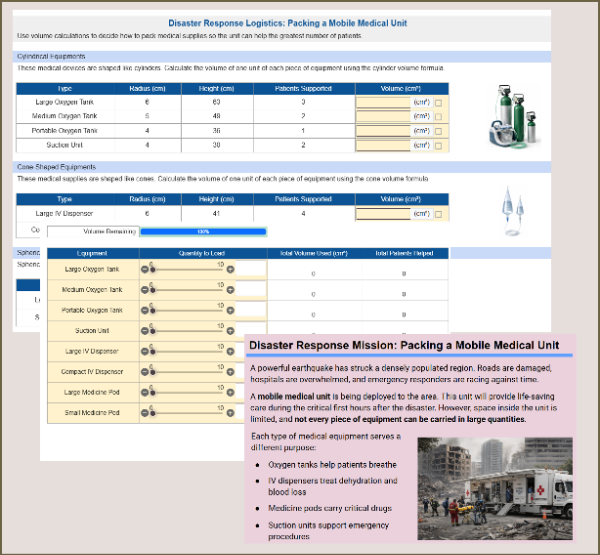
Disaster Response: Packing a Mobile Medical Unit Using Volume Calculation

Pack a mobile medical unit in this interactive real-world math challenge. Students calculate volumes of cylinders, cones, and spheres, then use sliders to choose equipment quantities that help at least 100 patients while staying within storage limits. A powerful application of CCSS 8.G.C.9 focused on decision making and optimization.

Skill PracticeGrades 6, 7, 8· 10 min

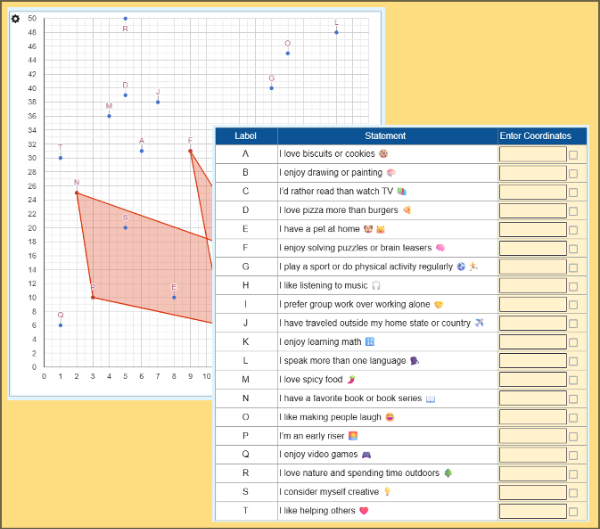
Back to School: My Coordinate Story

Students read 20 fun statements and choose the ones that describe them. For each, they find the matching point on a graph and enter its coordinates. As they do, a unique shape forms on the coordinate plane. This back-to-school activity falls under Geometry and helps students practice plotting points while expressing themselves.

Skill PracticeGrade 8· 20 min

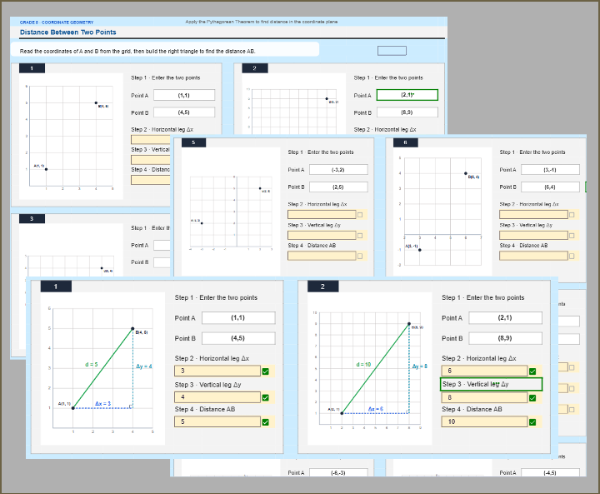
Distance Between Points Using Pythagorean Theorem

Turn the distance formula into something students can see. On an interactive coordinate grid, students read two points, build the horizontal and vertical legs, and watch a right triangle form before applying the Pythagorean Theorem to find the distance. Ten auto-graded problems progress from clean whole-number triangles to mixed-quadrant challenges. Aligned to 8.G.B.8.

LabGrades 7, 8· 180 min

Precision Construction: A Geometry Project

Step into the role of a construction engineer! In this hands-on geometry lab, students estimate costs for concrete, flooring, painting, HVAC, roofing, landscaping, and more using real-world floor plans. Covers area, volume, surface area, and unit conversions. Auto-graded and perfect for 7th grade classrooms.

LabGrade 8· 120 min

The Navigator's Cipher: Pythagorean Problem

-Turn the Pythagorean theorem into a treasure hunt. In this story-driven Grade 8 lab, students decode a navigator's secret map, measure a hidden island, repair a ship, and triangulate buried treasure. Five auto-graded activities, ~4-5 class periods, covering 8.G.A.3, 8.G.B.6, 8.G.B.7, and 8.G.B.8. Run it right after introducing the theorem.

Skill PracticeGrade 8· 30 min

Turning Shapes: Exploring Rotations on the Coordinate Plane

Rotate shapes on the coordinate plane to discover how orientation changes while size and shape stay the same. In this interactive worksheet, students apply rotation rules for 90°, 180°, and 270° turns about the origin, record new coordinates, and visualize that rotations create congruent figures.