Designing Metronova Metro: Distances on the Coordinate Grid

Design a metro rail system by calculating distances between stations using the Pythagorean Theorem. Identify coordinates, build a travel route, estimate total rail length and construction cost, and justify your proposal. With optional randomization, each student receives unique station coordinates.

Transform coordinate geometry into a real engineering experience with this interactive Metro Rail Distance Mapping Challenge. In this hands-on worksheet, students step into the role of a city route design engineer, tasked with building a complete metro rail line across a coordinate grid. Using the Pythagorean Theorem and the distance formula, students calculate straight-line distances between stations, design an efficient travel route, and estimate the total construction cost—just like real urban planners and transportation engineers.


Students begin by identifying coordinates for eight major metro stations on the map. They then design their own custom metro route: selecting a starting station, choosing the order in which each station will be visited, and calculating the distance for every segment of their path. As each segment is entered correctly, the worksheet automatically draws the rail line on the graph, helping students visualize the emerging transportation network.


What Students Will Do

  • Identify the coordinates of metro stations on a grid
  • Choose a starting point for the route
  • Choose next station, calculate distance between starting station and selected next station
  • Repeat this to visit all stations and return to the starting point
  • Watch their route appear dynamically as they enter correct distances
  • Compute total rail length and convert to real-world units
  • Estimate construction costs using a cost-per-mile model
  • Write a final engineering proposal based on their findings

Skills Covered

  • Distance formula
  • Real-world applications of the Pythagorean Theorem
  • Coordinate plane interpretation
  • Route design and optimization

Why This Activity Is Engaging

  • Students make real decisions about station order and route efficiency
  • The metro lines appear visually and interactively as distances are solved
  • Immediate validation and auto-grading

Bring math to life with a meaningful, visually rich transportation design challenge—your students will love seeing how geometry helps build real cities.

Learning Objective

Students will apply the Pythagorean Theorem and the distance formula to calculate the straight-line distance between points on a coordinate plane. They will use these calculations to design and analyze a complete metro rail route, determine total route length and construction costs, and evaluate route efficiency using mathematical reasoning.

Randomization Available

If randomization is enabled, every student will receive a unique set of coordinates for each of the eight metro stations, which means all calculated distances will also be different. This prevents copying and ensures each student completes their own version of the route-planning challenge. Station positions should shift slightly on the grid while keeping the overall layout realistic and workable (within the 0–25 range on both axes).

💡 Tip: When assigning this activity to your classroom, you can optionally enable randomization to give each student a unique version of the problems. When you re-assign the same worksheet, each student will get a new set of questions, helping them master the content through repeated practice.

Designing Metronova Metro: Distances on the Coordinate Grid preview
Preview
Grade level
8
Type
Mini Lab (real-world worksheet)
Duration
20 minutes
Auto-graded
Yes
Randomized per student
Yes
Common Core standards
8.G.B.8
Topics
GeometryScale DrawingsPythagorean Theorem
Tags
Real WorldFinancial CalculationsCareer MathStory-BasedConceptual UnderstandingGraph-Based

Related grade 8 activities

More interactive, auto-graded activities on the same standards and topics.

Skill PracticeGrade 8· 20 min

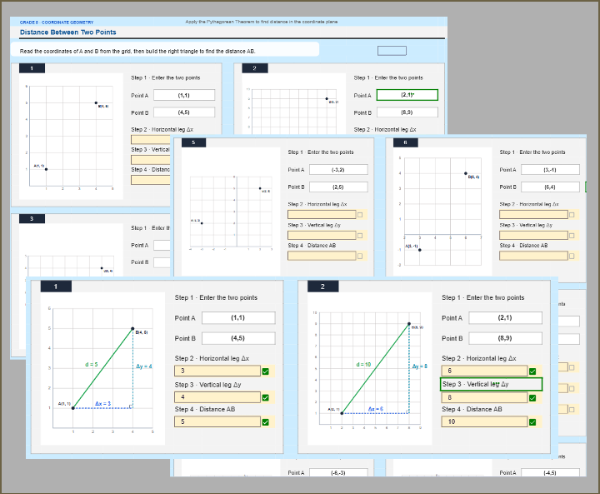
Distance Between Points Using Pythagorean Theorem

Turn the distance formula into something students can see. On an interactive coordinate grid, students read two points, build the horizontal and vertical legs, and watch a right triangle form before applying the Pythagorean Theorem to find the distance. Ten auto-graded problems progress from clean whole-number triangles to mixed-quadrant challenges. Aligned to 8.G.B.8.

LabGrade 8· 120 min

The Navigator's Cipher: Pythagorean Problem

-Turn the Pythagorean theorem into a treasure hunt. In this story-driven Grade 8 lab, students decode a navigator's secret map, measure a hidden island, repair a ship, and triangulate buried treasure. Five auto-graded activities, ~4-5 class periods, covering 8.G.A.3, 8.G.B.6, 8.G.B.7, and 8.G.B.8. Run it right after introducing the theorem.

Mini LabGrade 8· 20 min

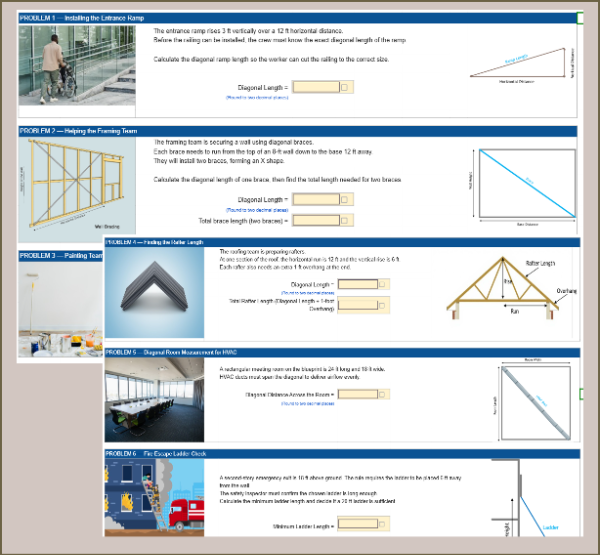
Community Center Construction - Pythagorean Mission

Help students apply the Pythagorean Theorem through real construction problems! From ramps and rafters to ladders and HVAC ducts, learners calculate diagonal distances and solve practical measurement tasks. Real-world visuals and auto-graded inputs make this an engaging 8th-grade geometry activity.

Skill PracticeGrades 6, 7, 8· 10 min

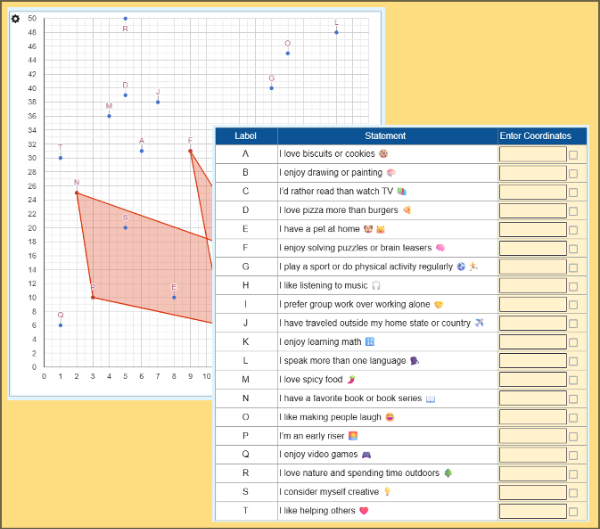
Back to School: My Coordinate Story

Students read 20 fun statements and choose the ones that describe them. For each, they find the matching point on a graph and enter its coordinates. As they do, a unique shape forms on the coordinate plane. This back-to-school activity falls under Geometry and helps students practice plotting points while expressing themselves.

LabGrades 7, 8· 180 min

Precision Construction: A Geometry Project

Step into the role of a construction engineer! In this hands-on geometry lab, students estimate costs for concrete, flooring, painting, HVAC, roofing, landscaping, and more using real-world floor plans. Covers area, volume, surface area, and unit conversions. Auto-graded and perfect for 7th grade classrooms.

Skill PracticeGrade 8· 30 min

Turning Shapes: Exploring Rotations on the Coordinate Plane

Rotate shapes on the coordinate plane to discover how orientation changes while size and shape stay the same. In this interactive worksheet, students apply rotation rules for 90°, 180°, and 270° turns about the origin, record new coordinates, and visualize that rotations create congruent figures.