Paint Mixing Studio: An Interactive Equivalent Ratios and Ratio Tables Worksheet for Grade 6
Make equivalent ratios something students can see. In Paint Mixing Studio, your 6th graders run the paint station for a giant school hallway mural. Every color has a recipe card written in parts, such as Meadow Green at 2 parts blue to 3 parts yellow. Students scale each recipe to the exact amount of paint each part of the mural needs.
The twist is that the math makes the color. When students press Mix the Paint, their amounts are blended into a live color swatch next to the target color. An equivalent ratio produces a perfect match. If a student adds instead of multiplying, or scales only one part, the paint comes out visibly wrong. Students get instant, visual feedback on proportional reasoning, and nobody has to give away the answer.
The finale: Design Your Own Color
Students invent a brand-new paint with sliders for blue, yellow, red and white, watch the color change as they mix, and name their creation. When they press Finalize my Recipe, a customer places an order for that paint. Students then work out the scale factor and the exact cups of each color to fill it. Every student’s order is different, so the final problem is personal, creative and impossible to copy.
What students practice
- Finding a scale factor and using it to scale a part-to-part ratio
- Completing ratio tables with missing values in any column
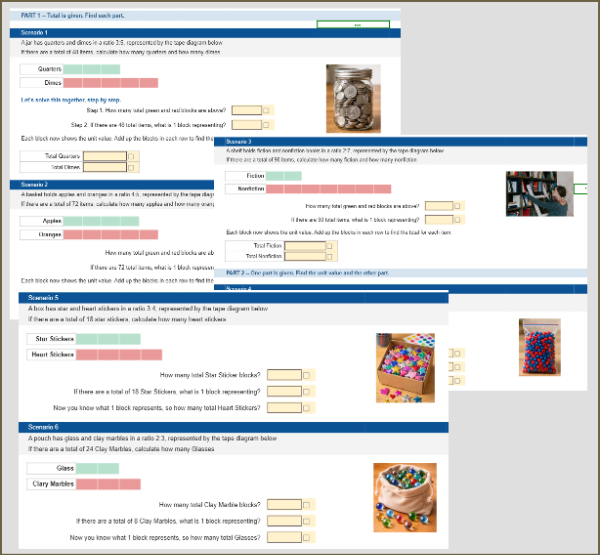
- Splitting a total amount into parts (part-to-whole reasoning)
- Scaling with a non-whole scale factor (half cups)
- Working with three-part and four-part ratios
- Fixing an incorrect mixture by working out how much paint to add
- Creating their own ratio and scaling it to fill a real order
Inside the worksheet
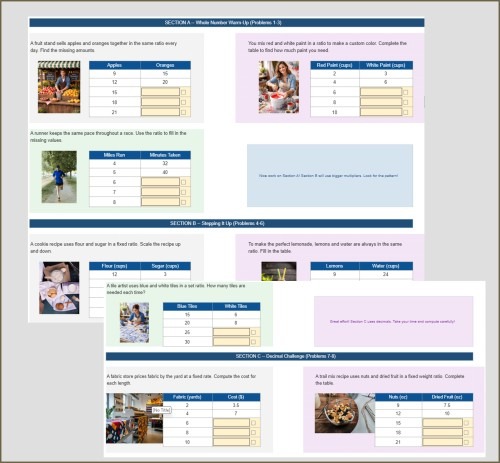
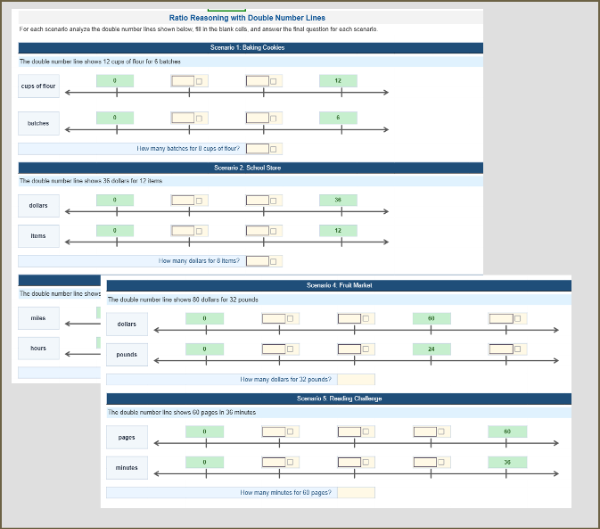
- 10 problems that build from simple scaling to multi-step reasoning
- Six recipe cards students look up as they work
- Live color swatches and a part-by-part mix bar, a visual model that also supports color-blind learners
- Auto-grading with a green tick beside every correct answer
- Randomized numbers for every student, which helps reduce copying
- A story-driven student introduction that sets up the mural mission
- About 25 to 30 minutes of focused practice, ideal for a full class period, small groups or homework
Standards alignment
- CCSS 6.RP.A.3: Use ratio and rate reasoning to solve real-world and mathematical problems
- Supports 6.RP.A.1 (ratio language) and 6.RP.A.3a (tables of equivalent ratios)
Perfect for
- Introducing or reinforcing equivalent ratios in 6th grade math
- Real-world and project-based math lessons
- Middle school math intervention and test review
- Teachers looking for engaging, no-prep digital ratio activities
When the colors match, students know their math is right. Paint Mixing Studio turns ratios from numbers on a page into a recipe they have to get right.
Keywords: ratios worksheet, ratio tables, equivalent ratios, 6th grade math, 6.RP.A.3, proportional reasoning, scale factor, part-to-part ratio, real-world math, interactive math worksheet, digital math activity, middle school math
Students use part-to-part ratios on paint recipe cards to mix buckets of different sizes. They find the value of one part from a given amount, then scale every color by that unit (the cups in 1 part) to complete missing amounts, fill equivalent-ratio tables, split a total into parts, and work with half cups. They also correct a mixture that is off-ratio and design their own recipe to fill a customer order. The key insight is that a color stays the same only when every ingredient is multiplied by the same number, so equivalent ratios keep the mix identical (CCSS 6.RP.A.1, 6.RP.A.3, 6.RP.A.3a).
The worksheet supports randomization. If you enable it every students will receive different ratios to work on. This prevent copying of answers.
💡 Tip: When assigning this activity to your classroom, you can optionally enable randomization to give each student a unique version of the problems. When you re-assign the same worksheet, each student will get a new set of questions, helping them master the content through repeated practice.