Global Manufacturing - Raw Material Cost Comparison

Students act as the CEO of a company, to find the cheapest country to purchase the raw materials, students will do unit conversion between different currencies.

Real-World Math Worksheet on Currency Conversion, Ratios, and Unit Rates


Step into the shoes of a global CEO in this engaging, real-world math worksheet! In the Global Manufacturing – Raw Material Cost Comparison activity, students take on the role of a decision-maker in an international company, comparing the cost of raw materials sourced from Japan, the UK, and Germany.


Using provided currency exchange rates, students will convert prices from Yen, Pound Sterling, and Euro to USD. Then, they’ll analyze and compare unit rates to determine the most cost-effective supplier for each material.


This hands-on math activity reinforces essential 6th and 7th grade Common Core standards around:


  • Ratios and proportional relationships
  • Unit rate comparisons
  • Fractions and decimals
  • Real-life applications of currency conversion and decision-making


real-world math worksheet, currency conversion worksheet, ratios and unit rates 6th grade, 7th grade math activity, global sourcing math activity, math worksheet on unit rates, compare prices using currency exchange, interactive math worksheet for middle school

Learning Objective

Students will apply mathematical reasoning to convert between international currencies, compare unit costs, and identify optimal purchasing decisions based on real-world data.


They will practice using division and proportional reasoning in the context of global supply chain analysis, reinforcing skills in unit rate conversion, decision-making, and data interpretation.

Randomization Available

If randomization is enabled, every student will get a different price to convert. This ensures that students can't just copy answers and helps individualized learning.

💡 Tip: When assigning this activity to your classroom, you can optionally enable randomization to give each student a unique version of the problems. When you re-assign the same worksheet, each student will get a new set of questions, helping them master the content through repeated practice.

Global Manufacturing - Raw Material Cost Comparison preview
Preview
Grade level
6, 7
Type
Mini Lab (real-world worksheet)
Duration
20 minutes
Auto-graded
Yes
Randomized per student
Yes
Topics
Numbers & OperationsRatios & ProportionsRatioUnit RateOperations with Rational NumbersNegative Numbers
Tags
Real WorldFinancial CalculationsBusiness MathTabular FormatStory-BasedApplicationCritical ThinkingBell RingerHomeworkExit Ticket

Related grades 6, 7 activities

More interactive, auto-graded activities on the same standards and topics.

Mini LabGrade 7· 20 min

Budgeting for Thanksgiving Feast

In this Thanksgiving-themed math worksheet, students convert ingredient quantities into standard units and calculate the cost of preparing a holiday meal. It’s a real-world activity that strengthens unit conversion, proportional reasoning, and budgeting skills.

Mini LabGrades 7, 8· 20 min

Community Kitchen - Weekly Budget Planning

In this community kitchen budgeting activity, students convert recipe quantities and calculate the cost of each ingredient needed to prepare a holiday-style meal. Includes turkey, mashed potatoes, gravy, carrots, peas, cranberry sauce, and more.

Mini LabGrade 7· 15 min

Cookie Ratios – Baking with Grandma’s Recipe

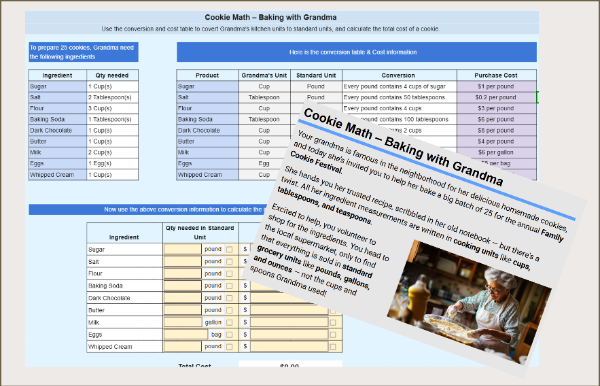
In this real-world math activity, students apply their understanding of ratios and fractions to convert Grandma’s recipe from kitchen units to standard grocery store units. Using a conversion chart and price list, they calculate the quantity and cost of each ingredient, determine the total expense for 25 cookies, and find the cost of one cookie.

LabGrades 6, 7· 120 min

Smoothie Fractions: Run the Bar

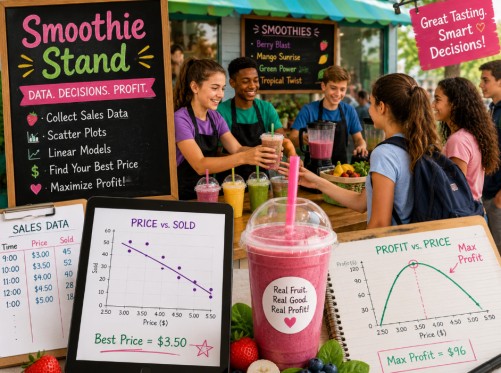
Students run a smoothie bar for a day, and every decision is a fraction problem with a real purpose. Six connected, auto-graded interactive worksheets covering multiply, divide, equivalent fractions, compare, and order. Carry-forward story keeps math meaningful. Common Core aligned. Run it in a day or across two weeks.