Mini LabGrades 6, 7· 20 min
Global Manufacturing - Raw Material Cost Comparison
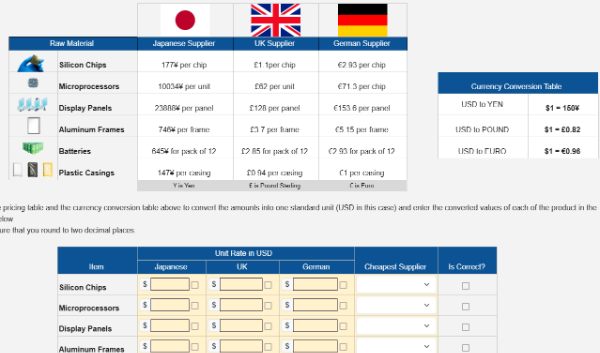
Students act as the CEO of a company, to find the cheapest country to purchase the raw materials, students will do unit conversion between different currencies.

Interactive Grade 6 worksheet with 5 ratio scenarios where students complete double number lines and solve for unknown values across real-world contexts. Auto-graded with optional randomization.
This interactive Grade 6 practice worksheet challenges students to think proportionally using one of the most powerful visual tools in middle school math — the double number line. Across 5 carefully crafted ratio scenarios, students are given a ratio and one known value, then must fill in all missing tick-mark values on both rows of the number line before answering a final question about the relationship.
Each scenario uses a different real-world context — recipes, distance, money, and more — so students stay engaged as they build fluency with proportional reasoning. By working through varied contexts with the same underlying structure, students develop the flexible thinking that Common Core standards demand.
Double number lines make abstract ratio relationships visible and concrete. Instead of memorizing a formula, students see the scaling happening in both dimensions simultaneously. The fill-in-the-blank number line format gives students a structured scaffold while still requiring genuine mathematical thinking at every step.
Before starting the activity, you can share the following Khan Academy link to students to recap ratios using double number line - https://www.khanacademy.org/math/cc-sixth-grade-math/cc-6th-ratios-prop-topic/visualize-ratios/v/ratios-and-double-number-lines
Assign this worksheet after introducing ratios and ratio tables. It works well as a bridge between ratio tables and formal proportion solving, reinforcing visual reasoning before symbolic methods.
In this worksheet, students will interpret ratios presented in real-world contexts and represent them accurately on double number lines by filling in all tick-mark values across both rows. Students will identify unit rates and apply proportional scaling to determine missing quantities in scenarios involving recipes, distance, money, and other everyday situations. Students will use the completed double number line as a reasoning tool to answer a targeted question — such as 'How many cups of flour are needed for 6 batches?' — demonstrating fluency with ratio relationships.
This worksheet supports randomization — each student will receive a unique set of ratio values and anchor numbers across all 5 scenarios, while the real-world contexts and double number line structure remain the same for everyone. Enabling randomization makes it easy to assign as independent practice since no two students will have identical answers. Would you like to enable randomization for this assignment?
💡 Tip: When assigning this activity to your classroom, you can optionally enable randomization to give each student a unique version of the problems. When you re-assign the same worksheet, each student will get a new set of questions, helping them master the content through repeated practice.
Fluently add, subtract, multiply, and divide multi-digit decimals using the standard algorithm for each operation.
All 6.NS.B.3 activities →Understand the concept of a ratio and use ratio language to describe a ratio relationship between two quantities. *For example, "The ratio of wings to beaks in the bird house at the zoo was 2:1, because for every 2 wings there was 1 beak." "For every vote candidate A received, candidate C received nearly three votes."*
All 6.RP.A.1 activities →Use ratio and rate reasoning to solve real-world and mathematical problems, e.g., by reasoning about tables of equivalent ratios, tape diagrams, double number line diagrams, or equations.
All 6.RP.A.3 activities →More interactive, auto-graded activities on the same standards and topics.
Students act as the CEO of a company, to find the cheapest country to purchase the raw materials, students will do unit conversion between different currencies.
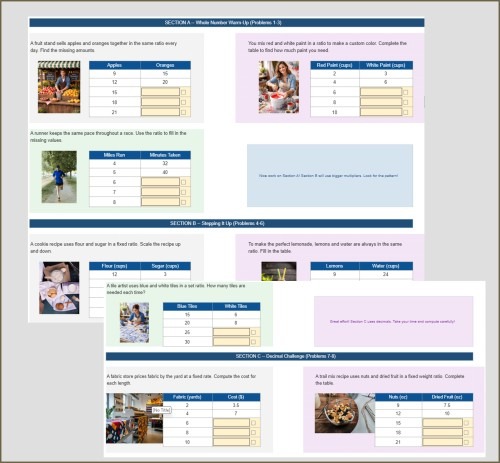
Interactive Grade 6 worksheet with 8 ratio table problems across three difficulty tiers — whole numbers, larger multipliers, and decimals. Students find missing values in two-column ratio tables using real-world contexts. Auto-graded with optional randomization.
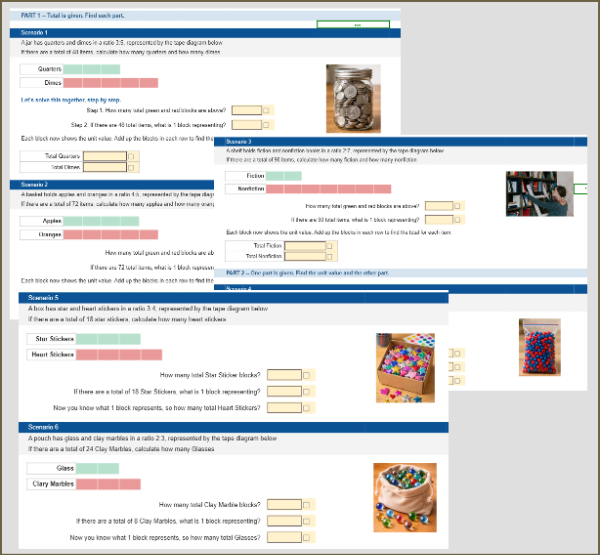
Interactive Grade 6 worksheet where students use tape diagrams to solve 6 ratio problems in real-world contexts - finding parts from totals and unknown parts from known parts. Auto-graded with randomization support.
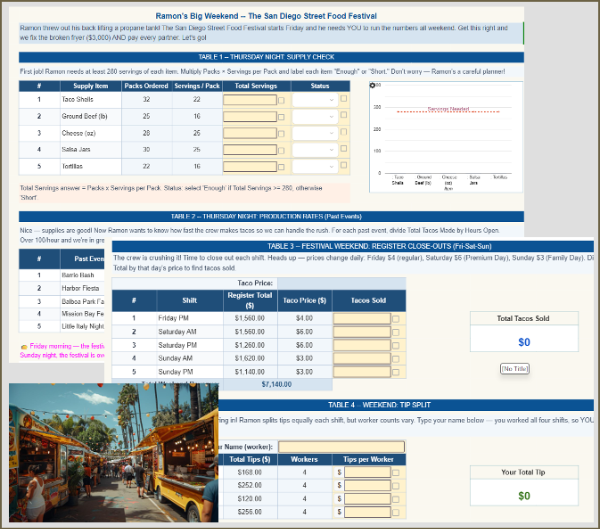
Step in as Ramon's assistant and run the numbers for a 4-day San Diego food truck festival. Multiply, divide, and track revenue across 5 sequenced tables. Auto-graded, randomized, Grade 6.
Students run a smoothie bar for a day, and every decision is a fraction problem with a real purpose. Six connected, auto-graded interactive worksheets covering multiply, divide, equivalent fractions, compare, and order. Carry-forward story keeps math meaningful. Common Core aligned. Run it in a day or across two weeks.
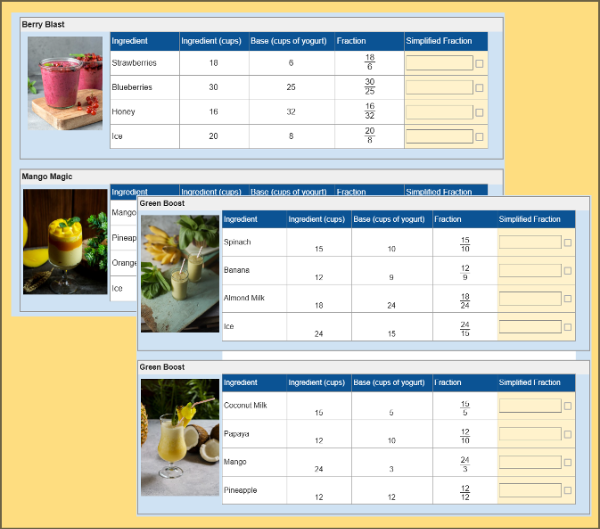
Step into the Smoothie Shop and simplify real-world recipe ratios! Students practice reducing fractions to lowest terms using the greatest common factor (GCF). Perfect for introducing or reviewing simplifying fractions through a fun, food-based context.