Mini LabGrades 6, 7· 20 min
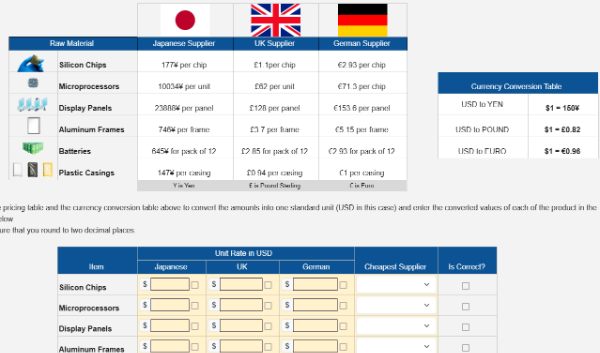
Global Manufacturing - Raw Material Cost Comparison
Students act as the CEO of a company, to find the cheapest country to purchase the raw materials, students will do unit conversion between different currencies.

Step into the Smoothie Shop and simplify real-world recipe ratios! Students practice reducing fractions to lowest terms using the greatest common factor (GCF). Perfect for introducing or reviewing simplifying fractions through a fun, food-based context.
Bring math to life with this real-world Simplifying Fractions activity!
In Smoothie Shop Simplifiers, students work as junior mixologists who must rewrite smoothie recipes using fractions in simplest form.
Each smoothie includes multiple ingredients, giving students plenty of practice simplifying numerators and denominators by finding their Greatest Common Factor (GCF).
Students quickly see why simplification matters—clearer ratios, easier comparisons, and fewer mistakes when scaling recipes.
The worksheet includes 20 fraction problems across five smoothies, instant feedback support, and optional randomization so each student receives a unique set of numbers.
Skills Covered:
Students will learn to simplify fractions to their lowest terms by dividing both the numerator and denominator by their greatest common factor (GCF).
They will understand that simplified fractions represent the same ratio or quantity in a clearer and more practical form used in real-world contexts, such as recipes and mixtures.
Would you like to enable randomization?
When randomization is turned on, each student will receive a unique set of numerators and denominators for the smoothie recipe fractions. All fractions are automatically generated to be simplifiable using a common factor, ensuring consistent difficulty while giving every student a different version of the same challenge.
💡 Tip: When assigning this activity to your classroom, you can optionally enable randomization to give each student a unique version of the problems. When you re-assign the same worksheet, each student will get a new set of questions, helping them master the content through repeated practice.
Find the greatest common factor of two whole numbers less than or equal to 100 and the least common multiple of two whole numbers less than or equal to 12. Use the distributive property to express a sum of two whole numbers 1-100 with a common factor as a multiple of a sum of two whole numbers with no common factor. *For example, express 36 + 8 as 4 (9 + 2).*.
All 6.NS.B.4 activities →Understand the concept of a ratio and use ratio language to describe a ratio relationship between two quantities. *For example, "The ratio of wings to beaks in the bird house at the zoo was 2:1, because for every 2 wings there was 1 beak." "For every vote candidate A received, candidate C received nearly three votes."*
All 6.RP.A.1 activities →Know that numbers that are not rational are called irrational. Understand informally that every number has a decimal expansion; for rational numbers show that the decimal expansion repeats eventually, and convert a decimal expansion which repeats eventually into a rational number.
All 8.NS.A.1 activities →
More interactive, auto-graded activities on the same standards and topics.
Students act as the CEO of a company, to find the cheapest country to purchase the raw materials, students will do unit conversion between different currencies.
Take your students on a spooky adventure through a haunted mansion filled with math puzzles! This Halloween-themed lab features 5 interactive worksheets covering ratios, fractions, percentages, and more. Completing each worksheet unlocks the next haunted room, leading to the final treasure. Perfect for engaging middle schoolers in a fun and educational Halloween experience!
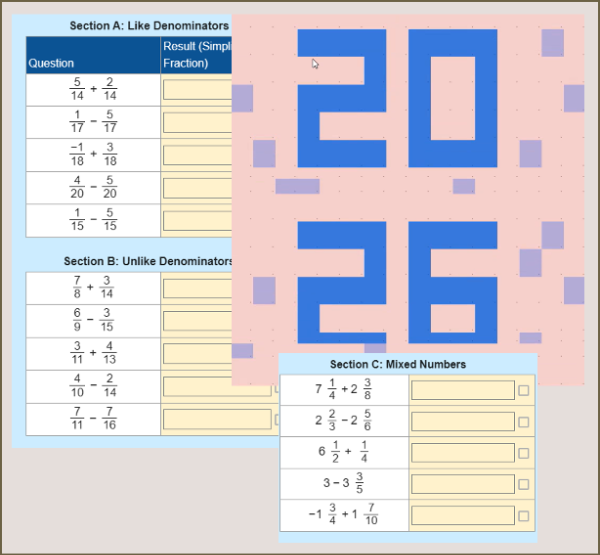
Engage students in adding and subtracting fractions and mixed numbers with this interactive Grade 7–8 math worksheet. Students work with like and unlike denominators, including positive and negative values, and enter answers as simplified fractions only. Built-in randomization gives each student unique problems, and a fun pixel-art reveal boosts motivation.
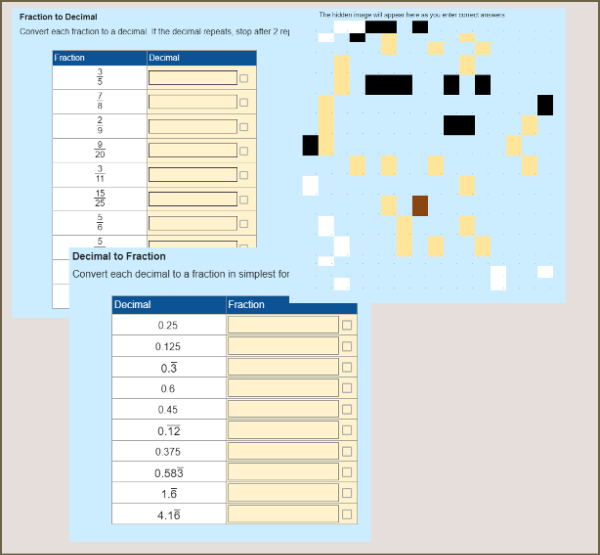
Practice converting fractions and decimals with this interactive 8th-grade math worksheet. Students convert fractions to decimals and decimals to fractions, identify terminating and repeating decimals, and receive instant feedback. Includes randomization so each student gets unique values, plus a fun pixel-art reveal to boost engagement.
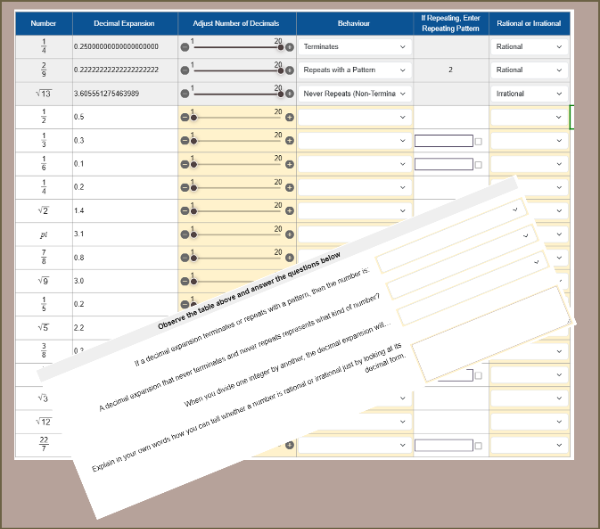
Explore rational and irrational numbers through an interactive decimal slider! Students reveal digits, spot repeating or terminating patterns, and classify numbers. A hands-on way to understand decimal behavior and the difference between rational and irrational numbers.
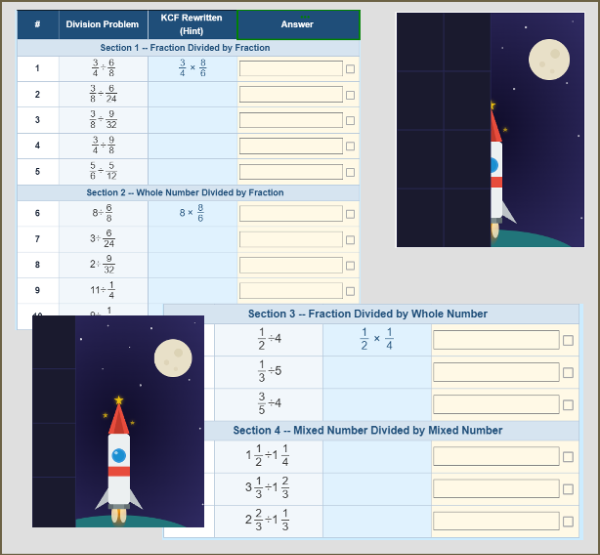
Interactive Grade 6 worksheet where students practice dividing fractions using the Keep-Change-Flip strategy across four progressive sections. 16 problems total, auto-graded with immediate feedback.