Irrational Numbers: The Repeating Decimal Lab

Explore rational and irrational numbers through an interactive decimal slider! Students reveal digits, spot repeating or terminating patterns, and classify numbers. A hands-on way to understand decimal behavior and the difference between rational and irrational numbers.

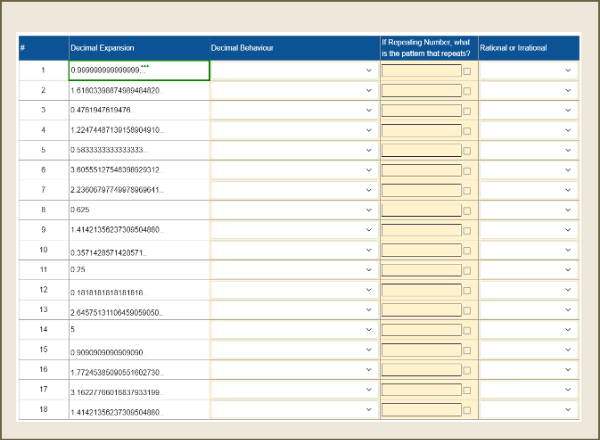
In this interactive math worksheet, students investigate how decimals reveal whether a number is rational or irrational. Using an adjustable slider, they uncover more digits of each number’s decimal expansion, observe whether it terminates, repeats with a pattern, or continues endlessly, and record their findings. Through this hands-on discovery process, students learn that rational numbers have decimal expansions that terminate or repeat, while irrational numbers never repeat or end.


Designed for middle school math (Grade 8, CCSS 8.NS.A.1), this self-checking worksheet encourages pattern recognition, reasoning, and conceptual understanding of number types. Teachers can assign it as an in-class exploration or homework practice, with automatic feedback and scoring to reinforce mastery of rational and irrational numbers.

Learning Objective

In this activity, students will explore the decimal expansions of different types of numbers to discover patterns that distinguish rational and irrational numbers. By adjusting the number of visible decimal places, students will observe which decimals terminate, which repeat with a pattern, and which continue without repetition. Through this investigation, students will conclude that numbers with terminating or repeating decimal expansions are rational, while those with non-terminating, non-repeating decimals are irrational.

Irrational Numbers: The Repeating Decimal Lab preview
Preview
Grade level
8
Type
Skill Practice
Duration
20 minutes
Auto-graded
Yes
Common Core standards
8.NS.A.1
Topics
Numbers & OperationsIrrational Numbers

Related grade 8 activities

More interactive, auto-graded activities on the same standards and topics.

Skill PracticeGrades 7, 8· 20 min

Adding & Subtracting Fractions and Mixed Numbers - Pixel Art

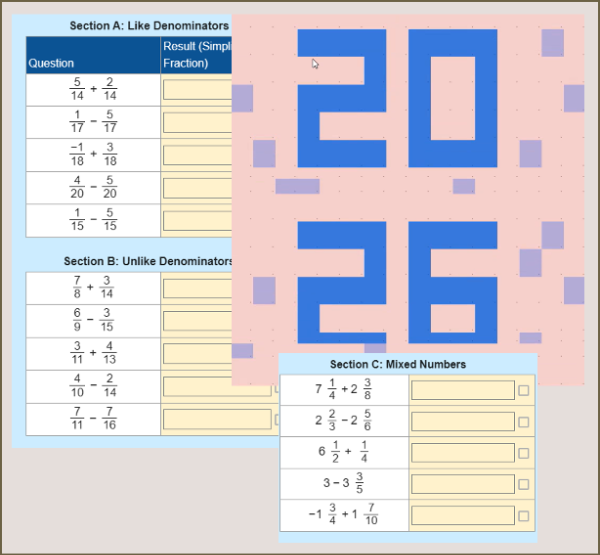
Engage students in adding and subtracting fractions and mixed numbers with this interactive Grade 7–8 math worksheet. Students work with like and unlike denominators, including positive and negative values, and enter answers as simplified fractions only. Built-in randomization gives each student unique problems, and a fun pixel-art reveal boosts motivation.

Skill PracticeGrade 8· 20 min

Converting Fractions and Decimals - Interactive Pixel

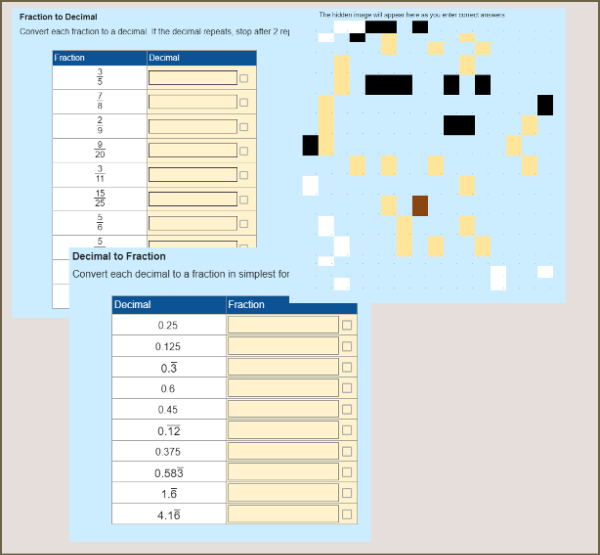
Practice converting fractions and decimals with this interactive 8th-grade math worksheet. Students convert fractions to decimals and decimals to fractions, identify terminating and repeating decimals, and receive instant feedback. Includes randomization so each student gets unique values, plus a fun pixel-art reveal to boost engagement.

Skill PracticeGrade 8· 20 min

Rational or Irrational?

Challenge your students to classify decimals as rational or irrational! In this interactive worksheet, students examine non-terminating decimals—some repeating, some not—to decide which can be written as fractions. A hands-on way to strengthen understanding of decimal patterns and rationality.

Mini LabGrade 8· 10 min

Back to School: Fundraiser Goal Tracker

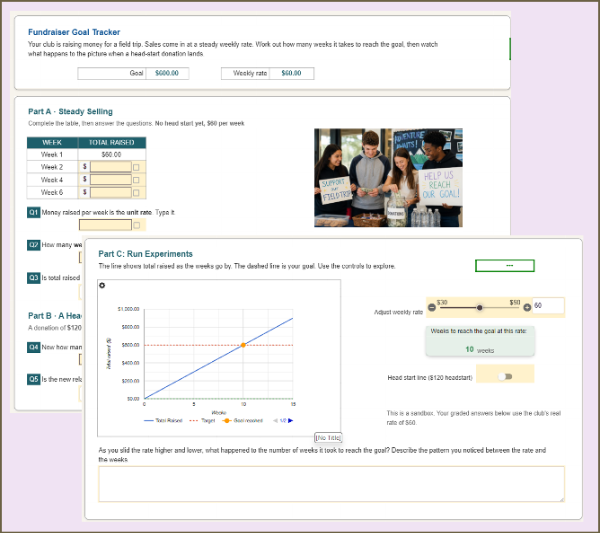
Interactive proportional relationships simulation. Students track a club fundraiser at a steady weekly rate, predict weeks to the goal, then see how a head-start donation breaks proportionality. Live graph, auto-graded, randomized values. Grades 7-8 review. CCSS 7.RP.A.2.

CompetitionGrades 7, 8· 120 min

Car Manufacturing: Number Challenge

Students apply ratios, percentages, and budgeting skills in this fast-paced, team-based math competition. As co-founders of a vehicle startup, they calculate production costs, analyze sales offers, and race through 10 business cycles—boosting engagement through real-world math, strategy, and collaboration.