Scaling the City - Coordinate Geometry

Students use a city map on a coordinate grid to calculate real-world distances between locations, convert grid units to meters, and determine travel times—bringing coordinate geometry to life through practical navigation tasks.

City Map Scale Adventure is a real-world, interactive math worksheet designed for 6th and 7th grade students to apply coordinate geometry concepts in a meaningful context. Students work with a coordinate-based city map, using horizontal and vertical distances to calculate how far one location is from another. With a defined scale (e.g., 1 unit = 100 meters), they convert grid units into real-world distances and determine total travel time for different city routes.


This activity reinforces scale drawing interpretation, coordinate reasoning, and unit conversion, all aligned to Common Core standard 7.G.A.1. It's perfect for reinforcing geometry with real-world applications such as city planning, navigation, and map reading. Teachers can enable randomization so that each student receives unique coordinates and paths.


🔍 Key Features:

  • Coordinate grid-based city layout
  • Real-world scale application (e.g., 1 unit = 100 meters)
  • Calculates distance and travel time
  • Auto-validates correct answers
  • Randomized for each student (if enabled)
  • Standards-aligned: CCSS 7.G.A.1


Learning Objective

Students will apply their understanding of scale drawings and the coordinate system to calculate real-world distances between locations using horizontal and vertical measurements. They will interpret a coordinate-based city map, compute distances in units, convert them to actual measurements using a given scale, and determine travel time—demonstrating how geometry supports real-life planning and navigation.

Randomization Available

If randomization is enabled, the coordinates of each city location (house, school, park, etc.) will be different for every student. As a result, the distances between locations and total travel times will vary. This helps prevent copying and ensures each student solves a unique version of the activity.

💡 Tip: When assigning this activity to your classroom, you can optionally enable randomization to give each student a unique version of the problems. When you re-assign the same worksheet, each student will get a new set of questions, helping them master the content through repeated practice.

Scaling the City - Coordinate Geometry preview
Preview
Grade level
6, 7
Type
Mini Lab (real-world worksheet)
Duration
15 minutes
Auto-graded
Yes
Randomized per student
Yes
Common Core standards
6.NS.C.87.G.A.1
Topics
GeometryRatioNumber Line ReasoningScale Drawings
Tags
Real WorldEveryday MathPractice WorksheetTabular FormatEscape RoomDrill & PracticeApplicationGraph-BasedBell RingerHomeworkExit Ticket

Related grades 6, 7 activities

More interactive, auto-graded activities on the same standards and topics.

Skill PracticeGrades 6, 7· 20 min

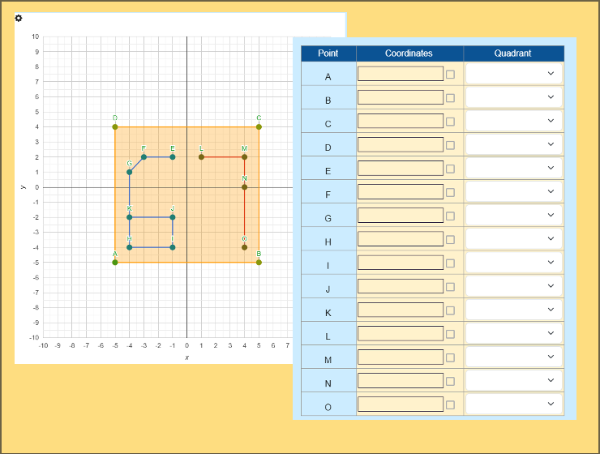
4-Quadrant Coordinate Mystery: Number 67

Practice coordinate graphing in all four quadrants with this fun mystery-picture activity! Students identify coordinates from labeled points, enter them into a table, and watch the graph reveal a hidden number. Reinforces quadrant recognition, positive/negative coordinates, and axis placement—perfect for 6th grade.

Skill PracticeGrades 6, 7, 8· 10 min

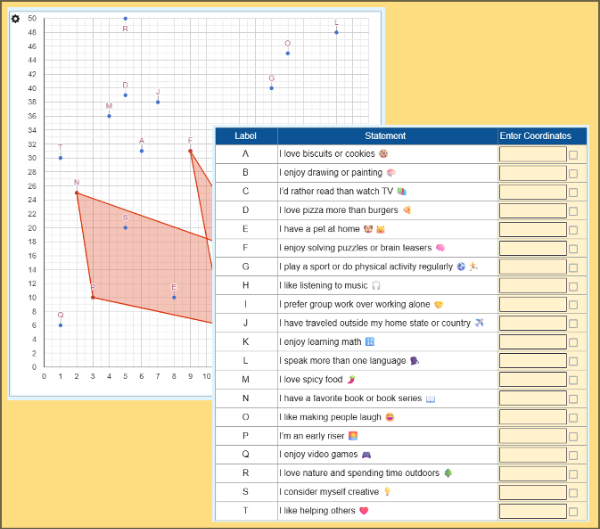
Back to School: My Coordinate Story

Students read 20 fun statements and choose the ones that describe them. For each, they find the matching point on a graph and enter its coordinates. As they do, a unique shape forms on the coordinate plane. This back-to-school activity falls under Geometry and helps students practice plotting points while expressing themselves.

LabGrades 7, 8· 180 min

Precision Construction: A Geometry Project

Step into the role of a construction engineer! In this hands-on geometry lab, students estimate costs for concrete, flooring, painting, HVAC, roofing, landscaping, and more using real-world floor plans. Covers area, volume, surface area, and unit conversions. Auto-graded and perfect for 7th grade classrooms.

Mini LabGrade 7· 15 min

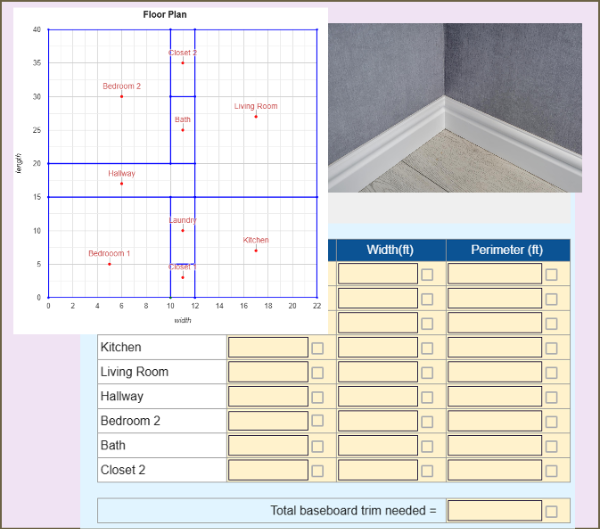
Baseboard Trim Estimation: Perimeter

Students use a floor plan on a coordinate grid to measure room dimensions, calculate perimeter, and estimate the total length and cost of baseboard trim needed for an apartment renovation. A hands-on geometry application!

Mini LabGrade 7· 15 min

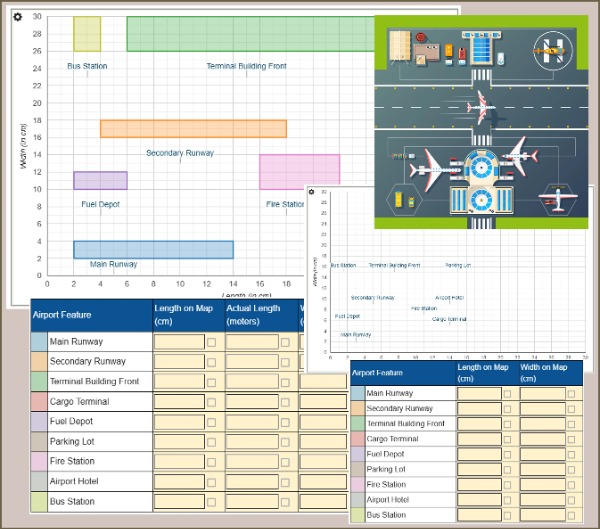
Scale Drawings: Convert and Rescale Airport Layout

In this interactive geometry activity, students measure features on a scale map, convert to real-world dimensions, then rescale the layout for a presentation. Visual feedback confirms correct answers instantly. A hands-on way to apply proportional reasoning and scaling!

Mini LabGrades 6, 7· 10 min

Tiling Estimation for Given Floor Plan

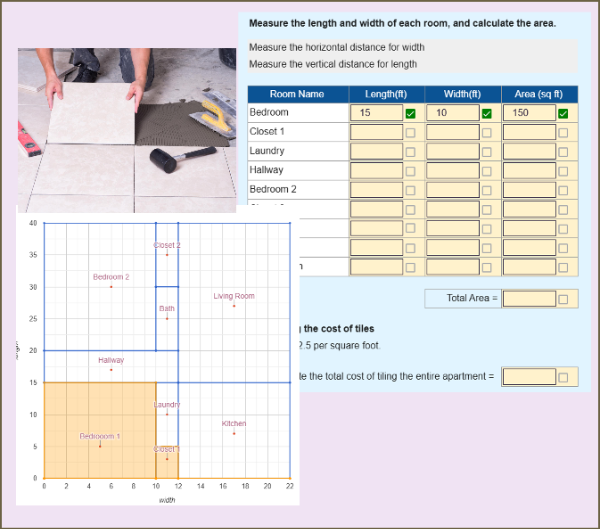
Students measure room dimensions from a coordinate grid-based floor plan, calculate area, and determine the total cost of tiling the apartment. A practical geometry task that connects math to real-world construction!