SLICE IT: Cross-Sections of Solids

Interactive cross-sections activity for 7.G.A.3. Students slice rectangular prisms and square pyramids, name each 2D cross-section, and compute its dimensions from the solid's measurements. A move-the-plane slider lets them explore before committing, with answers revealed only when correct. Includes curved-solid extensions. Self-checking and no-prep.

Slice It: Cross-Sections of Solids — Interactive 7.G.A.3 Activity


Help your students master cross-sections with this hands-on, self-checking digital activity built for Common Core standard 7.G.A.3. Instead of guessing from a flat textbook picture, students slide a cutting plane through 3D solids, name the two-dimensional shape that results, and calculate its dimensions from the solid's given measurements. The cross-section reveals only when their shape and dimensions are both correct, so students get immediate feedback and stay engaged.


This activity moves students beyond simply naming shapes. They reason about why a slice produces a given cross-section and how its size relates to the original solid, connecting cross-sections to the proportional and similarity reasoning at the heart of Grade 7.


What's included:

  • Three rectangular prism problems covering horizontal and vertical slices, showing how the same box yields different rectangles depending on orientation
  • Three square pyramid problems including horizontal slices (similar, scaled-down shapes), a vertical slice through the apex (triangle), and a slice beside the apex (trapezoid)
  • Three curved-solid extension problems (cylinder, cone, sphere) to stretch curious students beyond the standard
  • Interactive move-the-plane slider so students explore multiple slice positions before committing
  • Self-checking answer reveal that shows the true cross-section only when the response is correct
  • No-prep and paperless — ready to assign as-is


Skills students practice:

  • Identifying cross-sections of right rectangular prisms and pyramids
  • Understanding how slice orientation changes the resulting shape
  • Computing cross-section dimensions using congruence and similarity
  • Visualizing 3D-to-2D relationships and spatial reasoning


Perfect for: in-class practice, math centers, homework, sub plans, early finishers, or test review on cross-sections and geometry.


Standard alignment: CCSS 7.G.A.3 — Describe the two-dimensional figures that result from slicing three-dimensional figures.


Grade level: 7th grade math (also useful as review or enrichment for 8th grade geometry)

Learning Objective

Students describe the two-dimensional cross-section that results when a plane slices a right rectangular prism or right rectangular pyramid (7.G.A.3). For each slice they name the shape and compute its dimensions from the solid's measurements, reasoning that a slice parallel to a face is congruent to that face (prism), and that a slice parallel to the base is a similar, scaled-down copy (pyramid). By the end, students can predict how a cross-section's shape and size change as the slicing plane's position and orientation change.

SLICE IT: Cross-Sections of Solids preview
Preview
Grade level
7
Type
Skill Practice
Duration
15 minutes
Auto-graded
Yes
Common Core standards
7.G.A.3
Topics
GeometryVolume of Cylinders, Cones, and Spheres
Tags
Practice Worksheet

Related grade 7 activities

More interactive, auto-graded activities on the same standards and topics.

Mini LabGrade 7· 20 min

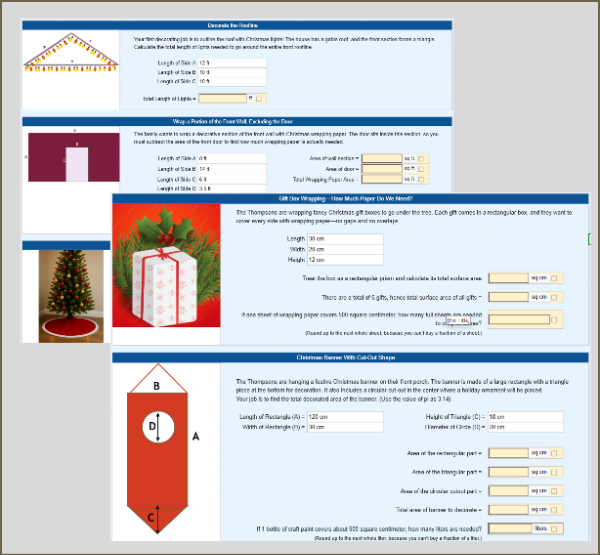
A Geometric Christmas: Home Decoration

Celebrate the holidays with this real-world geometry challenge! Students calculate perimeter, area, and surface area as they decorate a roofline with lights, wrap a wall, design a tree skirt, wrap gift boxes, and paint a festive banner. Perfect for practicing 7th-grade geometry with a fun Christmas theme!

Mini LabGrade 7· 15 min

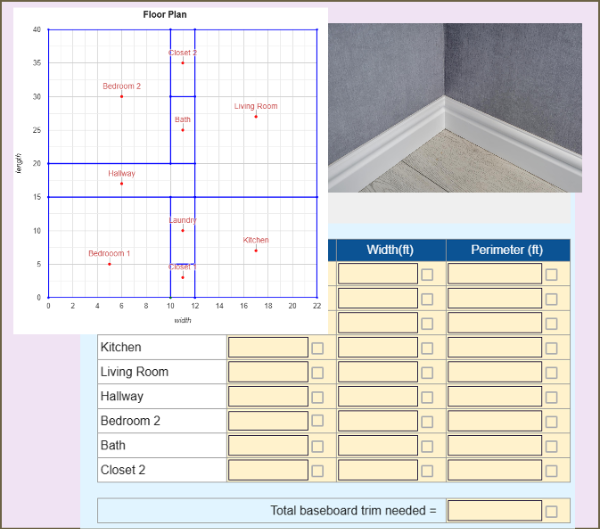
Baseboard Trim Estimation: Perimeter

Students use a floor plan on a coordinate grid to measure room dimensions, calculate perimeter, and estimate the total length and cost of baseboard trim needed for an apartment renovation. A hands-on geometry application!

Mini LabGrade 7· 20 min

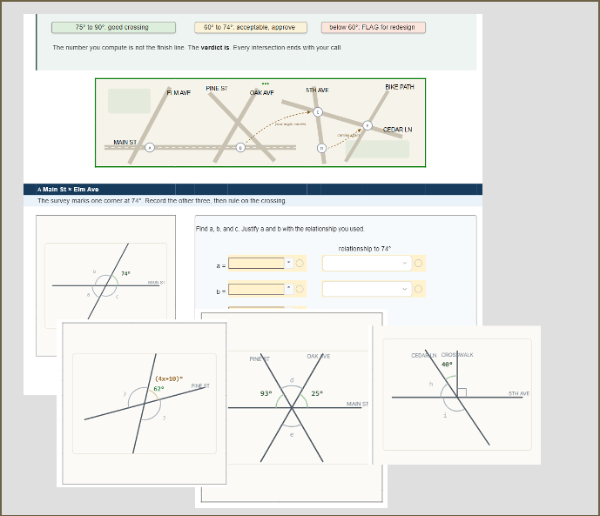
City Intersections: Real-World Angle Relationships

City Intersections is an interactive, auto-graded worksheet for 7th grade geometry (7.G.B.5). Students act as city surveyors, using vertical, adjacent, complementary, and supplementary angles to check whether street crossings meet the road-safety code. They compute the angles, then deliver a verdict: approve or flag. Every student gets a randomized version, so no two worksheets are the same.

Mini LabGrade 7· 20 min

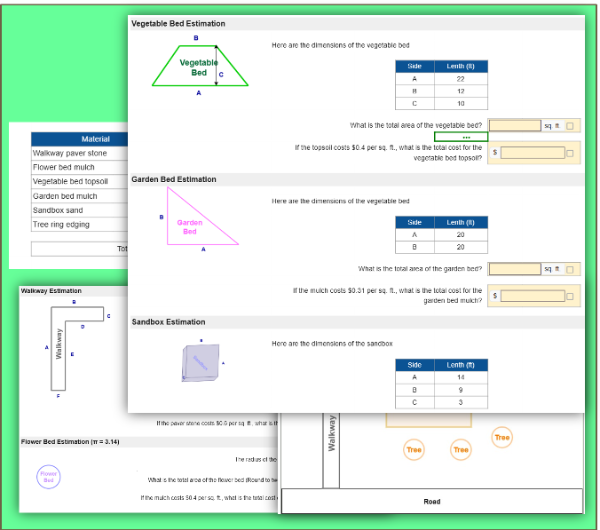
Geometry - Landscaping Cost Estimation

In this real-world geometry activity, students calculate area, volume, and circumference of different landscape features to estimate the total cost of a backyard project. Shapes include rectangles, triangles, trapezoids, circles, and more. A perfect blend of math and practical application!

LabGrades 7, 8· 180 min

Precision Construction: A Geometry Project

Step into the role of a construction engineer! In this hands-on geometry lab, students estimate costs for concrete, flooring, painting, HVAC, roofing, landscaping, and more using real-world floor plans. Covers area, volume, surface area, and unit conversions. Auto-graded and perfect for 7th grade classrooms.

Mini LabGrade 7· 15 min

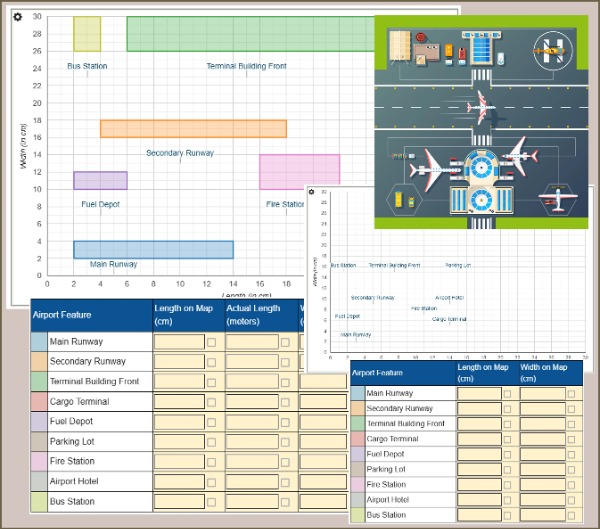
Scale Drawings: Convert and Rescale Airport Layout

In this interactive geometry activity, students measure features on a scale map, convert to real-world dimensions, then rescale the layout for a presentation. Visual feedback confirms correct answers instantly. A hands-on way to apply proportional reasoning and scaling!