Mini LabGrades 6, 7· 20 min
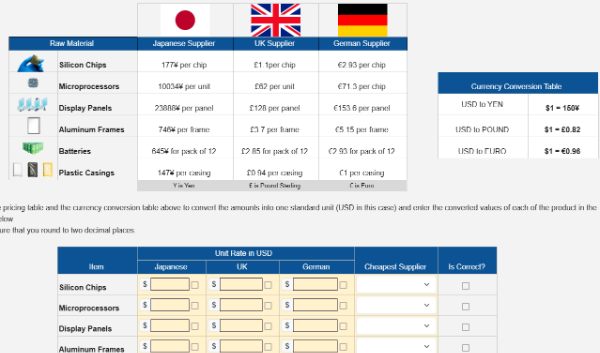
Global Manufacturing - Raw Material Cost Comparison
Students act as the CEO of a company, to find the cheapest country to purchase the raw materials, students will do unit conversion between different currencies.

Interactive Grade 6 worksheet with 12 unit rate problems across three difficulty tiers — whole-number, one-decimal, and two-decimal rates — using real-world contexts like groceries and travel. Auto-graded with randomization.
This interactive Grade 6 worksheet gives students structured, scaffolded practice computing unit rates from real-world ratio pairs. Organized into three progressive difficulty tiers, students work through 12 problems drawn from everyday contexts — food shopping, travel, technology, and more — building fluency and confidence as the numbers get more challenging.
Tier 1 (Problems 1–4) uses whole-number ratios with clean whole-number unit rates. Tier 2 (Problems 5–8) introduces quantities that yield one-decimal-place rates. Tier 3 (Problems 9–12) uses more complex quantities producing two-decimal-place rates — all constructed backward to guarantee exact, clean answers.
Students find the unit rate for each problem (e.g., dollars per pound, miles per hour) and enter their answer in the input field. Conditional formatting highlights correct answers in green and incorrect answers in red, giving students instant visual feedback.
This worksheet is engaging because the tiered structure gives every student an accessible starting point while still providing a meaningful challenge — and because every number comes from a realistic, relatable everyday scenario rather than abstract pairs.
Students should be comfortable with basic division of whole numbers and an introductory understanding of what a ratio represents before attempting this worksheet.
Assign this worksheet after introducing unit rates with 6.RP.A.2 and before moving into ratio tables and proportional reasoning with 6.RP.A.3. It works well as a skills-consolidation drill or a formative assessment.
In this worksheet, students will compute unit rates from real-world ratio pairs across 12 problems organized in three tiers of increasing difficulty. Students will identify and divide Quantity A by Quantity B in contexts such as price per pound, miles per hour, and data speed per second to find whole-number, one-decimal, and two-decimal unit rates. Students will apply the concept of a unit rate (6.RP.A.2) and unit rate reasoning in practical contexts (6.RP.A.3b) while practicing fluent decimal division (6.NS.B.3). By the end of the worksheet, students will demonstrate the ability to accurately extract and compute unit rates from a variety of everyday scenarios at increasing levels of precision.
This worksheet supports randomization — each student receives a unique set of Quantity A and Quantity B values across all 12 problems, while the difficulty tier structure and real-world contexts remain the same for everyone. Would you like to enable randomization for this assignment?
💡 Tip: When assigning this activity to your classroom, you can optionally enable randomization to give each student a unique version of the problems. When you re-assign the same worksheet, each student will get a new set of questions, helping them master the content through repeated practice.
Fluently add, subtract, multiply, and divide multi-digit decimals using the standard algorithm for each operation.
All 6.NS.B.3 activities →Understand the concept of a unit rate a/b associated with a ratio a:b with b ≠ 0, and use rate language in the context of a ratio relationship. *For example, "This recipe has a ratio of 3 cups of flour to 4 cups of sugar, so there is 3/4 cup of flour for each cup of sugar." "We paid $75 for 15 hamburgers, which is a rate of $5 per hamburger."*
All 6.RP.A.2 activities →Solve unit rate problems including those involving unit pricing and constant speed. *For example, if it took 7 hours to mow 4 lawns, then at that rate, how many lawns could be mowed in 35 hours? At what rate were lawns being mowed?*
All 6.RP.A.3b activities →More interactive, auto-graded activities on the same standards and topics.
Students act as the CEO of a company, to find the cheapest country to purchase the raw materials, students will do unit conversion between different currencies.
Students will find the unit rate of seven products in three stores - Farm Fresh, Market Bargain, and Quality stores. They will compare the unit prices and find the cheapest store to purchase each ingredient.
Students run a smoothie bar for a day, and every decision is a fraction problem with a real purpose. Six connected, auto-graded interactive worksheets covering multiply, divide, equivalent fractions, compare, and order. Carry-forward story keeps math meaningful. Common Core aligned. Run it in a day or across two weeks.
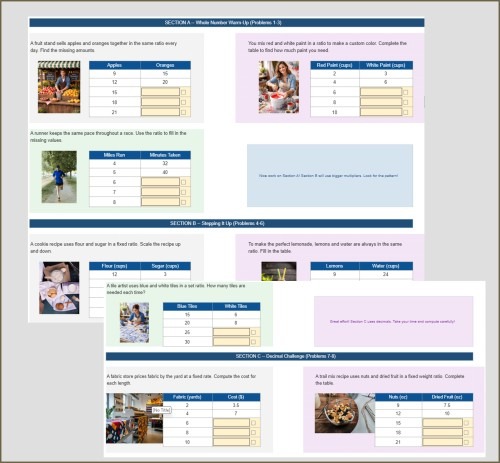
Interactive Grade 6 worksheet with 8 ratio table problems across three difficulty tiers — whole numbers, larger multipliers, and decimals. Students find missing values in two-column ratio tables using real-world contexts. Auto-graded with optional randomization.
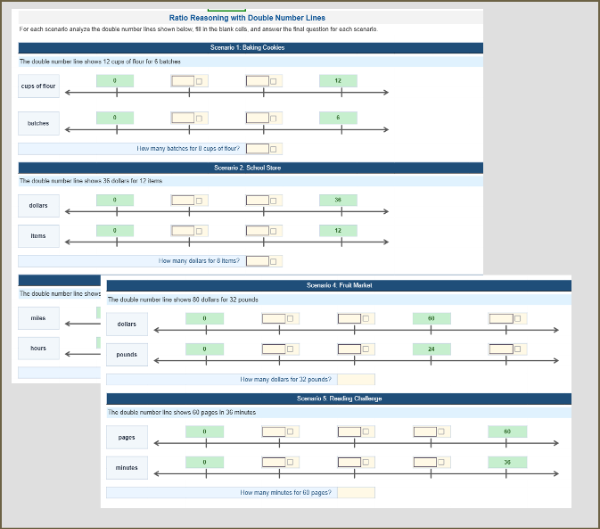
Interactive Grade 6 worksheet with 5 ratio scenarios where students complete double number lines and solve for unknown values across real-world contexts. Auto-graded with optional randomization.
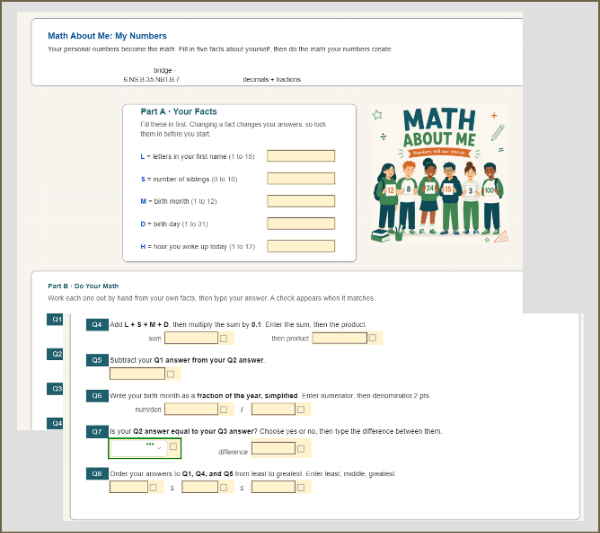
Interactive back-to-school math activity. Students turn five personal facts into decimal and fraction practice, then get instant auto-graded feedback. Every worksheet computes different answers because the inputs are the student. Grades 6-8 review. CCSS 6.NS.B.3, 6.NS.B.4.