Volume Estimation for HVAC Planning

Students use a floor plan to calculate the volume of rooms by measuring dimensions and applying the formula for volume of rectangular prisms. They then estimate the HVAC cost, connecting geometry to real-world heating and cooling applications.

Air It Out! is an engaging 6th–7th grade geometry worksheet where students step into the role of an HVAC planner. Using a floor plan plotted on a coordinate grid, students measure the length and width of rooms and apply the volume formula for rectangular prisms (V = length × width × height) to calculate the air volume for each room.


With a standard ceiling height provided, students determine the total volume of the apartment and estimate the cost of HVAC installation using a simplified cost per cubic foot. As they enter correct answers, immediate feedback helps reinforce understanding.


This worksheet helps students grasp how geometry, especially volume, is applied in real-world planning, budgeting, and design—from heating systems to storage and construction.


🔍 Key Features:

  • Realistic floor plan on a coordinate grid
  • Hands-on application of volume calculation
  • Simplified cost estimation for HVAC installation
  • Visual feedback for student input
  • Aligned with 6.G.A.2 and 7.G.B.6 Common Core standards
  • Connects geometry to real-world STEM careers


Perfect for classrooms seeking meaningful, applied math activities that show students how geometry is used in life beyond the classroom.

Learning Objective

Students will apply the volume formula for right rectangular prisms (V = length × width × height) to calculate the air volume of rooms in a floor plan. They will use these calculations to estimate the total volume of air in an apartment and determine the cost of HVAC installation based on a simplified rate, demonstrating how volume is used in real-world planning and budgeting scenarios.

Volume Estimation for HVAC Planning preview
Preview
Grade level
6, 7
Type
Mini Lab (real-world worksheet)
Duration
15 minutes
Auto-graded
Yes
Common Core standards
6.G.A.27.G.B.6
Topics
GeometryScale DrawingsArea and CircumferenceVolume and Surface Area
Tags
Real WorldCareer MathTabular FormatStory-BasedApplicationGraph-BasedBell RingerHomeworkExit Ticket

Related grades 6, 7 activities

More interactive, auto-graded activities on the same standards and topics.

Skill PracticeGrade 7· 20 min

Real-World Problems Involving Volume

Students will calculate the volume of various objects, such as a shipping box or fish tank, using given dimensions. Each student will receive a unique set of dimensions, promoting individualized practice and reinforcing their understanding of volume calculations in real-world scenarios.

Skill PracticeGrade 7· 15 min

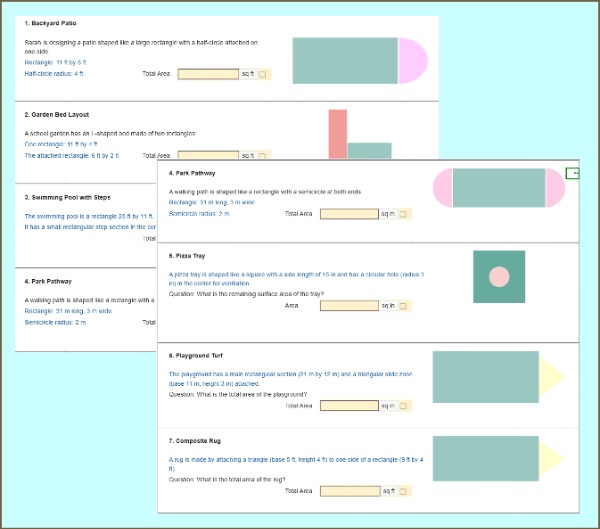
Area of Composite Figures – Real-World Word Problems

Calculate the area of composite figures using real-world scenarios like patios, pools, and pathways. Students break down each shape into rectangles, triangles, or circles, apply formulas, and find total area by adding or subtracting. A fun, practical way to apply geometry skills and deepen understanding of area concepts.

LabGrade 6· 60 min

Crate Build: Area, Volume, and Surface Area

Pack & Ship Co. is a hands-on Grade 6 geometry capstone. Students become builders filling a real client's crate order across five connected worksheets, applying coordinate geometry, composite area, volume, and surface area. Every measurement carries forward to a final bill, so careless work has real consequences. Covers all four 6.G standards in one engaging, auto-graded job.

Skill PracticeGrade 6· 15 min

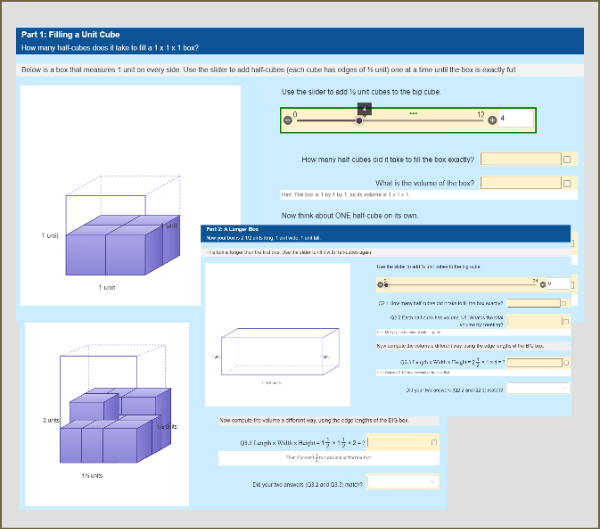
Discovering Volume with Half-Cubes

Interactive 6.G.A.2 worksheet where students fill three rectangular prisms with half-unit cubes using a slider, then verify volume two ways: counting (cubes × 1/8) and formula (L × W × H). Students discover why V = L × W × H works for fractional edge lengths through hands-on packing of 1×1×1, 2½×1×1, and 1½×1½×2 boxes. Auto-graded. Grade 6.

LabGrades 7, 8· 180 min

Precision Construction: A Geometry Project

Step into the role of a construction engineer! In this hands-on geometry lab, students estimate costs for concrete, flooring, painting, HVAC, roofing, landscaping, and more using real-world floor plans. Covers area, volume, surface area, and unit conversions. Auto-graded and perfect for 7th grade classrooms.