Angles Formed by Parallel Lines and a Transversal

Students join the Riverton road crew and use angle relationships to find all eight corners where a diagonal avenue crosses two parallel streets. They name the rule for each angle (corresponding, alternate interior, same-side interior, vertical, linear pair), enter the measure, and watch the map fill in. Two crossings add solving for x. Auto-graded, randomized, 8.G.A.5.

Parallel Lines and Transversals Explorer: Grade 8 Angle Relationships Practice (8.G.A.5)


Give your Grade 8 students a reason to care about angle relationships. In this interactive, auto-graded geometry worksheet, students join the Riverton road crew. The town is pouring new curb ramps at every street corner, and each ramp has to fit its corner’s angle. The crew measured just one angle at each crossing. Students use the rules for parallel lines cut by a transversal to find the other seven.


What students do


Across four crossings, students find all 32 angles (labeled A to H) formed where a diagonal avenue, the transversal, crosses two parallel streets. For every angle, they:


  • choose the angle relationship that justifies it: corresponding angles, alternate interior angles, alternate exterior angles, same-side interior (co-interior) angles, vertical angles, or a linear pair;
  • enter the angle measure.


Each correct angle is painted onto a live street map, so students see their progress build. A built-in check adds up each pair of same-side interior angles. If a pair does not make 180°, students know right away which two answers to recheck.


Built-in algebra connection


In crossings 3 and 4, the crew only wrote down expressions such as (2x + 10)° and (3x − 5)°. Students first identify how the two angles are related. Then they write and solve a linear equation for x and use it to find every angle. This connects angle facts to multi-step equations, a core Grade 8 skill.


Why teachers use it


  • Standards-aligned: CCSS 8.G.A.5, about angles created when parallel lines are cut by a transversal.
  • Auto-graded with instant feedback: every relationship and measure is checked live, and scores sync to your teacher console.
  • Randomized: each student gets different angle values and equations, so answers can’t be copied.
  • Scaffolded: hints on the first crossing only, plus an Angle Rules box students can look back at.
  • Real-world context: a short story intro shows students why angle relationships matter to road engineers, carpenters and builders.
  • Ready to assign: about 20 minutes, works for classwork, homework, intervention or review.


Great for


Grade 8 math, pre-algebra and middle school geometry units on parallel lines and transversals, angle relationships, congruent and supplementary angles, and solving equations with angle measures.

Learning Objective

Students find all eight angles formed where a transversal crosses two parallel streets, choosing the angle relationship that justifies each measure and checking their work with co-interior sums. In the last two crossings they write and solve a linear equation from angle expressions. This builds fluency with corresponding, alternate interior and co-interior angles and with using these facts to find unknown angles (8.G.A.5).

Randomization Available

The worksheet support randomization. If you enable it every students will receive different angles to work. This prevent copying of answers.

💡 Tip: When assigning this activity to your classroom, you can optionally enable randomization to give each student a unique version of the problems. When you re-assign the same worksheet, each student will get a new set of questions, helping them master the content through repeated practice.

Angles Formed by Parallel Lines and a Transversal preview
Preview
Grade level
8
Type
Mini Lab (real-world worksheet)
Duration
20 minutes
Auto-graded
Yes
Randomized per student
Yes
Common Core standards
8.G.A.5
Topics
GeometryAngle Relationships
Tags
Real WorldPractice WorksheetTabular Format

Related grade 8 activities

More interactive, auto-graded activities on the same standards and topics.

Skill PracticeGrade 8· 20 min

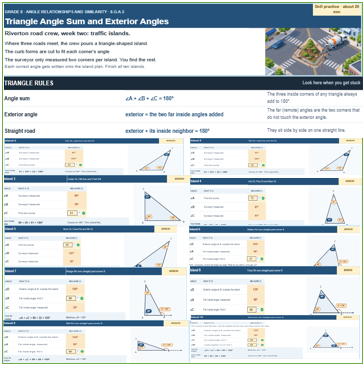
Triangle Angle Sum and Exterior Angles

Students join the Riverton road crew to find the missing corners of ten triangular traffic islands. They use the triangle angle sum (180°) and the exterior angle theorem, while a running total catches slips like 185° before they move on. Correct angles label the island drawing. Auto-graded, randomized, Grade 8, 8.G.A.5.

Skill PracticeGrades 6, 7, 8· 10 min

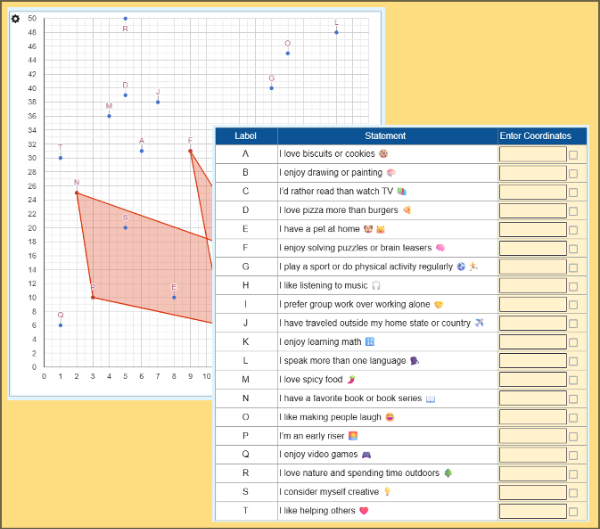
Back to School: My Coordinate Story

Students read 20 fun statements and choose the ones that describe them. For each, they find the matching point on a graph and enter its coordinates. As they do, a unique shape forms on the coordinate plane. This back-to-school activity falls under Geometry and helps students practice plotting points while expressing themselves.

Skill PracticeGrade 8· 20 min

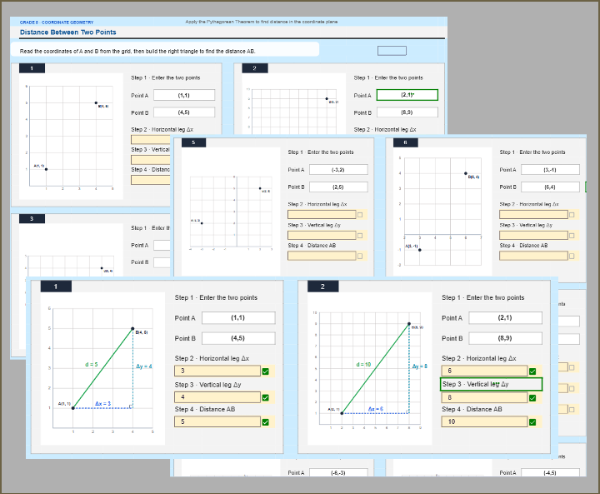
Distance Between Points Using Pythagorean Theorem

Turn the distance formula into something students can see. On an interactive coordinate grid, students read two points, build the horizontal and vertical legs, and watch a right triangle form before applying the Pythagorean Theorem to find the distance. Ten auto-graded problems progress from clean whole-number triangles to mixed-quadrant challenges. Aligned to 8.G.B.8.

LabGrades 7, 8· 180 min

Precision Construction: A Geometry Project

Step into the role of a construction engineer! In this hands-on geometry lab, students estimate costs for concrete, flooring, painting, HVAC, roofing, landscaping, and more using real-world floor plans. Covers area, volume, surface area, and unit conversions. Auto-graded and perfect for 7th grade classrooms.

LabGrade 8· 120 min

The Navigator's Cipher: Pythagorean Problem

-Turn the Pythagorean theorem into a treasure hunt. In this story-driven Grade 8 lab, students decode a navigator's secret map, measure a hidden island, repair a ship, and triangulate buried treasure. Five auto-graded activities, ~4-5 class periods, covering 8.G.A.3, 8.G.B.6, 8.G.B.7, and 8.G.B.8. Run it right after introducing the theorem.

Skill PracticeGrade 8· 30 min

Turning Shapes: Exploring Rotations on the Coordinate Plane

Rotate shapes on the coordinate plane to discover how orientation changes while size and shape stay the same. In this interactive worksheet, students apply rotation rules for 90°, 180°, and 270° turns about the origin, record new coordinates, and visualize that rotations create congruent figures.