Triangle Angle Sum and Exterior Angles: Grade 8 Practice Worksheet (8.G.A.5)
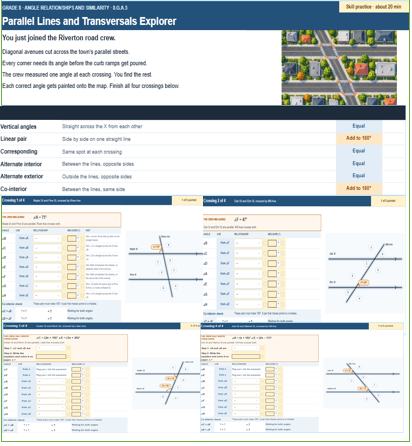
Help your Grade 8 students master the triangle angle sum theorem and the exterior angle theorem with a real-world, auto-graded geometry worksheet. Students join the Riverton road crew as it builds triangle-shaped traffic islands where three roads meet. The surveyor measured only some of each island’s corners, and students use angle facts to find the rest so the curb forms can be cut to fit.
What students do
- Part 1: Interior angles of a triangle. On five islands, students get two interior angles and find the third using ∠A + ∠B + ∠C = 180°. The set covers acute, obtuse and right triangles, and the missing angle moves from corner to corner, so students reason rather than follow a pattern.
- Part 2: Exterior angles of a triangle. On five more islands, a road runs straight past one corner, forming an exterior angle. Students use the exterior angle theorem (an exterior angle equals the sum of the two remote interior angles) to find a missing remote interior angle.
- The final challenge asks students to find two angles. They use a linear pair (exterior angle plus its adjacent interior angle equals 180°) for one and the angle sum for the other. This ties both facts together, building the informal argument behind the exterior angle theorem.
Built-in self-check
A running readout adds up the student’s own angles as they type. If they make an arithmetic slip, they see “That is 185°, not 180°” right away and fix it before moving on. In Part 2, the readout checks that the two remote interior angles really add up to the exterior angle. When an answer is correct, its value appears on the scale drawing of the island, so students see their progress build.
Why teachers use it
- Standards-aligned: CCSS 8.G.A.5, about angle sum and exterior angle facts for triangles.
- Auto-graded with instant feedback: every answer is checked live and scores sync to your teacher console.
- Randomized: each student gets different angle measures, so answers can’t be copied.
- Scaffolded: a hint on the first problem of each part, a rules box students can look back at, and an optional story intro.
- Real-world context: connects angle relationships to how road crews, builders and engineers work.
- Ready to assign: about 20 minutes, works for classwork, homework, intervention, test review or a sub plan.
Great for
Grade 8 math, pre-algebra and middle school geometry units on triangle angle sum, exterior angles, remote interior angles, supplementary angles and linear pairs, and finding missing angles in triangles.
Students find missing angles in ten triangular traffic islands, first by using the fact that a triangle’s interior angles sum to 180° and then by using the exterior angle theorem. A running self-check total shows any arithmetic slip, and the final island ties both facts together through a linear pair. This builds fluency with the triangle angle-sum and exterior-angle facts (8.G.A.5).
The worksheet support randomization. If you enable it every students will receive different angles to work. This prevent copying of answers.
💡 Tip: When assigning this activity to your classroom, you can optionally enable randomization to give each student a unique version of the problems. When you re-assign the same worksheet, each student will get a new set of questions, helping them master the content through repeated practice.