Mission to the Planets – Scientific Notation in Action

Blast off on a math mission through the solar system! In this interactive worksheet, students use scientific notation to calculate and compare planetary distances, travel times, and orbits. A fun, story-driven way to understand why scientists use exponential form to work with extremely large and small numbers.

Take your students on an exciting space adventure while mastering one of math’s most powerful tools — scientific notation. In this interactive worksheet, learners become part of a NASA exploration team navigating the solar system. They’ll calculate distances from the Sun, estimate travel times between planets, and compare orbital paths — all using scientific notation.


Through real-world, space-themed problems, students will discover why converting large or small numbers into exponential form makes math easier, faster, and more meaningful. Each calculation connects to an authentic scientific purpose, such as determining how far Mars is from Earth or how small a course correction needs to be during space travel.


Key Features:


  • 🚀 Story-based learning: Students act as space explorers completing real NASA-style tasks.
  • 🌍 Real-world math: Uses actual solar system data for authentic comparisons.
  • ✨ Interactive & auto-graded: Step-by-step practice with instant feedback.
  • 🔄 Supports randomization: Each student can get unique planet data for individualized learning.
  • 📘 Aligned to Common Core (8.EE.A.3 & 8.EE.A.4): Understanding and applying scientific notation.


By the end of the mission, students will not only master scientific notation but also appreciate how scientists use exponents to describe both the vastness of space and the tiniest measurements in science — making math feel truly out of this world! 🌌

Learning Objective

Students will apply the concept of scientific notation to represent, compare, and calculate with very large and very small numbers. Through real-world space exploration scenarios, they will learn how converting numbers into exponential form simplifies operations such as multiplication, division, subtraction, and comparison of magnitudes.

Mission to the Planets – Scientific Notation in Action preview
Preview
Grade level
8
Type
Mini Lab (real-world worksheet)
Duration
30 minutes
Auto-graded
Yes
Common Core standards
8.EE.A.38.EE.A.4
Topics
Expressions & EquationsScientific Notation
Tags
Real World

Related grade 8 activities

More interactive, auto-graded activities on the same standards and topics.

Mini LabGrade 8· 15 min

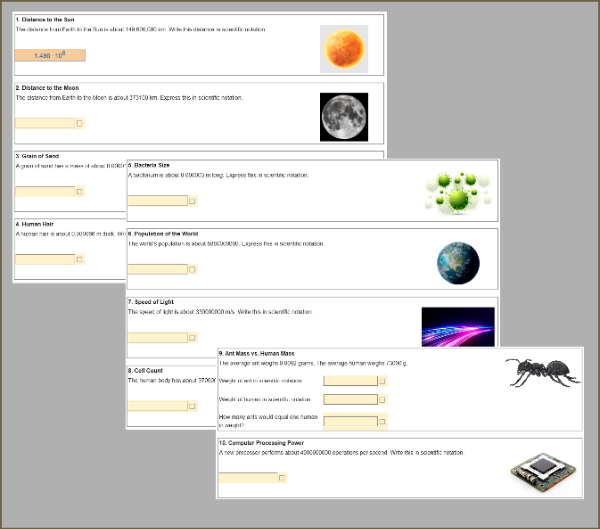
From Atoms to Galaxies: Scientific Notation in Action

Explore real-world measurements from the cosmos to the microscopic world while learning how to write large and small numbers in scientific notation. Students convert quantities into exponential form to make data easier to read, compare, and compute—building confidence with powers of ten and place value understanding.

Skill PracticeGrade 8· 20 min

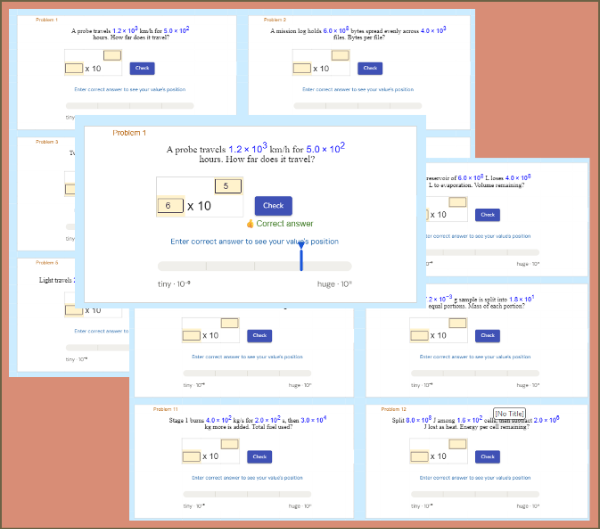
Space Data Lab: Operations with Scientific Notation

Interactive 8.EE.A.4 practice on operations with scientific notation. Students add, subtract, multiply, and divide in a space themed lab, with instant coefficient and exponent checking, a magnitude meter for number sense, and built in randomization so every student gets a unique version. Includes a student intro guide and answer key.

Mini LabGrade 8· 20 min

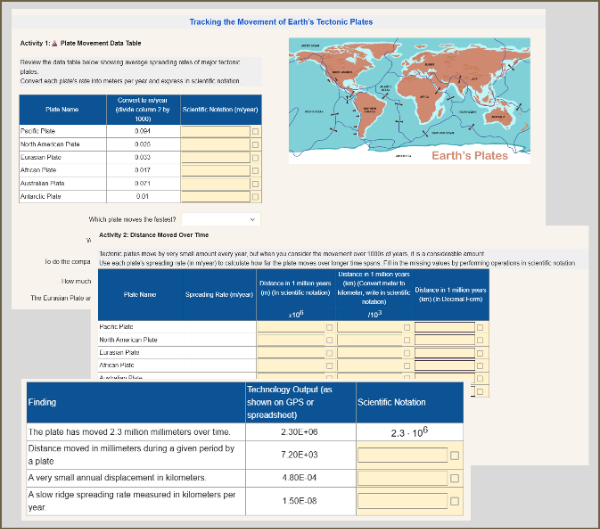
Tracking the Movement of Earth’s Tectonic Plates

Explore how scientists use scientific notation to measure the slow motion of Earth’s tectonic plates. Students convert plate movement data, calculate long-term distances, and interpret technology-generated outputs like E-notation — learning how exponential form makes real-world measurements easier to compare and understand.

Skill PracticeGrade 8· 20 min

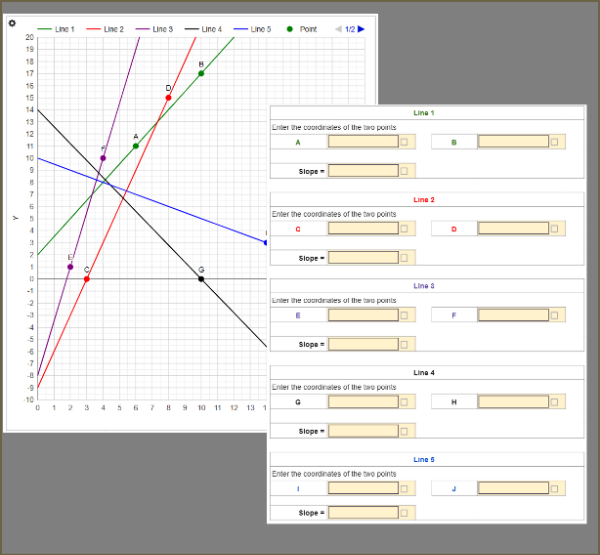
Calculating Slope from Two Points on a Graph

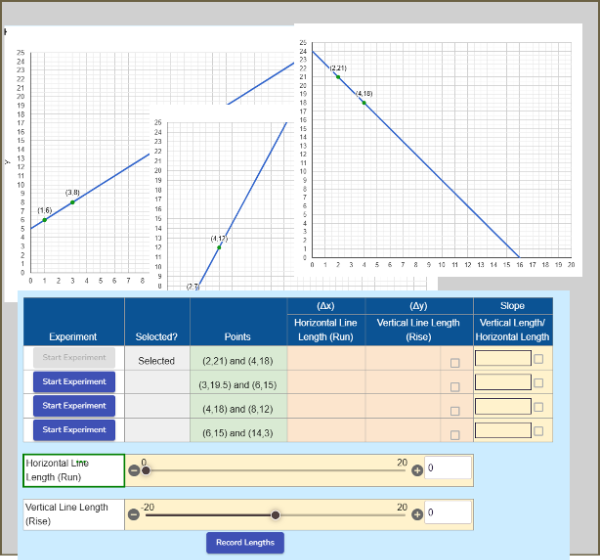
Help students master slope using real graphs. In this interactive worksheet, learners identify coordinates, apply the slope formula, and compare slopes of multiple lines. Supports randomization so each student receives different lines and points, making it perfect for 8th-grade slope practice.

LabGrade 8· 120 min

Food Truck Using Expressions & Functions

Curbside is an interactive Grade 8 math lab where students run a food truck and use real math to decide if it makes money. Across 7 auto-graded worksheets they build revenue, cost, break-even, and profit, compare competitors, and weigh a marketing curve. A hands-on way to make expressions, equations, and functions feel real. Common Core aligned (8.EE, 8.F).

Skill PracticeGrade 8· 20 min

Interactive Slope Investigation: Finding Δy and Δx

Explore slope through hands-on experiments! Students use sliders to measure rise (Δy) and run (Δx) between two points, calculate slope, and compare lines with positive and negative slopes. A visual, interactive way to understand steepness, direction, and why slope stays constant on a linear graph.