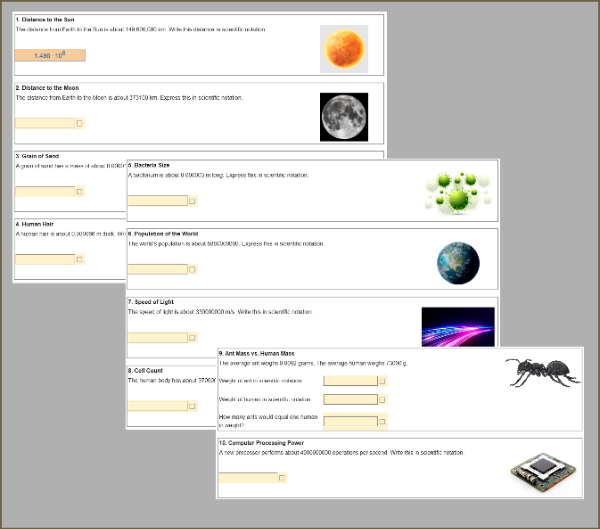
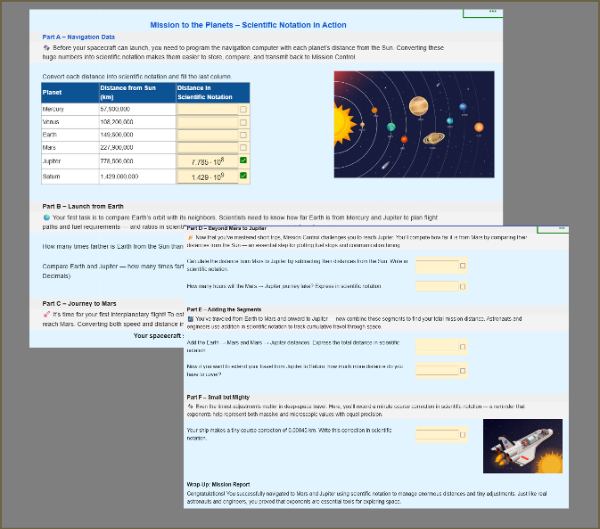
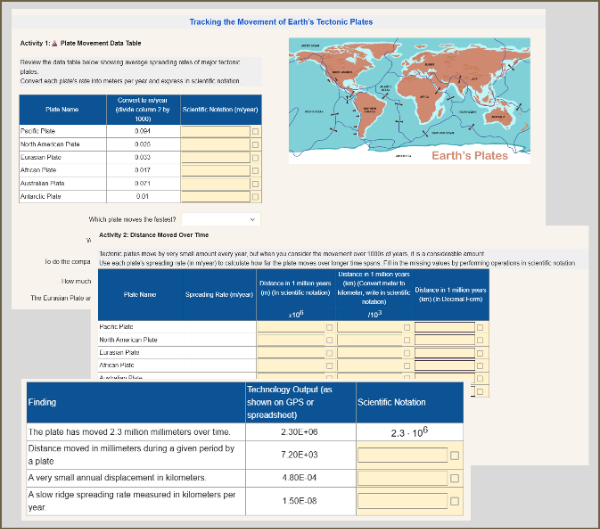
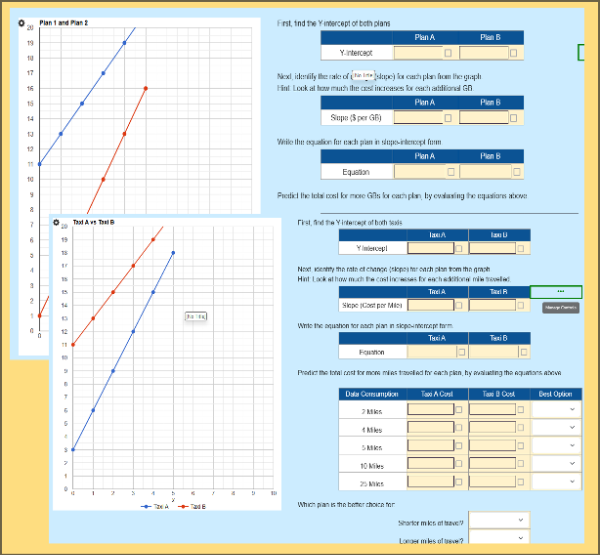
Help your 8th grade students master operations with scientific notation through Space Data Lab, an interactive, auto-graded practice worksheet aligned to Common Core standard 8.EE.A.4. Students add, subtract, multiply, and divide numbers written in scientific notation while working through realistic science contexts like astronomical distances, data storage, fuel calculations, and microscopic measurements.
What makes this resource different:\
- Separate coefficient and exponent checking gives students precise feedback on exactly which part needs another look, instead of a flat right-or-wrong mark.
- A magnitude meter shows students how large or small their answer is, building the number sense that 8.EE.A.4 is really about.
- Carefully sequenced problems start with multiplication and division, move through addition and subtraction (which require matching exponents first), and finish with mixed multi-step problems that stretch stronger students.
- Built-in randomization gives every student a different version, with fresh numbers drawn from clean-answer pools each time it loads.
That randomization makes the resource ideal for practice, retakes, test prep, and discouraging answer-sharing, and you can reassign it as many times as you like.
This activity includes:
- The interactive, self-checking worksheet with 12 problems
- A short student-facing introduction guide with the four operation rules and two worked examples
- A complete teacher answer key with worked solutions
Topics and skills covered:
- Scientific notation and powers of ten
- Exponent rules for multiplying and dividing
- Adding and subtracting in scientific notation (matching exponents first)
- Normalizing coefficients to proper form
- Working with very large and very small numbers
- Real-world STEM applications
Perfect for 8th grade math, pre-algebra, and Algebra 1 review.
Keywords: scientific notation, 8.EE.A.4, operations with scientific notation, 8th grade math, middle school math, exponents, powers of ten, interactive math worksheet, auto-graded, self-checking, STEM, pre-algebra.
Students will perform all four operations (addition, subtraction, multiplication, and division) on numbers written in scientific notation and express each result in proper scientific notation with a coefficient between 1 and 10, in alignment with Common Core standard 8.EE.A.4. Working through realistic science contexts such as astronomical distances, data storage, and microscopic measurements, students will apply the rules for combining powers of ten, recognize when a result must be renormalized (for example, when a sum like 11 x 10⁴ becomes 1.1 x 10⁵), and build intuition for the magnitude of very large and very small quantities.
This worksheet supports randomization. When it's on, every student gets different coefficients and numbers, while the operations, scenarios, and difficulty stay the same. This makes each copy unique, which helps prevent answer-sharing and makes the worksheet reusable for practice, retakes, and test prep.
💡 Tip: When assigning this activity to your classroom, you can optionally enable randomization to give each student a unique version of the problems. When you re-assign the same worksheet, each student will get a new set of questions, helping them master the content through repeated practice.