📊 Real-World Percent Change Worksheet for Middle School
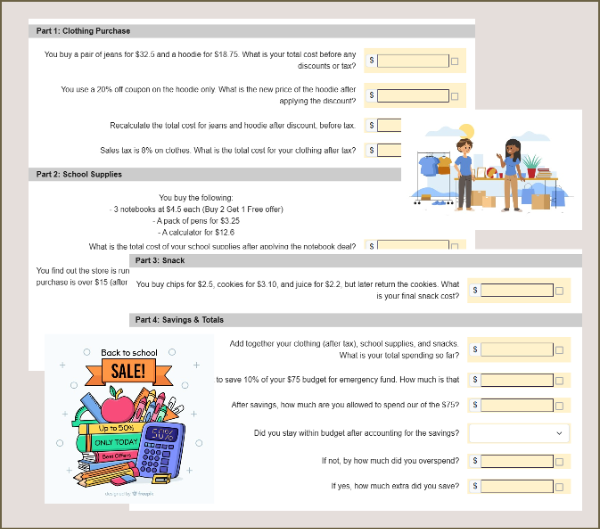
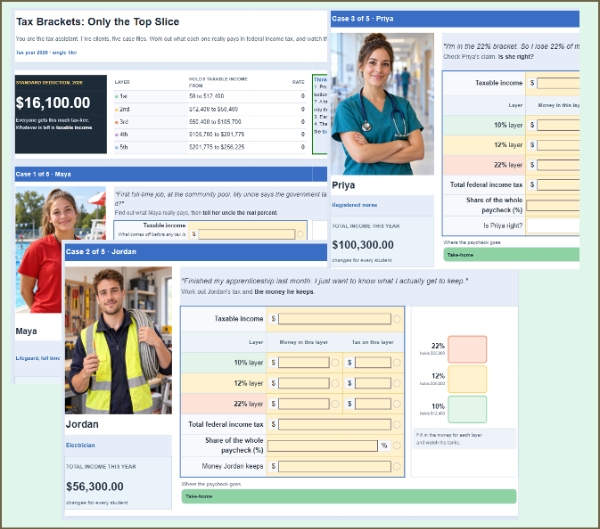
This engaging worksheet helps students master percent increase and percent decrease through realistic financial scenarios. Students follow a connected storyline and analyze how values change in stock investments, monthly budgets, and online store pricing. The activity emphasizes understanding percent change as a decision-making tool, not just a formula.
What students will do
- Determine whether values represent an increase or a decrease
- Calculate percent change using real-world data
- Compare changes across multiple scenarios
- Interpret results and explain financial decisions
Real-world scenarios included
- Stock investment gains and losses - Sam invested money in different stocks and wants to compare how much each investment increased or decreased over time.
- Monthly expense changes in a personal budget - Sam is tracking changes in his monthly expenses to see which costs went up or down and by how much.
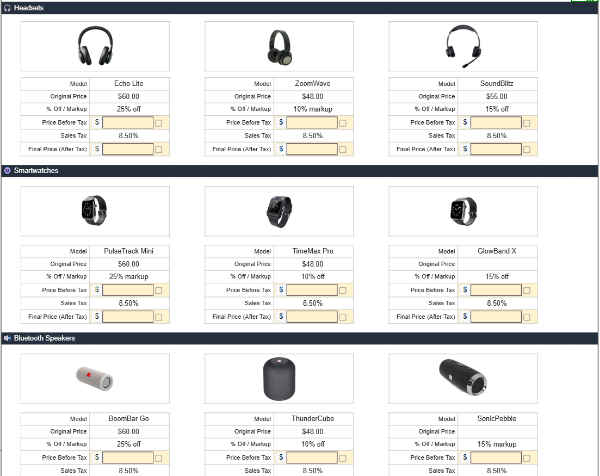
- Discounts and markups in an online store - Sam adjusts prices in his online store using discounts and markups and wants to understand how much each price change affects his business.
Why teachers love this worksheet
- Strong alignment to Grade 7 proportional reasoning standards
- Table-based structure supports clarity and consistency
- Built-in randomization gives each student different values
- Ideal for independent practice, classwork, or assessment
- Supports auto-grading and reduces copying
Standards alignment
- CCSS 7.RP.A.3
- Supports 7.EE.B.3 and mathematical reasoning practices
This worksheet is perfect for math classes, personal finance units, or applied problem-solving lessons that connect mathematics to real life.
Students will analyze real-world financial situations to identify percent increases and decreases and accurately calculate percent change using numerical data.
This worksheet supports randomization, meaning each student receives different starting values, new values, and percent changes, if randomization is enabled. This encourages independent thinking, reduces copying, and makes class discussions more meaningful.
💡 Tip: When assigning this activity to your classroom, you can optionally enable randomization to give each student a unique version of the problems. When you re-assign the same worksheet, each student will get a new set of questions, helping them master the content through repeated practice.