Mini LabGrade 7· 15 min
Back to School Shopping: Rational Operations
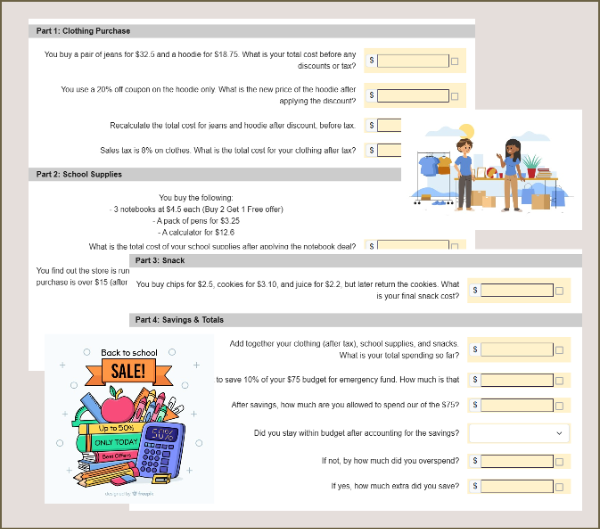
A real-world budgeting challenge where students apply rational number operations—decimals, fractions, and percentages—to stay within a $75 back-to-school budget.

The activity revolves around the concept of baking a Christmas cake on a tight budget compared to the cost of purchasing one from a store. Students will be guided through ingredient conversions, cost calculations, and the joy of creating a homemade treat.
With the holiday spirit in full swing, students take on a real-world challenge: Can they bake a delicious Christmas cake for less than the $25 store-bought price? In this festive and engaging 7th-grade math worksheet, students dive into a cost-saving baking adventure that reinforces key math skills through a relatable and meaningful task.
Store-bought Christmas cakes are expensive—each one costing around $25. Determined to spread joy without overspending, students decide to bake their own cake from scratch. They’ll calculate ingredient conversions, find costs using a price chart, and compare the final total to see how much they save by baking it themselves.
🎁 Make math meaningful and festive—assign this real-world budgeting challenge today and let your students bake their way to better financial sense!
Students will apply real-world math skills to calculate the cost of baking a cake from scratch by:
This activity reinforces key 7th grade standards in ratios and proportional relationships, decimal operations, and data interpretation—all within a real-life context students can relate to.
Solve multi-step real-life and mathematical problems posed with positive and negative rational numbers in any form (whole numbers, fractions, and decimals), using tools strategically. Apply properties of operations to calculate with numbers in any form; convert between forms as appropriate; and assess the reasonableness of answers using mental computation and estimation strategies. *For example: If a woman making $25 an hour gets a 10% raise, she will make an additional 1/10 of her salary an hour, or $2.50, for a new salary of $27.50. If you want to place a towel bar 9 3/4 inches long in the center of a door that is 27 1/2 inches wide, you will need to place the bar about 9 inches from each edge; this estimate can be used as a check on the exact computation*.
All 7.EE.B.3 activities →Solve real-world and mathematical problems involving the four operations with rational numbers.
All 7.NS.A.3 activities →Use proportional relationships to solve multistep ratio and percent problems. Examples: simple interest, tax, markups and markdowns, gratuities and commissions, fees, percent increase and decrease, percent error.
All 7.RP.A.3 activities →
More interactive, auto-graded activities on the same standards and topics.
A real-world budgeting challenge where students apply rational number operations—decimals, fractions, and percentages—to stay within a $75 back-to-school budget.
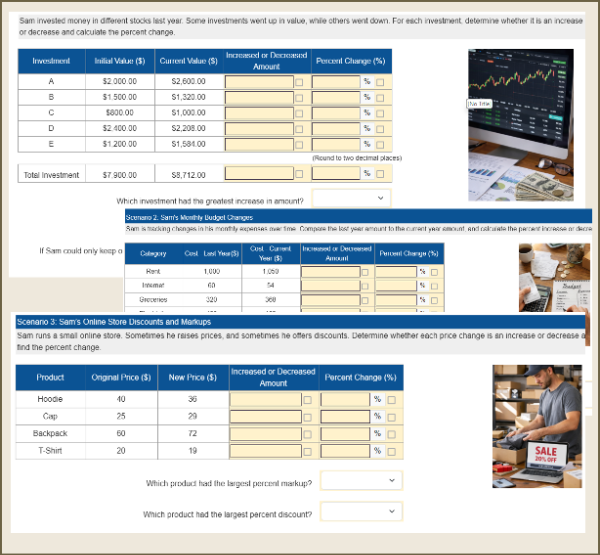
Students analyze real-world financial situations to calculate percent increase and decrease. Using a connected storyline, students examine changes in stock investments, monthly expenses, and online store prices. This worksheet builds proportional reasoning through table-based problems and supports randomized values for independent, auto-graded practice.
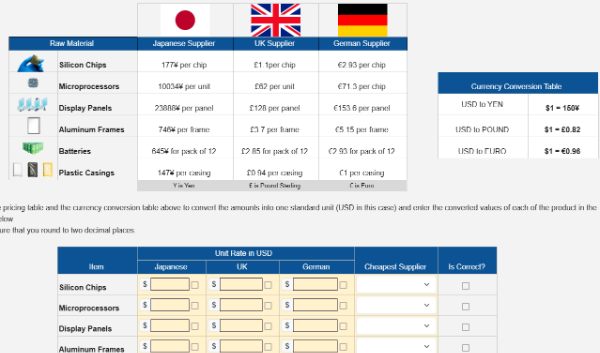
Students act as the CEO of a company, to find the cheapest country to purchase the raw materials, students will do unit conversion between different currencies.
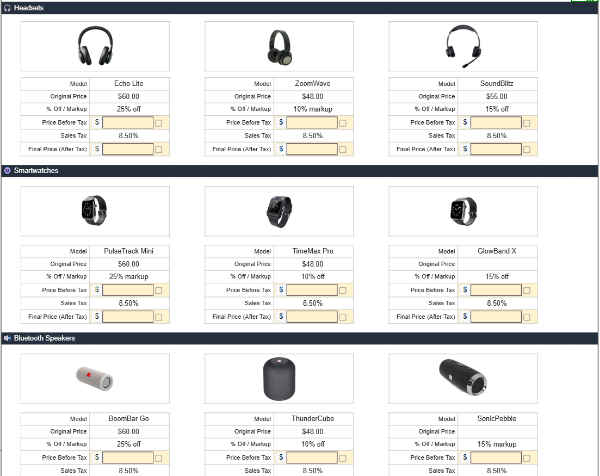
In this real-world math challenge, students use percent skills to shop smart at a tech store. They apply discounts, markups, and sales tax to build a tech bundle within a $150 budget, developing proportional reasoning and financial literacy.
Students will use the simple interest formula and its variations to find the interest, principal to be deposited, and the interest rate they should be looking for to get $100,000 after 10 years for their dream house.
Students will use the simple interest formula and its variations to find the interest, principal to be deposited, and the interest rate they should be looking for to get $100,000 after 10 years for their dream house.