
Why Projects Make Math Real
Ask a middle school student why they are learning a particular math skill, and the most honest answer is often a shrug. Not because the student lacks curiosity, but because the typical worksheet gives them no reason to care. A page of twenty isolated problems asks for the right answer and nothing more. The student computes, checks, and moves on. Nothing they did on problem four has anything to do with problem nineteen. Nothing carries forward. Nothing is at stake.
A project changes that completely.
A math project is a multi-day, multi-worksheet experience built around a single real-world scenario, where the decisions a student makes early on shape the results they get later. The student is not answering questions. They are building something, and the math is the tool that lets them build it well.
For Grades 6 to 8, this shift is not a nice-to-have. It is the difference between math that feels like a chore and math that feels like it matters.
The Problem With Isolated Practice
Traditional worksheets treat every problem as a fresh start. This has a hidden cost. When problems are disconnected, students never experience the most important truth about mathematics: that decisions have consequences, and those consequences compound.
In the real world, no calculation stands alone. The price you set affects your revenue. The dimensions you choose affect whether your design fits. The budget you allocate determines what you can afford later. Math is a chain of connected reasoning, and isolated practice severs every link. This is the same idea behind our broader view of how mathematics underpins the systems that shape the modern world: math is rarely a single step, but a connected model.
Students who only ever do disconnected problems learn to compute. They do not learn to reason across a system, which is the skill that actually matters once they leave the classroom.
What a Project Does Differently
A well-designed project rests on a few principles that, together, make math feel real.
1. Connected Decisions
In a project, the work is sequential and cumulative. A choice a student makes in the second worksheet flows forward into the fifth. The numbers they generate are their numbers, not a textbook's. Two students working the same project can arrive at genuinely different outcomes, because they made different decisions along the way.
This is the single most powerful feature of project-based math. It mirrors how mathematics actually works outside school, where today's calculation becomes tomorrow's starting point.
2. Student Responsibility and Ownership
When decisions carry forward, students become responsible for them. A student who sets a price too high early in a project will see the consequence later when the revenue does not add up. That moment, where a student traces a disappointing result back to a choice they made themselves, is one of the most valuable learning experiences in middle school math.
This is ownership. The student is not checking their work against an answer key. They are accountable to a scenario they helped create. Responsibility transforms a passive task into an active one, and active learning is what survives in memory. Decades of classroom research on project-based learning point in the same direction: students retain more, and engage more deeply, when learning is anchored to meaningful work they own.
3. A Real Scenario With Real Stakes
Every project is anchored to a believable situation: designing a structure, running an attraction, surviving a journey, managing a budget. The scenario is not decoration. It is the reason the math exists. When a student understands why a ratio matters, because getting it wrong means their park loses money or their structure does not fit, the abstract skill becomes concrete.
4. Aesthetic and Tangible Payoff
Projects produce something a student can see and be proud of: a completed design, a working model, a finished plan. That visible result is the reward for the reasoning that produced it. Worksheets rarely offer this. A project almost always does.
Connected Activities Build Connected Understanding
The reason connected activities work is not motivational. It is cognitive.
When a value a student calculated on day one reappears on day three, the student is forced to hold the whole system in mind. They cannot treat each step as disposable. They have to understand how the parts relate, because the parts genuinely do relate. This is exactly the kind of thinking that builds durable understanding rather than short-term recall.
Disconnected practice asks: can you do this skill once?
A project asks: can you carry this reasoning through a real situation, where every step depends on the last?
The second question is harder, more honest, and far more aligned with what we actually want middle school students to be able to do.
What This Looks Like in Practice
Here are a few examples of how a connected, project-based approach plays out across the Grades 6 to 8 standards. Each one anchors to a specific Common Core skill, wraps it in a real scenario, and carries student decisions forward from start to finish.
Example 1: A Theme Park Design Project (Grade 7, Ratios and Proportional Relationships) Students design and price the attractions for a new theme park on a fixed plot of land. Early choices about which rides to build and how to price tickets carry all the way through to a final return-on-investment calculation that is unique to each student. A student who priced aggressively and a student who priced cautiously will reach the end with different results, and both will understand exactly why. Explore the Theme Park Tycoon project.
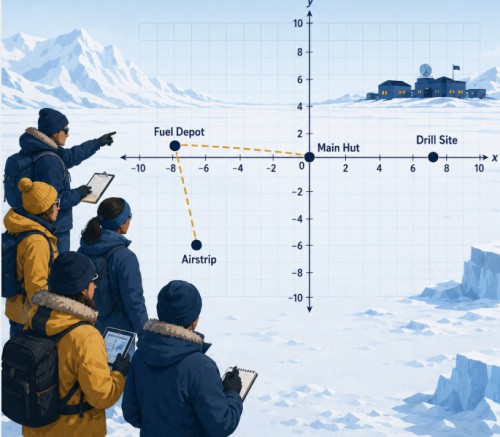
Example 2: A Survival Planning Project (Grade 6, The Number System) Students plan a multi-day journey across a harsh environment where fuel, food, and time are limited resources. Every allocation decision affects whether they make it to safety. Negative numbers, coordinates, and careful arithmetic stop being abstract when they determine whether the plan actually works. Explore the Research Station Zero project.
Example 3: A Precision Construction Project (Geometry) Students make a series of geometric decisions to construct a precise design, where each measurement constrains the next. There is no room for sloppy reasoning, because an error early on makes the final construction impossible. The project forces the kind of precision that isolated geometry problems never demand. Explore the Precision Construction project.
Why This Matters for Middle School Specifically
Grades 6 to 8 are exactly the years when students decide whether they are "a math person." It is the window where math becomes abstract enough to lose students who do not see the point, and where engagement either takes root or quietly disappears.
Project-based learning meets students at this moment with the one thing isolated practice cannot offer: a reason to care. When a student is responsible for decisions that genuinely shape an outcome, math stops being a subject done to them and becomes a tool they wield. That shift in posture, from passive to active, from computing to reasoning, is what keeps students engaged through the hardest years of their math education.
Conclusion
Worksheets have their place. Skills need practice, and practice needs repetition. But practice alone teaches students to compute without teaching them to reason. Projects close that gap. By connecting decisions across multiple days, giving students genuine responsibility for the choices they make, and anchoring everything to a scenario with real stakes, project-based math turns middle school math from a series of forgettable tasks into work that students actually own.
The math does not change. The standards do not change. What changes is whether the student has a reason to engage with them. And that reason, more than any single skill, is what makes the difference.