The Big Barbecue Day: Unit Rates
Students will find the unit rate of seven products in three stores - Farm Fresh, Market Bargain, and Quality stores. They will compare the unit prices and find the cheapest store to purchase each ingredient.
Students will calculate rates based on various real-life scenarios. Examples include determining the average speed in miles per hour or the cost per apple. These problems help students apply their understanding of ratios and rates in practical situations, reinforcing their ability to solve real-world problems involving proportional reasoning.
In this ratio practice worksheet, students will engage with various real-life scenarios that require them to calculate rates. These problems are designed to help students apply their understanding of ratios and rates in practical, everyday situations. By working through these scenarios, students will develop a deeper comprehension of how ratios are used to solve real-world problems, reinforcing their mathematical reasoning and problem-solving skills.
Students will be presented with scenarios such as:
Key Features:
Students will compute the unit rates for different scenarios given.

Understand the concept of a unit rate a/b associated with a ratio a:b with b ≠ 0, and use rate language in the context of a ratio relationship. *For example, "This recipe has a ratio of 3 cups of flour to 4 cups of sugar, so there is 3/4 cup of flour for each cup of sugar." "We paid $75 for 15 hamburgers, which is a rate of $5 per hamburger."*
All 6.RP.A.2 activities →Use ratio and rate reasoning to solve real-world and mathematical problems, e.g., by reasoning about tables of equivalent ratios, tape diagrams, double number line diagrams, or equations.
All 6.RP.A.3 activities →Solve unit rate problems including those involving unit pricing and constant speed. *For example, if it took 7 hours to mow 4 lawns, then at that rate, how many lawns could be mowed in 35 hours? At what rate were lawns being mowed?*
All 6.RP.A.3b activities →Compute unit rates associated with ratios of fractions, including ratios of lengths, areas and other quantities measured in like or different units. *For example, if a person walks 1/2 mile in each 1/4 hour, compute the unit rate as the complex fraction ^1/2/1/4 miles per hour, equivalently 2 miles per hour*.
All 7.RP.A.1 activities →More interactive, auto-graded activities on the same standards and topics.
Students will find the unit rate of seven products in three stores - Farm Fresh, Market Bargain, and Quality stores. They will compare the unit prices and find the cheapest store to purchase each ingredient.
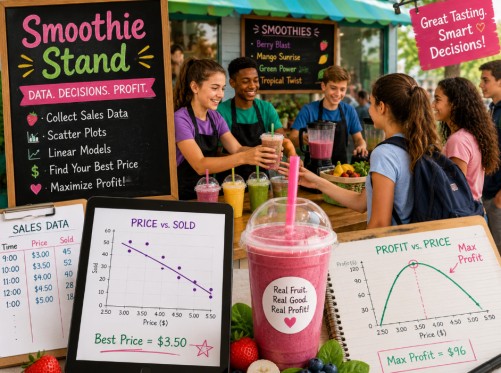
Students run a smoothie bar for a day, and every decision is a fraction problem with a real purpose. Six connected, auto-graded interactive worksheets covering multiply, divide, equivalent fractions, compare, and order. Carry-forward story keeps math meaningful. Common Core aligned. Run it in a day or across two weeks.
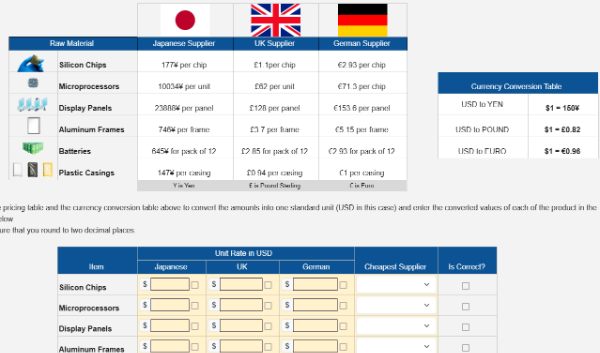
Students act as the CEO of a company, to find the cheapest country to purchase the raw materials, students will do unit conversion between different currencies.
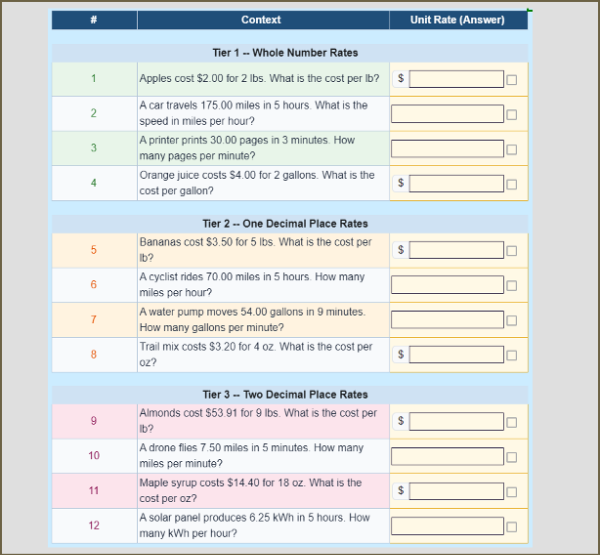
Interactive Grade 6 worksheet with 12 unit rate problems across three difficulty tiers — whole-number, one-decimal, and two-decimal rates — using real-world contexts like groceries and travel. Auto-graded with randomization.
In this Thanksgiving-themed math worksheet, students convert ingredient quantities into standard units and calculate the cost of preparing a holiday meal. It’s a real-world activity that strengthens unit conversion, proportional reasoning, and budgeting skills.
In this community kitchen budgeting activity, students convert recipe quantities and calculate the cost of each ingredient needed to prepare a holiday-style meal. Includes turkey, mashed potatoes, gravy, carrots, peas, cranberry sauce, and more.