Proportional Relationship & Slope-Intercept Formula

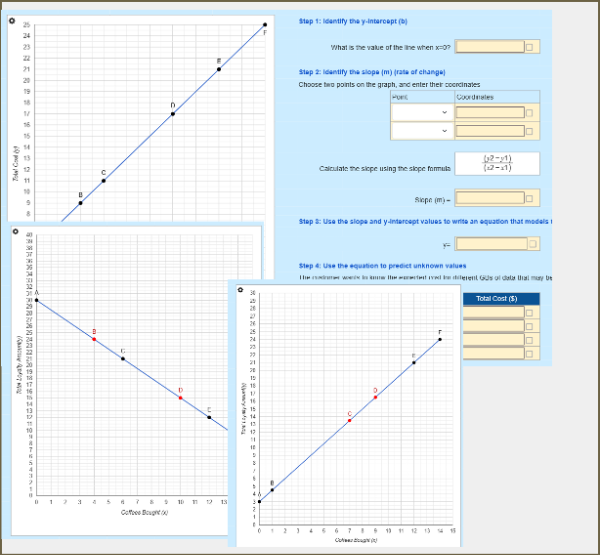
Help students understand linear relationships through real-world scenarios. In this worksheet, learners write expressions, complete tables, analyze graphs, and identify slope as the unit rate and the y-intercept as the starting value. A strong conceptual bridge leading to the equation y = mx + b.

This interactive worksheet helps students develop a deep understanding of linear relationships by modeling real-world situations step by step. Instead of memorizing formulas, students explore how totals change using expressions, tables, and graphs. Through realistic scenarios, learners discover how a constant rate of change creates a straight-line graph and how the starting value appears as the y-intercept.


The activity is designed as a conceptual bridge leading naturally to the equation y = mx + b, making it ideal for introducing or reinforcing slope-intercept form in 8th grade.


Students will:

  • Write expressions to represent real-world situations
  • Complete tables of values and observe patterns
  • Analyze graphs to identify linear relationships
  • Calculate slope and interpret it as the unit rate
  • Identify the y-intercept as the starting value
  • Connect real-world models to the form y = mx + b


Perfect for:

  • Introducing linear functions and rate of change
  • Strengthening conceptual understanding before formal equations
  • Classwork, homework, or guided practice
  • Building real-world connections to algebra concepts


This worksheet also supports randomization, ensuring each student receives different slopes and y-intercepts for individualized practice and meaningful engagement.

Learning Objective

Students will model real-world situations using linear relationships by writing expressions, completing tables, and graphing values. They will identify the slope as the unit rate and the y-intercept as the starting value, and explain how these relate to the equation y = mx + b

Randomization Available

This worksheet supports randomization. When enabled, each student will receive different real-world scenarios with unique slopes (unit rates) and y-intercepts (starting values), ensuring individualized practice.

💡 Tip: When assigning this activity to your classroom, you can optionally enable randomization to give each student a unique version of the problems. When you re-assign the same worksheet, each student will get a new set of questions, helping them master the content through repeated practice.

Proportional Relationship & Slope-Intercept Formula preview
Preview
Grade level
8
Type
Mini Lab (real-world worksheet)
Duration
20 minutes
Auto-graded
Yes
Randomized per student
Yes
Common Core standards
8.EE.B.5
Topics
Expressions & EquationsProportional RelationshipsLinear Equations
Tags
Real WorldFinancial Calculations

Related grade 8 activities

More interactive, auto-graded activities on the same standards and topics.

Skill PracticeGrade 8· 20 min

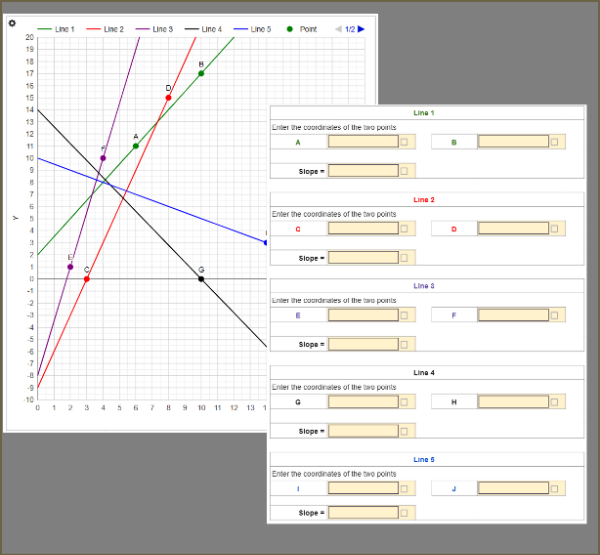
Calculating Slope from Two Points on a Graph

Help students master slope using real graphs. In this interactive worksheet, learners identify coordinates, apply the slope formula, and compare slopes of multiple lines. Supports randomization so each student receives different lines and points, making it perfect for 8th-grade slope practice.

LabGrade 8· 120 min

Food Truck Using Expressions & Functions

Curbside is an interactive Grade 8 math lab where students run a food truck and use real math to decide if it makes money. Across 7 auto-graded worksheets they build revenue, cost, break-even, and profit, compare competitors, and weigh a marketing curve. A hands-on way to make expressions, equations, and functions feel real. Common Core aligned (8.EE, 8.F).

Skill PracticeGrades 7, 8· 30 min

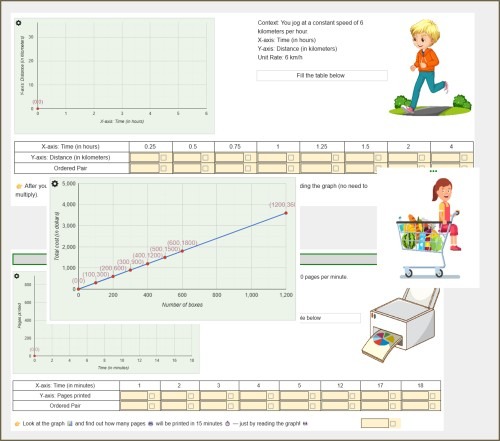
Proportional Relation– Build the Graph

Students explore proportional relationships by completing tables and graphs for real-world scenarios like jogging and packaging costs. They’ll use unit rates, plot ordered pairs, and observe how proportional relationships form straight lines through the origin.

Mini LabGrade 8· 20 min

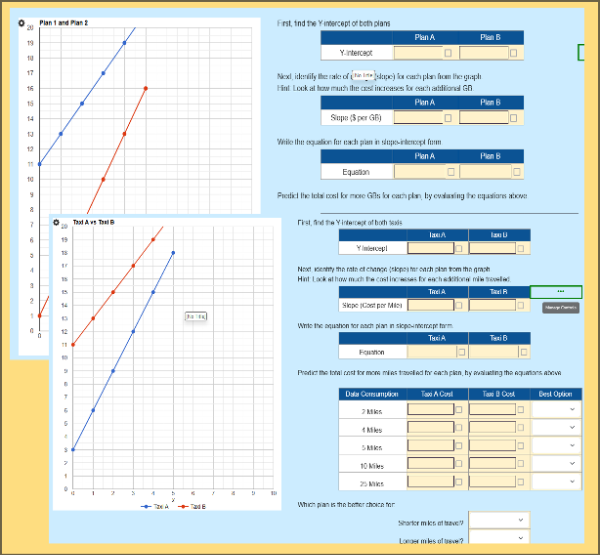
Comparing Linear Models: Which Changes Faster?

Students compare real-world linear models by analyzing graphs, identifying slope and y-intercept, writing equations in slope-intercept form, and predicting values. Through an internet plan comparison, learners use equations to determine the better option for low and high usage, building strong conceptual understanding of linear relationships.

Skill PracticeGrade 8· 20 min

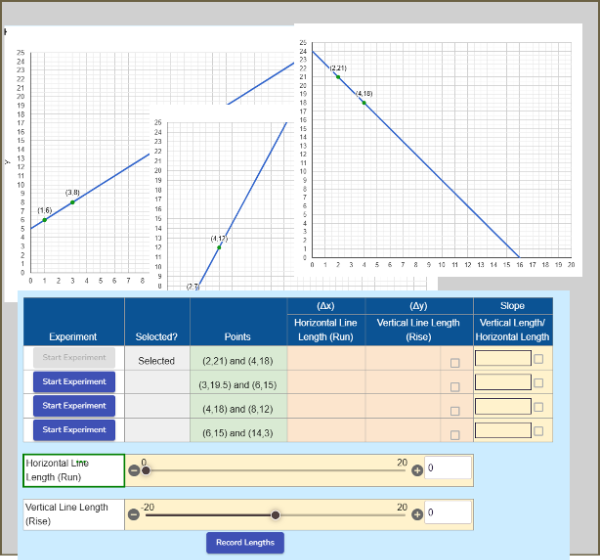
Interactive Slope Investigation: Finding Δy and Δx

Explore slope through hands-on experiments! Students use sliders to measure rise (Δy) and run (Δx) between two points, calculate slope, and compare lines with positive and negative slopes. A visual, interactive way to understand steepness, direction, and why slope stays constant on a linear graph.