Proportional Relation– Build the Graph

Students explore proportional relationships by completing tables and graphs for real-world scenarios like jogging and packaging costs. They’ll use unit rates, plot ordered pairs, and observe how proportional relationships form straight lines through the origin.

Help your 7th-grade students visualize and understand proportional relationships with this interactive digital worksheet! Through engaging real-world examples—such as jogging at a constant speed and calculating packaging costs—students practice using unit rates to fill tables, plot points, and discover how proportional relationships form straight lines through the origin.


As students complete the tables, the graph is generated automatically based on their inputs, allowing them to instantly see how changes in the table affect the line on the coordinate plane. This hands-on interactivity helps reinforce the connection between tables, equations, and graphs.


The worksheet also supports randomization, so every student can receive a unique set of numbers and proportional scenarios—making learning individualized and preventing copying.


Learning Highlights:

  • Identify and represent proportional relationships between quantities.
  • Use unit rates to make predictions and solve real-world problems.
  • Understand that proportional relationships create straight lines through the origin.
  • Connect equations, tables, and graphs to deepen conceptual understanding.


Aligned Standard:


CCSS.MATH.CONTENT.7.RP.A.2 — Recognize and represent proportional relationships between quantities.

Perfect for class practice, homework, or digital assignments, this worksheet makes proportional reasoning visual, interactive, and engaging for middle-school learners.

Learning Objective

Students will identify, represent, and analyze proportional relationships between two quantities by completing tables, plotting points on coordinate graphs, and interpreting unit rates in real-world contexts.


They will learn that:

  • Proportional relationships form a straight line passing through the origin.
  • The unit rate (constant of proportionality) determines the slope of the line.
  • Tables, graphs, and equations are connected representations of the same relationship.

Aligned Standard:


CCSS.MATH.CONTENT.7.RP.A.2 — Recognize and represent proportional relationships between quantities.

Randomization Available

Would you like to enable randomization so that each student receives a different set of numbers and values in this worksheet? This helps prevent copying and encourages independent problem-solving while keeping the learning objectives the same.

💡 Tip: When assigning this activity to your classroom, you can optionally enable randomization to give each student a unique version of the problems. When you re-assign the same worksheet, each student will get a new set of questions, helping them master the content through repeated practice.

Proportional Relation– Build the Graph preview
Preview
Grade level
7, 8
Type
Skill Practice
Duration
30 minutes
Auto-graded
Yes
Randomized per student
Yes
Common Core standards
7.RP.A.28.EE.B.5
Topics
Expressions & EquationsRatios & ProportionsRatioProportional RelationshipsLinear Equations
Tags
Exit TicketAssessment

Related grades 7, 8 activities

More interactive, auto-graded activities on the same standards and topics.

Mini LabGrade 8· 10 min

Back to School: Fundraiser Goal Tracker

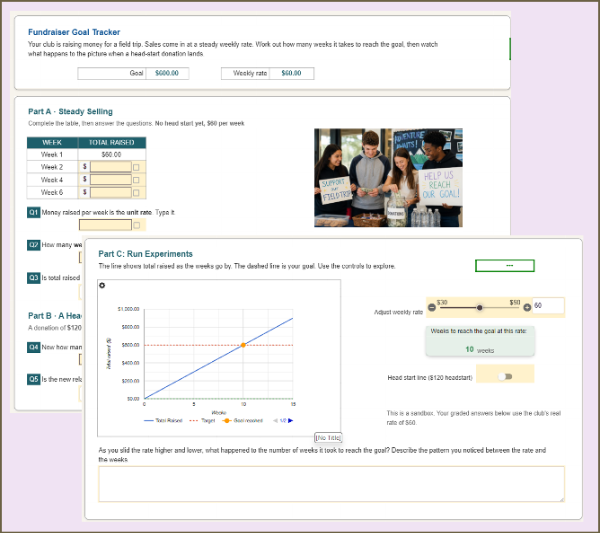
Interactive proportional relationships simulation. Students track a club fundraiser at a steady weekly rate, predict weeks to the goal, then see how a head-start donation breaks proportionality. Live graph, auto-graded, randomized values. Grades 7-8 review. CCSS 7.RP.A.2.

Mini LabGrade 7· 20 min

Budgeting for Thanksgiving Feast

In this Thanksgiving-themed math worksheet, students convert ingredient quantities into standard units and calculate the cost of preparing a holiday meal. It’s a real-world activity that strengthens unit conversion, proportional reasoning, and budgeting skills.

Mini LabGrade 7· 15 min

City Park Design Using Equivalent Ratios

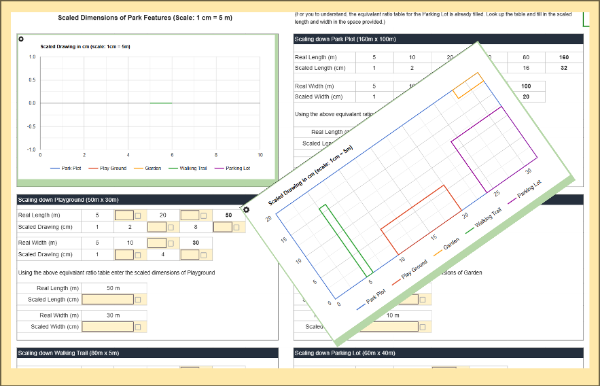
In this hands-on activity, students use equivalent ratios to scale down real-world park dimensions and see their design come to life in an automatically generated graph. As they convert measurements, complete ratio tables, and analyze the final layout, they build fluency in proportional reasoning and visual interpretation.

Mini LabGrades 7, 8· 20 min

Community Kitchen - Weekly Budget Planning

In this community kitchen budgeting activity, students convert recipe quantities and calculate the cost of each ingredient needed to prepare a holiday-style meal. Includes turkey, mashed potatoes, gravy, carrots, peas, cranberry sauce, and more.

Mini LabGrade 8· 20 min

Comparing Linear Models: Which Changes Faster?

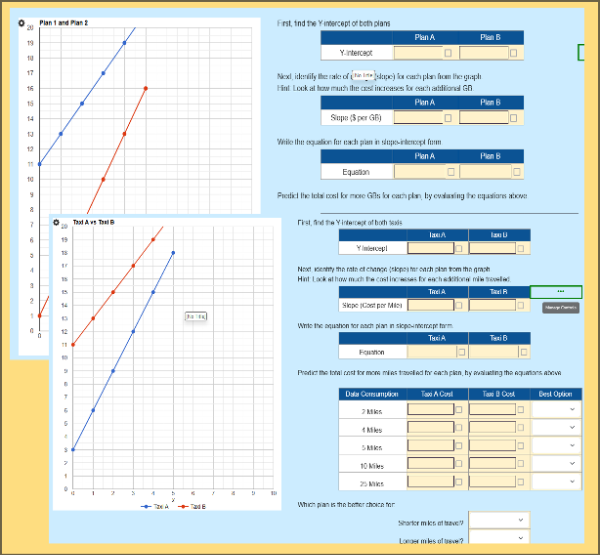
Students compare real-world linear models by analyzing graphs, identifying slope and y-intercept, writing equations in slope-intercept form, and predicting values. Through an internet plan comparison, learners use equations to determine the better option for low and high usage, building strong conceptual understanding of linear relationships.

Mini LabGrade 7· 15 min

Cookie Ratios – Baking with Grandma’s Recipe

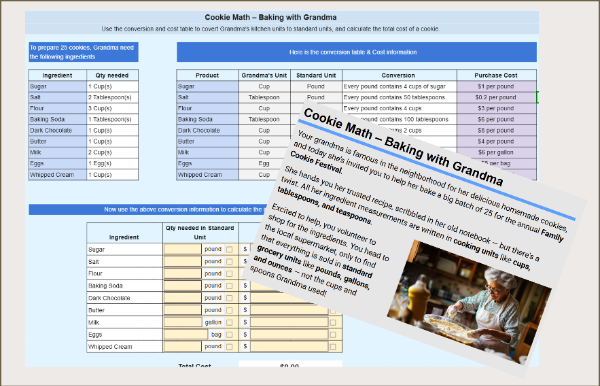
In this real-world math activity, students apply their understanding of ratios and fractions to convert Grandma’s recipe from kitchen units to standard grocery store units. Using a conversion chart and price list, they calculate the quantity and cost of each ingredient, determine the total expense for 25 cookies, and find the cost of one cookie.