Simplify Using Exponent Rules - Practice Worksheet

Practice simplifying expressions using the laws of exponents in this interactive worksheet. Students apply product, quotient, power, zero, and negative exponent rules to master exponent operations. Supports randomization so each student receives different exponents for individualized practice.

Help your 8th-grade students master the laws of exponents with this fully interactive and auto-graded worksheet! Students will simplify expressions using the properties of integer exponents while receiving instant feedback on every response.


In this activity, students will:

  • Apply the product, quotient, power, zero, and negative exponent rules to simplify expressions
  • Enter exponents using the caret (^) symbol — for example, 2^3 to represent 2³
  • Practice both numeric and variable-based expressions to build confidence for algebra


Key Features:

  • 💡 Interactive practice: Students receive instant validation after each answer.
  • 🔄 Randomization support: Each student can receive different base numbers and exponents for individualized learning.
  • 📊 Auto-grading: The system automatically checks answers, reducing teacher workload.
  • 🧠 Standards alignment: Perfectly aligned to Common Core Standard 8.EE.A.1.
  • 🧩 Flexible use: Ideal for class practice, homework, or review before assessments.


This worksheet provides the perfect bridge between arithmetic and algebra, ensuring students deeply understand how exponents behave and how to simplify complex expressions with ease.

Learning Objective

Students will apply the properties of integer exponents—including product, quotient, power, zero, and negative exponent rules—to simplify algebraic and numeric expressions accurately and recognize patterns in exponent operations.

Randomization Available

This worksheet supports randomization, where the exponents and base numbers are automatically varied for each student, providing unique practice problems and promoting individualized learning.

💡 Tip: When assigning this activity to your classroom, you can optionally enable randomization to give each student a unique version of the problems. When you re-assign the same worksheet, each student will get a new set of questions, helping them master the content through repeated practice.

Simplify Using Exponent Rules - Practice Worksheet preview
Preview
Grade level
8
Type
Skill Practice
Duration
15 minutes
Auto-graded
Yes
Randomized per student
Yes
Common Core standards
8.EE.A.1
Topics
Expressions & EquationsScientific Notation

Related grade 8 activities

More interactive, auto-graded activities on the same standards and topics.

Mini LabGrade 8· 20 min

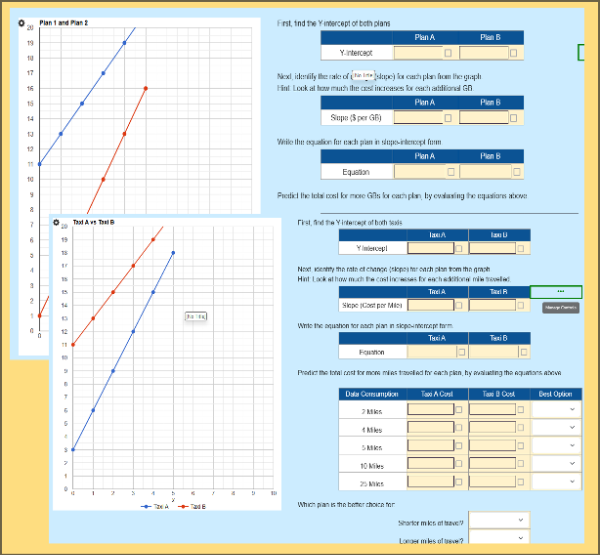
Comparing Linear Models: Which Changes Faster?

Students compare real-world linear models by analyzing graphs, identifying slope and y-intercept, writing equations in slope-intercept form, and predicting values. Through an internet plan comparison, learners use equations to determine the better option for low and high usage, building strong conceptual understanding of linear relationships.

LabGrade 8· 120 min

Food Truck Using Expressions & Functions

Curbside is an interactive Grade 8 math lab where students run a food truck and use real math to decide if it makes money. Across 7 auto-graded worksheets they build revenue, cost, break-even, and profit, compare competitors, and weigh a marketing curve. A hands-on way to make expressions, equations, and functions feel real. Common Core aligned (8.EE, 8.F).

Mini LabGrade 8· 15 min

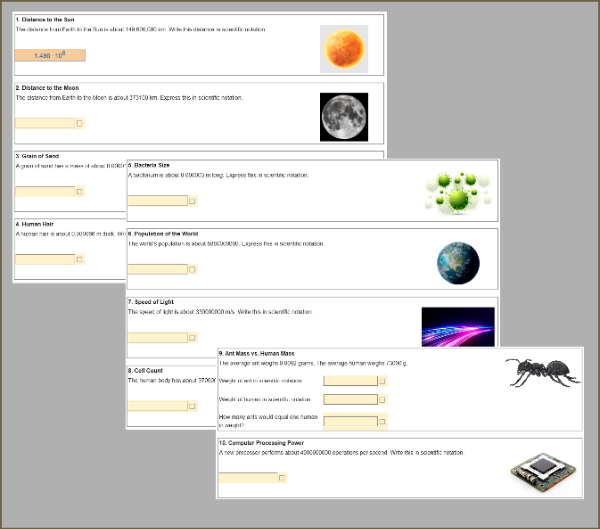
From Atoms to Galaxies: Scientific Notation in Action

Explore real-world measurements from the cosmos to the microscopic world while learning how to write large and small numbers in scientific notation. Students convert quantities into exponential form to make data easier to read, compare, and compute—building confidence with powers of ten and place value understanding.

Mini LabGrade 8· 30 min

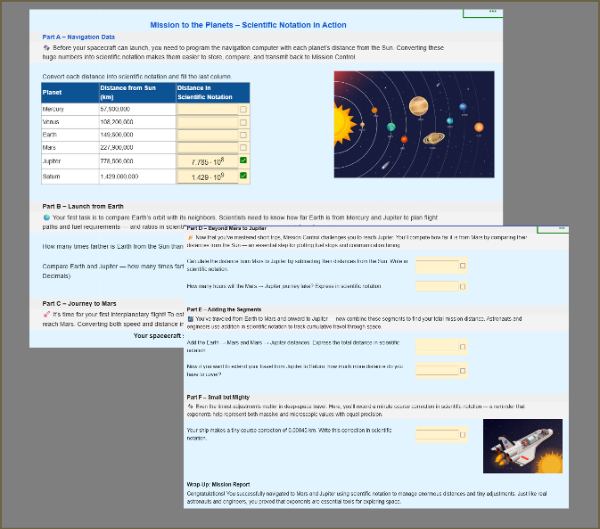
Mission to the Planets – Scientific Notation in Action

Blast off on a math mission through the solar system! In this interactive worksheet, students use scientific notation to calculate and compare planetary distances, travel times, and orbits. A fun, story-driven way to understand why scientists use exponential form to work with extremely large and small numbers.

Mini LabGrade 8· 20 min

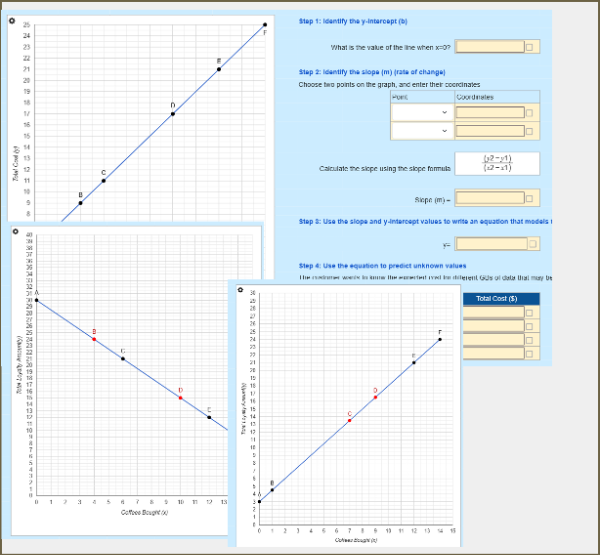
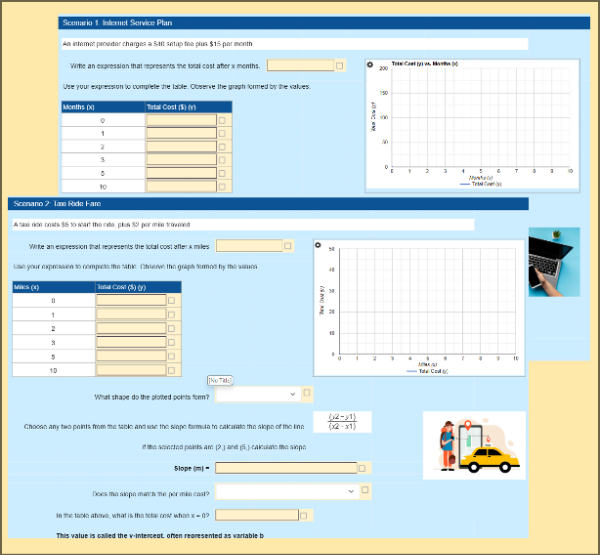
Proportional Relationship & Slope-Intercept Formula

Help students understand linear relationships through real-world scenarios. In this worksheet, learners write expressions, complete tables, analyze graphs, and identify slope as the unit rate and the y-intercept as the starting value. A strong conceptual bridge leading to the equation y = mx + b.