Solving One- and Two-Step Linear Equations

Solve one-step and two-step linear equations with instant feedback. This interactive worksheet helps students practice isolating variables, applying inverse operations, and checking solutions. Includes mixed practice and supports randomization so every student gets unique equations. Perfect for Grade 7–8 algebra practice and reinforcement.

Solving One- and Two-Step Linear Equations – Interactive Practice Worksheet


Help students master solving linear equations with this engaging, auto-graded worksheet designed for middle school algebra. Students practice one-step and two-step equations by isolating the variable using inverse operations, building confidence and accuracy through immediate feedback.


What students will do

  • Solve one-step equations involving addition, subtraction, multiplication, and division
  • Solve two-step linear equations using a clear, structured approach
  • Apply algebraic reasoning in mixed practice problems
  • Receive instant validation to self-correct and learn independently


Key features

  • Supports randomization, giving each student a unique set of equations
  • Ideal for guided practice, independent work, homework, or assessment
  • Auto-graded with clear input fields for fast checking
  • Reinforces core algebra skills needed for linear functions and graphing


Standards alignment

  • Aligned to CCSS 8.EE.C.7 and related middle school algebra standards


Perfect for Grade 7–8 classrooms, this worksheet provides targeted, skill-based practice to strengthen students’ understanding of linear equations and prepare them for more advanced algebra topics.

Learning Objective

Students will solve one-step and two-step linear equations by applying inverse operations, accurately isolate the variable, and verify solutions, building fluency and confidence in algebraic problem-solving aligned to Grade 8 standards.

Solving One- and Two-Step Linear Equations preview
Preview
Grade level
8
Type
Skill Practice
Duration
20 minutes
Auto-graded
Yes
Randomized per student
Yes
Topics
Expressions & EquationsSolving EquationsLinear Equations

Related grade 8 activities

More interactive, auto-graded activities on the same standards and topics.

Mini LabGrade 8· 20 min

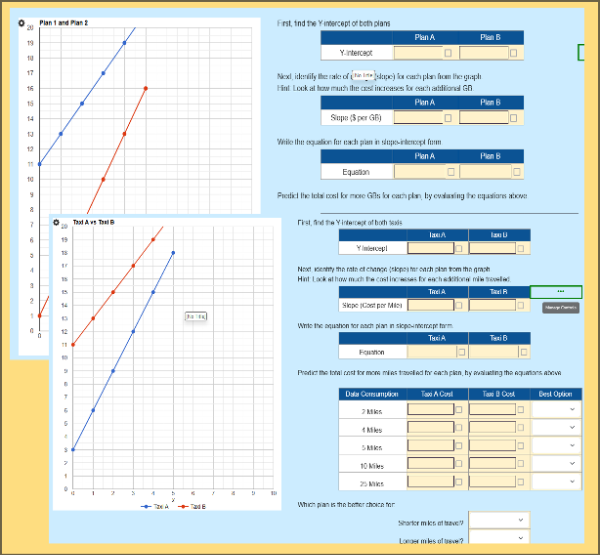
Comparing Linear Models: Which Changes Faster?

Students compare real-world linear models by analyzing graphs, identifying slope and y-intercept, writing equations in slope-intercept form, and predicting values. Through an internet plan comparison, learners use equations to determine the better option for low and high usage, building strong conceptual understanding of linear relationships.

LabGrade 8· 120 min

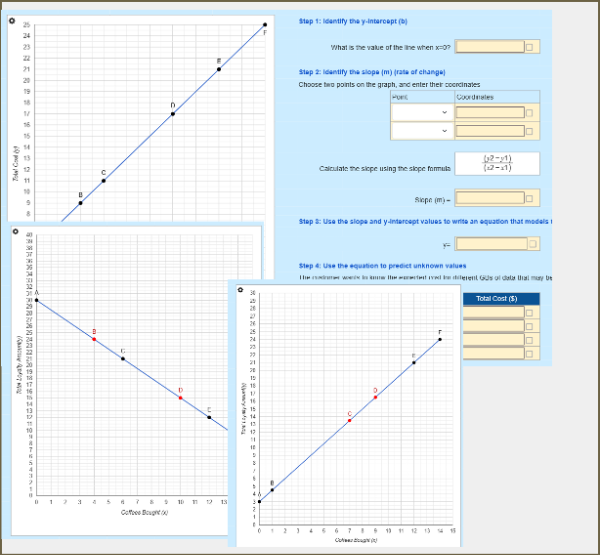
Food Truck Using Expressions & Functions

Curbside is an interactive Grade 8 math lab where students run a food truck and use real math to decide if it makes money. Across 7 auto-graded worksheets they build revenue, cost, break-even, and profit, compare competitors, and weigh a marketing curve. A hands-on way to make expressions, equations, and functions feel real. Common Core aligned (8.EE, 8.F).

Mini LabGrade 8· 15 min

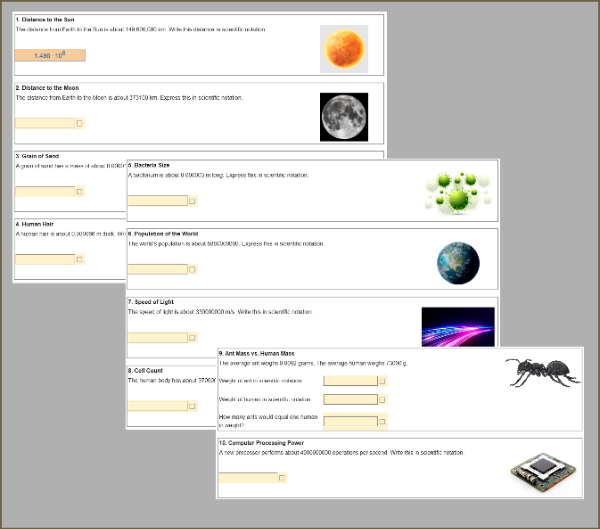
From Atoms to Galaxies: Scientific Notation in Action

Explore real-world measurements from the cosmos to the microscopic world while learning how to write large and small numbers in scientific notation. Students convert quantities into exponential form to make data easier to read, compare, and compute—building confidence with powers of ten and place value understanding.

Mini LabGrade 8· 30 min

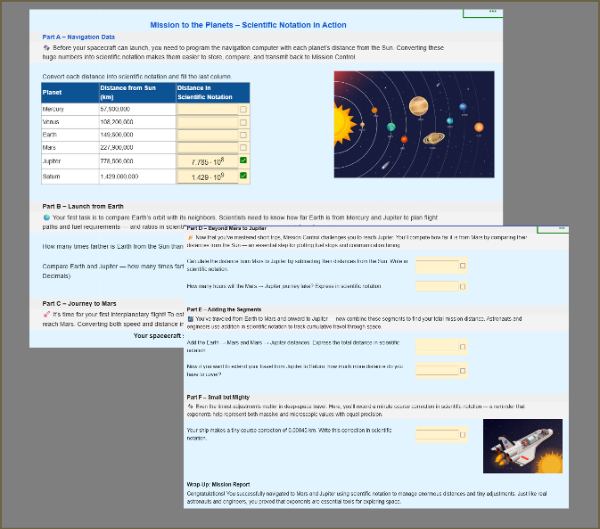
Mission to the Planets – Scientific Notation in Action

Blast off on a math mission through the solar system! In this interactive worksheet, students use scientific notation to calculate and compare planetary distances, travel times, and orbits. A fun, story-driven way to understand why scientists use exponential form to work with extremely large and small numbers.

Mini LabGrade 8· 20 min

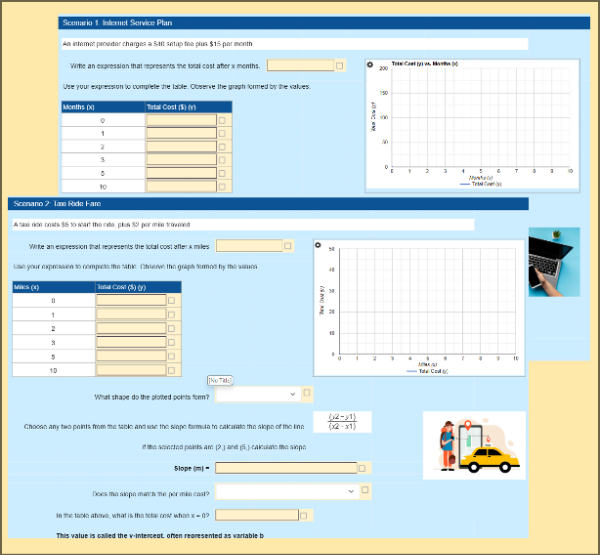
Proportional Relationship & Slope-Intercept Formula

Help students understand linear relationships through real-world scenarios. In this worksheet, learners write expressions, complete tables, analyze graphs, and identify slope as the unit rate and the y-intercept as the starting value. A strong conceptual bridge leading to the equation y = mx + b.