Skill PracticeGrades 7, 8· 20 min
Mean Absolute Deviation Practice
Practice calculating the Mean Absolute Deviation (MAD) of a data set step-by-step—starting from the mean, to absolute deviations, and finally to the MAD value.

Students compare the sleep patterns of 7th and 8th graders using real-world data. They calculate mean, median, range, and IQR, then interpret histograms and make informal inferences about group differences. This worksheet supports randomization, so each student may receive different sleep data.
Your school’s health committee is launching a campaign to promote better sleep habits. They’ve collected sleep data from 7th and 8th graders and asked for your help to analyze it.
As a student data analyst, your job is to investigate how much students in each grade are sleeping and whether there’s a real difference between the two groups.
Students will compare two populations using measures of center (mean and median) and measures of variability (range and interquartile range). Through analysis of real-world sleep data from 7th and 8th graders, students will draw informal comparative inferences, interpret distribution patterns using histograms, and explain how statistical measures provide insight into group differences and consistency.
This worksheet supports randomization, which means each student will receive a different set of 12 sleep data points to analyze. The data will vary slightly for each student but will stay mostly within the same range for both 7th and 8th grade groups.
💡 Tip: When assigning this activity to your classroom, you can optionally enable randomization to give each student a unique version of the problems. When you re-assign the same worksheet, each student will get a new set of questions, helping them master the content through repeated practice.
Informally assess the degree of visual overlap of two numerical data distributions with similar variabilities, measuring the difference between the centers by expressing it as a multiple of a measure of variability. *For example, the mean height of players on the basketball team is 10 cm greater than the mean height of players on the soccer team, about twice the variability (mean absolute deviation) on either team; on a dot plot, the separation between the two distributions of heights is noticeable*.
All 7.SP.B.3 activities →Use measures of center and measures of variability for numerical data from random samples to draw informal comparative inferences about two populations. *For example, decide whether the words in a chapter of a seventh-grade science book are generally longer than the words in a chapter of a fourth-grade science book*.
All 7.SP.B.4 activities →Construct and interpret scatter plots for bivariate measurement data to investigate patterns of association between two quantities. Describe patterns such as clustering, outliers, positive or negative association, linear association, and nonlinear association.
All 8.SP.A.1 activities →
More interactive, auto-graded activities on the same standards and topics.
Practice calculating the Mean Absolute Deviation (MAD) of a data set step-by-step—starting from the mean, to absolute deviations, and finally to the MAD value.
Students will analyze four types of graphs: a scatter plot, a histogram, a bar chart, and a line chart. Their task is to interpret the data presented in each graph and answer specific questions related to the information.
Students will analyze five different data sets, each representing a real-life scenario such as weekly attendance or pages read by students. Their task is to calculate the mean, median, mode, range, and interquartile range for each data set, helping them develop essential skills in statistical analysis.
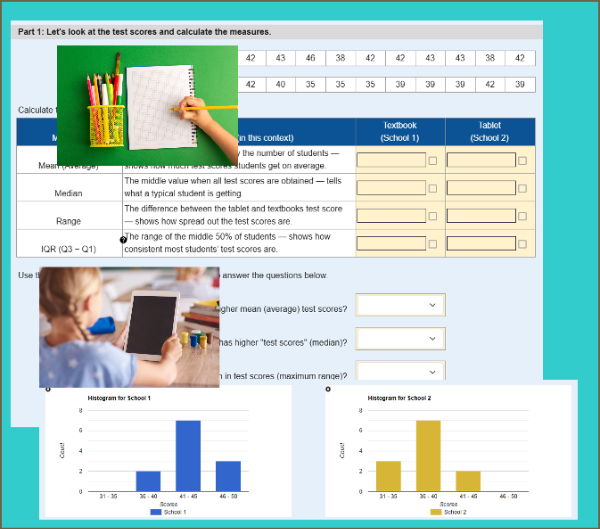
Students analyze test score data from two schools — one using tablets, the other using textbooks — to calculate mean, median, range, and IQR. They compare the distributions using numerical measures and histograms to draw conclusions about student performance.
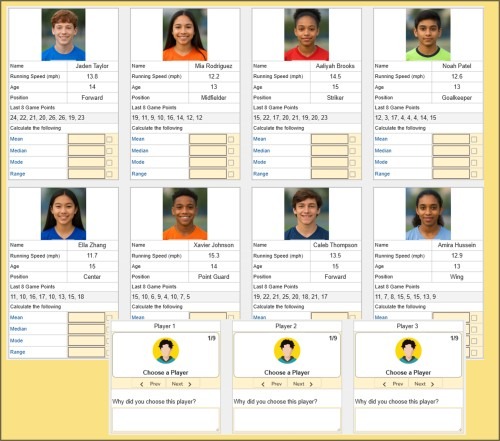
In this engaging worksheet, students analyze 8 sports players using real-world data. They calculate mean, median, mode, and range of game stats, then select the best 3 players for their dream team. A fun way to apply statistics in decision-making!
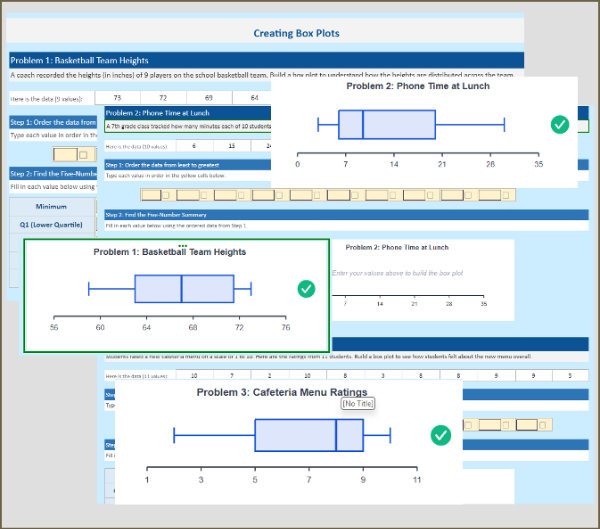
Build fluency with box plots through 3 real-world practice problems. Students sort data, find the five-number summary (Min, Q1, Median, Q3, Max), calculate IQR, and watch the box plot draw itself as they fill in each value. Each problem features a different distribution shape, with instant feedback when answers are correct.